OPINION
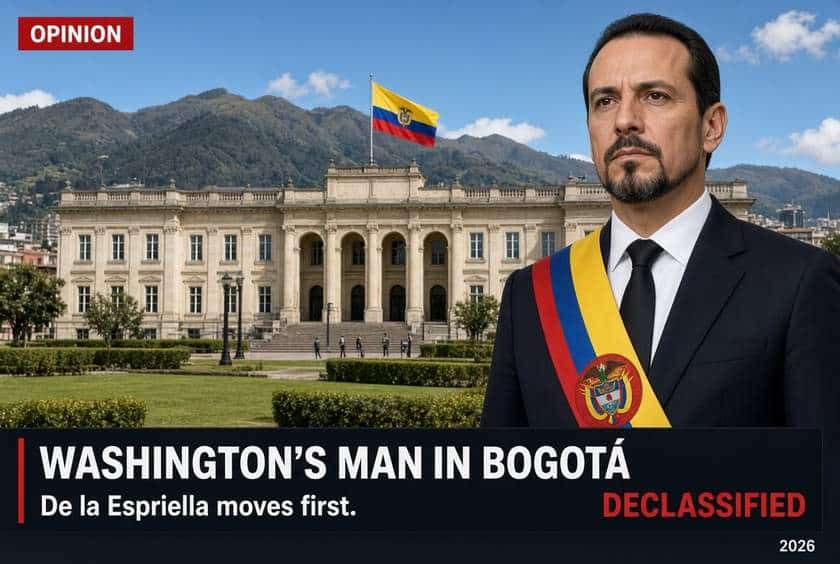
Defenders of Abelardo de la Espriella like to call him Washington’s ally. That word is too generous. An ally negotiates. What Colombia has seen in two months is a president who arrived with Washington’s agenda preloaded and ready to implement at a pace negotiations rarely produce.
No one needs a secret memo to see it. The record is public, and much of it was announced by Washington itself.
Made in Miami
Start with who he was before he ran. De la Espriella spent more than a decade in Miami and became a US citizen in 2023, swearing allegiance to the United States. He has given more than $92,000 to a Miami Republican congresswoman since 2017. America’s top diplomat, Marco Rubio, jokes about knowing him from before politics.
This is not a Colombian politician who later found friends in Washington. It is a member of South Florida’s Republican world who went home to run for president. When Trump endorsed him, he was not picking a foreign candidate. He was backing one of his own.
The first week tells you everything
If you want one decision that reveals whose priorities run Colombia’s foreign policy, take the Golan Heights. Three days into his term, Colombia recognized Israeli sovereignty over the occupied Syrian plateau. Only one other country on earth holds that position: the United States, under Trump.
It’s unclear how many Colombians voted for this, and harder still to see what Colombia gains from it. Israel’s foreign minister said the deal was struck the day before the inauguration, before de la Espriella had even taken the oath. A president thinking first of Colombia does not spend his opening week aligning with a position the rest of the world, including the UN, rejects.
Colombian experts warned of the cost. Fabián Cárdenas, an international law professor at the Pontificia Universidad Javeriana, told the magazine Cambio the decision could backfire: a country that accepts territory taken by force weakens its own hand in its border disputes with Peru and Venezuela.
Sovereignty, outsourced
Joining Trump’s Shield of the Americas proves little by itself; 18 countries in the region had already signed up. What stands out is how Colombia joined. Petro was not even invited to the coalition’s founding summit in March. Within a week of the inauguration, Colombia was the 19th member, and it went beyond joining: at a coalition meeting in Panama, Pete Hegseth announced that Colombia had requested joint US military operations on its own soil. At the same meeting, Hegseth urged members not to recognize the International Criminal Court.
Then came the extraditions. Within three weeks, he ordered five guerrilla and paramilitary leaders extradited to the US. They had represented their groups in peace talks with Petro’s government, which had suspended their transfers. Whatever one thinks of Petro’s peace talks, the message was clear: when Petro’s peace process and American indictments conflicted, de la Espriella chose the indictments.
Resources follow the flag
A month into the presidency, Rubio flew to Barranquilla and left with two agreements: one on critical minerals and rare earths, one on civil nuclear cooperation. Washington says openly that the goal is to cut China out of the supply chain. Colombia’s minerals are being slotted into America’s strategic plans.
At home, the government moved to lift mining restrictions on more than 5.3 million hectares. The memoranda are non-binding. But the direction is unmistakable: the ground is being cleared, and the first partner at the table is the United States.
The mandate defense, and why it falls short
His supporters answer that Colombians voted for all of this. He promised the Jerusalem embassy, the fumigation and the end of peace talks, and he won.
But he won by less than one point, with the open backing of a foreign president. That is a mandate to govern, not a blank check to align Colombia with every US position. And the defense proves less than it claims. A platform that already reads like Washington’s wish list, written by a US citizen from Miami, is not evidence of independence. It is the clearest sign that the alignment came first and the campaign came second.
What Colombians should watch for
Going all in on one administration carries its own risk. After the Golan decision, Federmán Rodríguez, who directs the international relations program at Bogotá’s Universidad del Rosario, told Cambio: “Colombia would be isolated; it would simply be alongside Donald Trump’s government.” As the magazine noted, a foreign policy tied to one administration, rather than to lasting American interests, could leave Colombia exposed if Washington’s politics shift.
The real test has not come yet. So far, Washington’s wishes and de la Espriella’s promises have pointed the same way, so he has never had to choose. That moment will come: over tariffs, deportations, or US troops operating inside Colombia.
When it does, Colombians should watch three things. Who gets the mining titles in the reopened districts. What the $1 billion actually buys once Congress acts. And whether the questions House Democrats raised about his Florida finances are ever answered.
If he sides with Colombia when it costs him something in Washington, his critics should say so. Until then, the burden of proof is on him.
Is Colombia’s New President Washington’s Man?
Sources
- Local 10 News, De La Espriella delivers first speech as president (dual US-Colombian citizenship), Aug 7, 2026
- La Silla Vacía, Donations to Rep. María Elvira Salazar, 2026
- China Global South Project, Rubio courts Latin American allies, Sep 2026
- IntelliNews, Colombia inaugurates de la Espriella (Trump endorsement, election margin), Aug 2026
- Al Jazeera, Colombia recognises Israeli claim over Golan Heights, Aug 11, 2026
- AP via ABC News, Hegseth says Colombia requested US collaboration (Shield of the Americas, joint operations, ICC), Aug 12, 2026
- Primicias, Extradition of five former negotiators, Aug 26, 2026
- Primicias, Revocation of the aerial spraying ban, Aug 2026
- Rio Times, Rubio and Colombia signed two papers in Barranquilla, Sep 9, 2026
- South China Morning Post, Rubio arrives in Colombia to sign minerals deal, Sep 2026
- Bloomberg Línea, Mines Ministry proposal on mining districts, Sep 2026
- Semana, Jerusalem embassy pledge, Nov 2025
- Vanguardia, House Democrats ask for investigation, Jun 18, 2026
- The New York Times, Can a US citizen become Colombia’s president?, Jun 4, 2026
- Cambio, The costs for Colombia of recognizing Israeli sovereignty over the Golan Heights, Aug 18, 2026
- Reuters via WDEZ, US says it plans $1 billion security assistance to Colombia’s new leader, Aug 7, 2026