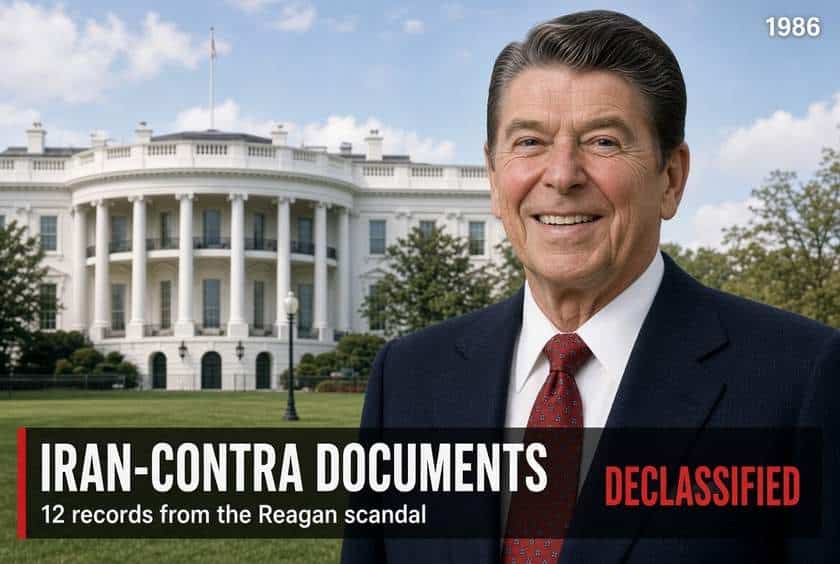
The Iran-Contra affair was a pair of covert Reagan administration operations, conducted between 1984 and 1986, that became public in November 1986. One sold U.S. weapons to Iran in an effort to free American hostages held in Lebanon. The other kept arming the Nicaraguan Contra rebels after Congress had cut off U.S. funding. On Nov. 25, 1986, Attorney General Edwin Meese announced that profits from the Iran arms sales had been diverted to the Contras, linking the two.
On Nov. 18, 2026, ahead of the scandal’s 40th anniversary, the National Security Archive at George Washington University published a selection of 12 documents from the affair, edited by Malcolm Byrne, Peter Kornbluh and Tom Blanton. The records were released over several decades through the congressional investigation, the Independent Counsel’s prosecutions and Freedom of Information Act litigation, and are not new declassifications. This entry follows them in chronological order.
Third-country funding, 1984 to 1985
On June 25, 1984, President Reagan’s National Security Planning Group met to discuss how to keep the Contra war going as congressional opposition grew (Document 1, NSPG minutes). The discussion centered on asking other countries to fund the rebels. According to the Archive’s reading of the minutes, Secretary of State George Shultz relayed White House Chief of Staff James Baker’s view that seeking third-country money would be “an impeachable offense.” Vice President George H.W. Bush argued that the only problem would arise if the United States promised the third parties something in return. Reagan closed by warning that if the discussion leaked, “we’ll all be hanging by our thumbs in front of the White House.”
On March 16, 1985, National Security Council staffer Lt. Col. Oliver North sent National Security Adviser Robert McFarlane a “Fallback Plan for the Nicaraguan Resistance” (Document 2). It proposed approaching donor nations, including Saudi Arabia, and giving Honduras a central support role if Congress refused further funds. In November 1986, after the operations were exposed, North rewrote this and other memos and returned the altered copies to NSC files in place of the originals. The Archive’s copy includes both versions. Investigators identified the forgery because its letterhead had not been in use in early 1985.
The Iran initiative, 1985
On June 17, 1985, McFarlane circulated a draft National Security Decision Directive on U.S. policy toward Iran to Shultz and Defense Secretary Caspar Weinberger (Document 3). Drafted by NSC and CIA staff, it argued that isolating Iran could open the way for Soviet influence and proposed allowing limited arms supplies. Both secretaries opposed it.
On Aug. 31, 1985, John Poindexter, then deputy national security adviser, sent North an electronic message titled “Private Blank Check” over the White House’s IBM PROFS email system (Document 4). It told North he could reply privately, outside the paper routing that sent most NSC documents through a central secretariat. Reagan-era White House emails became public after the National Security Archive sued to preserve the backup tapes.
The arms deliveries began in August 1985 with shipments of TOW anti-tank missiles through Israel. A November shipment of HAWK anti-aircraft missiles failed. On Dec. 7, 1985, Reagan met Shultz, Weinberger and other advisers in the White House residence. Weinberger’s handwritten diary records the president as saying he could answer charges of illegality but not the charge that “big strong President Reagan passed up chance to free hostages” (Document 5).
The diversion memo, 1986
A North memorandum dated April 4, 1986, “Release of American Hostages in Beirut,” set out a plan to use “residuals” from the Iran arms sales to fund the Contras (Document 6). Justice Department investigators found it in North’s NSC files in late November 1986. It is the principal surviving document describing the diversion. North destroyed a large volume of other records during the same period.
Exposure, October to November 1986
On Oct. 5, 1986, a Sandinista soldier shot down a C-123 cargo plane carrying supplies to the Contras. The surviving crew member, Eugene Hasenfus, told a press conference in Nicaragua that the operation was tied to the CIA. On Nov. 3, a Lebanese news magazine reported a secret U.S. delegation’s visit to Tehran earlier that year.
Bush began dictating a daily diary on Nov. 4, 1986, describing it as a record of his 1988 presidential campaign. In the entry for Nov. 5, he said of the hostage negotiations that he was “one of the few people that know fully the details” (Document 8, diary transcript extract). Bush did not produce the diary in response to document requests in 1987 and 1992. Prosecutors learned of it in December 1992.
On Nov. 9, 1986, Shultz’s executive assistant, Charles Hill, recorded the secretary’s preparation for a meeting with the president (Document 9). Hill’s notes quote Shultz as saying there was “a Watergate-like atmosphere around here.” Hill’s notes run to several thousand pages, and most have not been declassified, according to the Archive.
Investigation and outcome, 1987 to 1992
The House and Senate held joint televised hearings in the summer of 1987. Independent Counsel Lawrence Walsh, appointed by the Justice Department in 1986, brought the criminal cases.
On April 6, 1989, during North’s prosecution, the government entered a stipulation summarizing classified evidence of quid pro quo arrangements with foreign governments that supported the Contras (Document 10). The governments named included Honduras, Guatemala, Panama, Saudi Arabia and Israel. In all, Saudi Arabia contributed $32 million to the Contras, according to the Archive.
North’s notebooks were released after a 1989 FOIA lawsuit brought by the Archive and Public Citizen Litigation Group. One entry is a note to check with the Ford Foundation, then the Archive’s major funder, about its grant to the Archive (Document 7). North did not act on it, according to the Archive.
On March 21, 1991, Walsh staff attorney Christian Mixter delivered two legal assessments. The 198-page memo on Reagan concluded that the Iran arms sales, as he authorized them, “did not violate the criminal law,” while acknowledging “a number of close legal calls.” It found “no basis for a criminal prosecution” over his answers to the post-November 1986 investigations (Document 11). The 89-page memo on Bush found that he had attended most of the key meetings Reagan attended, but treated him as a subordinate officer less likely to be criminally liable (Document 12). It predates the discovery of the Bush diary.
Most defendants, including Weinberger, Poindexter and North, either had charges vacated on technical grounds or received pardons from Bush on Christmas Eve 1992, according to the Archive. Walsh responded to the pardons by declaring that the cover-up “has now been completed.”
The 12 documents
| No. | Date | Record | Subject |
|---|---|---|---|
| 1 | June 25, 1984 | NSPG minutes, “Central America” | Third-country funding for the Contras |
| 2 | March 16, 1985 | North to McFarlane, “Fallback Plan” | Donor nations; altered copy from Nov. 1986 |
| 3 | June 17, 1985 | Draft NSDD, “U.S. Policy Toward Iran” | Proposal for limited arms to Iran |
| 4 | Aug. 31, 1985 | Poindexter to North, “Private Blank Check” | Private PROFS email channel |
| 5 | Dec. 7, 1985 | Weinberger diary | Reagan’s decision to continue arms sales |
| 6 | April 4, 1986 | North memo, “Release of American Hostages in Beirut” | The diversion plan |
| 7 | 1980s | North notebook entry | Ford Foundation grant to the Archive |
| 8 | Nov. 4-5, 1986 | Bush diary transcript | Bush’s knowledge of the Iran deals |
| 9 | Nov. 9, 1986 | Charles Hill notes | Shultz on the damage |
| 10 | April 6, 1989 | Government stipulation, U.S. v. North | Quid pro quos with foreign governments |
| 11 | March 21, 1991 | Mixter to Walsh, Reagan liability | Recommends against prosecuting Reagan |
| 12 | March 21, 1991 | Mixter to Walsh, Bush liability | Bush’s role in meetings and Honduras deal |
The full selection, with the Archive’s introduction and links to earlier Iran-Contra postings, is in the National Security Archive’s 40th-anniversary briefing book.
Sources
- National Security Archive, “Iran-Contra Scandal Marks 40th Anniversary,” ed. Malcolm Byrne, Peter Kornbluh and Tom Blanton (Nov. 18, 2026)
- National Security Council, National Security Planning Group minutes, “Subject: Central America,” SECRET (June 25, 1984)
- Oliver L. North to Robert C. McFarlane, “Fallback Plan for the Nicaraguan Resistance,” TOP SECRET (March 16, 1985)
- White House, draft National Security Decision Directive, “U.S. Policy Toward Iran,” TOP SECRET (June 17, 1985)
- John Poindexter to Oliver North, “Private Blank Check,” SECRET (Aug. 31, 1985)
- Caspar W. Weinberger, diary entry (Dec. 7, 1985)
- Oliver L. North, “Release of American Hostages in Beirut” (the “diversion memo”), TOP SECRET/SENSITIVE (April 4, 1986)
- Oliver North notebook entry on the Ford Foundation grant to the National Security Archive
- George H.W. Bush, diary transcript extracts (Nov. 4-5, 1986)
- Charles Hill, notes, excerpt (Nov. 9, 1986)
- Office of the Independent Counsel, U.S. Government stipulation on quid pro quos with other governments (April 6, 1989)
- C.J. Mixter to Lawrence Walsh, “Criminal Liability of Former President Reagan” (March 21, 1991)
- C.J. Mixter to Lawrence Walsh, “Criminal Liability of President Bush” (March 21, 1991)