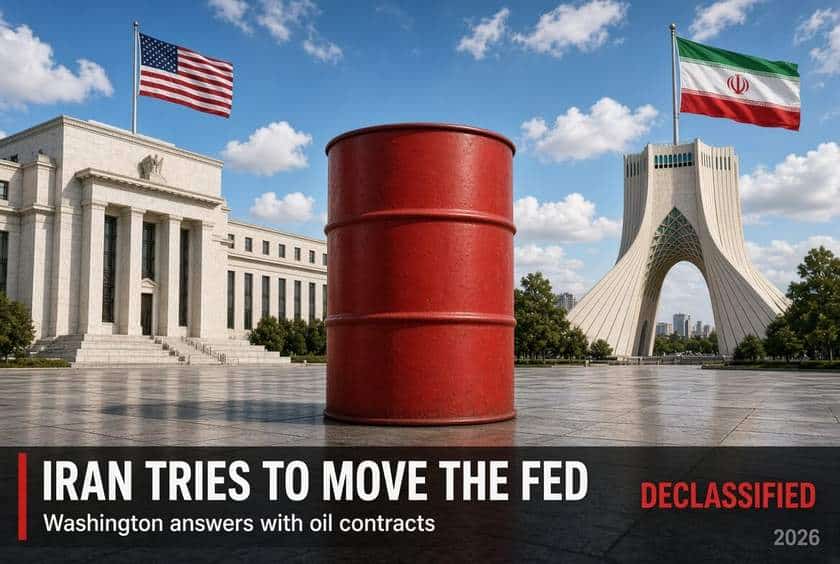
On September 16, a few hours before the Federal Reserve raised interest rates for the first time in three years, Iran’s parliament speaker posted a math problem.
It was the Taylor rule, the formula Fed watchers use to judge where rates should sit. Mohammad Bagher Ghalibaf had bolted two new terms onto it. One stood for the Strait of Hormuz. The other stood for the Bab el-Mandeb. Underneath, he wrote: “You can’t 25bp a chokepoint.”
It read like a joke. It was also a claim of power. A country under naval blockade, with its own currency collapsing, was saying it could reach across an ocean and nudge the price of an American mortgage.
Washington hasn’t answered with equations. It has answered with tanker cargoes, 100-year oil concessions and late-night calls to European capitals. Together they point to a bet of its own: let oil stay expensive just long enough for the world to sign up with American suppliers, then let it fall.
The math problem
The original rule asks two questions. Is inflation above target? Is the economy running hot? A yes to either means higher rates. Ghalibaf’s version adds a third: how badly are the straits disrupted?
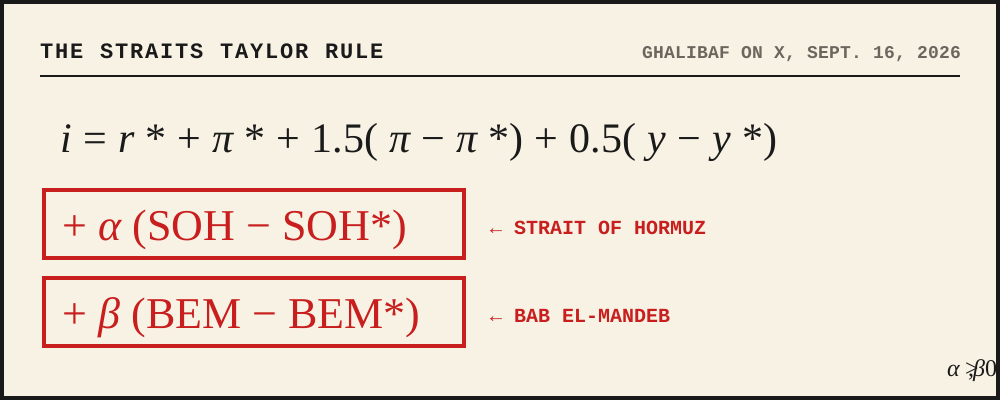
The logic is simple and uncomfortable. Disrupted shipping raises oil. Oil becomes diesel. Diesel moves the trucks that stock every grocery shelf. Prices climb, and a Fed that follows its rulebook hikes.
That hike cannot produce a single barrel of oil. All it can do is make borrowing more expensive.
From the strait to your kitchen table
U.S. diesel now averages $6.37 a gallon, up about 70% since the war began in late February. Farmers are paying it in the middle of harvest. Truckers pass it on to everyone else.
Then comes the rate, the part of the argument The Jay Martin Show helped popularize. Freddie Mac’s average 30-year mortgage rate was just under 6% on the eve of the war and just over 7% by late September. On a $400,000 loan, that gap means roughly $276 more a month, or more than $3,300 a year for the same house.
The biggest borrower of all is Washington. Every hike raises what the Treasury pays to roll over roughly $40 trillion in debt. That is the spiral Ghalibaf is pointing at: oil feeds inflation, inflation feeds rates, rates feed the government’s interest bill, and the bill makes lenders nervous.
Iran’s clock
Tehran’s strategy runs on Fed meetings. Every month oil stays expensive is another month of pressure on U.S. rates. Iranian officials barely hide it. In August, Iran’s security chief, Mohsen Rezaei, vowed to “neutralize the economic war” and threatened to halt oil flows through Hormuz entirely, according to state-affiliated Press TV. Analysts have told TIME that Iran’s leaders may believe time is on their side.
The weak spot: Iran is bleeding faster than its target. Inflation there is estimated at 70% to 90%. The rial keeps sliding. Under a U.S. naval blockade, Iran shipped no crude by tanker in September, according to preliminary Bloomberg estimates. Tehran is trying to outlast a far richer opponent while its own house is on fire.
America’s clock
Washington’s clock runs on contracts.
The clearest proof is in Qatar. Before the war, it was one of the world’s gas superpowers. After Iranian missiles crippled its Ras Laffan complex, QatarEnergy started buying American LNG just to keep its own customers supplied: 33 cargoes this year, against four in all of 2025. Now it is reportedly shopping for long-term U.S. supply to cover capacity that could stay offline for up to five years. China, the world’s biggest LNG buyer, is reportedly hunting for long-term deals that avoid Hormuz entirely.
U.S. LNG exports rose 23% in the first half of 2026. Shipments to Asia more than doubled.
That is the irony at the heart of this fight. Every tanker Iran threatens sends another buyer to Texas or Louisiana. Tehran’s pressure campaign doubles as America’s best sales pitch.
Treasury Secretary Scott Bessent has said where he thinks it ends. In two years, he said in September, oil will move through pipelines around Hormuz and the strait will be “like a worthless piece of water.” Erase the strait, and you erase Ghalibaf’s two terms.
Cheap at the pump, expensive everywhere else
There’s an obvious objection. If Washington benefits from expensive oil, why is it fighting so hard to bring prices down?
Because it isn’t fighting world prices. It’s fighting pump prices, with a midterm election on November 3.
The administration has drained the Strategic Petroleum Reserve to its lowest level since 1982. On Friday, after Trump threatened to ban U.S. diesel exports, the G7 agreed to release 100 million barrels of diesel and crude, with diesel front-loaded into the first 20 days. That’s about one day of world oil demand. It barely dents the global price.
It doesn’t need to. In August, about half of Europe’s imported diesel came from the United States. If Europeans burn through their own reserves for a few weeks, more American diesel stays home, just as voters head to the polls.
The same day, Trump dropped the threat. “We were never going to do it,” he said. A real ban would have wrecked America’s pitch as the world’s reliable supplier. As a bluff, it got Europe to absorb the cost. And the G7 pledged not to restrict energy exports to one another, which protects the very trade Washington is building.
The 100-year bet
The longest bet is in Venezuela.
In January, U.S. forces captured Nicolás Maduro. In late August, Trump announced what he called the biggest oil deal in history. Venezuela’s interim government handed a company called North American Blue Energy Partners 100-year concessions on 17 fields holding about 65 billion barrels. That is more than the proven reserves of the entire United States.
On paper, it’s a Barbados-based company run by a Venezuelan businessman. In practice, Washington holds the levers. The State Department can buy a fifth of the output at cost and has first refusal on the rest. The U.S. can veto board members, most directors must be American, and the contract answers to U.S. courts.
Caracas insists it keeps sovereignty and calls it a 25-year arrangement. An Oil & Gas Journal editorial questions whether it can survive Venezuela’s constitution and its new hydrocarbons law. But the direction is clear. Next door, Colombia’s new president has vowed to revive drilling and allow fracking. The Western Hemisphere is pumping more, and none of it has to pass through Hormuz.
Who blinks first
Here is the whole race in one line. Iran needs oil expensive for as long as possible. America needs it expensive only until the contracts are signed.
Nothing so far proves Washington planned it this way. A White House scrambling to survive an oil shock before an election would make most of the same moves. When the U.S. approved Israel’s March strike on Iran’s South Pars gas field, an Israeli official said it was meant to warn Iran that if it kept disrupting Hormuz, more of its energy sites could be hit. And by some estimates, oil flows through Hormuz have already recovered to close to 80% of prewar levels.
So watch three dates.
- October 28. The Fed decides again. If a tanker is hit or a pipeline goes quiet in the run-up and oil climbs into the vote, Ghalibaf’s formula is still working. A hike would land six days before the election.
- November 3. Until then, expect more pump-price relief and more export deals.
- After November 3. This is the real tell. If Washington suddenly pushes hard for cheap oil, through a Hormuz deal, a ceasefire or a flood of Venezuelan barrels, the strategy was real. If it stays comfortable with expensive oil, it was luck, not design.
Ghalibaf’s formula only works as long as the world’s oil has to squeeze through two narrow straits. The question is whether America can make those straits irrelevant before Iran’s two terms do real damage to the bond market.
Sources
- Kurdistan24: Ghalibaf’s Straits Taylor Rule
- ThePrint: the economics behind Ghalibaf’s post
- CNN: Fed raises rates for the first time since 2023
- The Jay Martin Show: the oil-to-mortgage argument
- Fox Business: Freddie Mac mortgage rate falls to 5.98% (Feb. 26)
- Freddie Mac: weekly mortgage rate archive (7.03% on Sept. 24)
- NPR: U.S. debt tops $40 trillion
- Al Jazeera via Yahoo: Is Iran losing its Hormuz leverage?
- CNN: Iran security chief’s “economic war” threat, Aug. 23 live updates
- TIME: Iran threatens US energy assets
- Spokesman-Review: Pressure builds on Iran
- Reuters via BOE Report: QatarEnergy buys 33 US LNG cargoes
- Reuters via BOE Report: QatarEnergy seeks US LNG deals through 2031
- Gasworld: QatarEnergy seeks US LNG deals
- Oilprice.com: Qatar turns to American LNG
- EIA: U.S. LNG exports rose 23% in the first half of 2026
- Korea Times: Bessent on Hormuz
- Washington Examiner: SPR at lowest level since 1982
- Just Security: Early Edition, March 19
- The Hill: G7 to release 100M barrels
- NBC News: G7 diesel and crude release
- Foreign Policy: G7 emergency diesel release
- Fortune: Trump drops diesel export ban
- Newslooks: G7 release and US diesel supply
- World Oil: US-Venezuela deal covers 17 fields
- Bernama: Details of the Venezuela deal
- FDD Long War Journal: US-Venezuela oil deal details
- NPR: Venezuela deal and the SPR
- Oil & Gas Journal: Editorial on the Venezuela deal
- Brazil Energy Insight: Colombia revives oil and gas
- Axios: South Pars strike approved by White House
- Axios: Israel strikes Iran gas facility in coordination with U.S. (March 18)