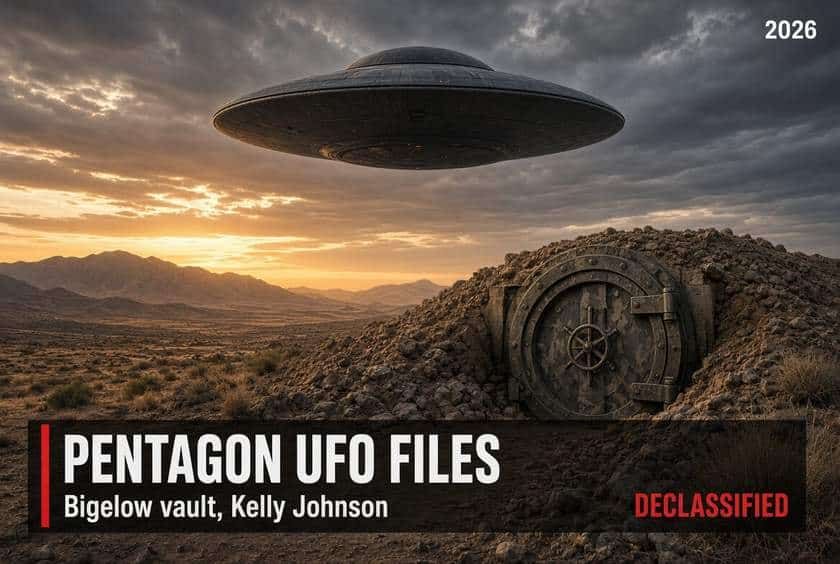
The Department of War published its eighth batch of UFO files on Friday, Nov. 20. CBS News counted 43 files, mostly Air Force and CIA records from the 1950s, plus a handful of recent sightings. The release’s biggest find wasn’t a sighting at all. It was a 2009 contractor report describing an underground vault in North Las Vegas, designed to hold “exotic material or tissue.”
We went through what the Pentagon posted and checked which pieces are new to the public. Some are. Others have been around for decades, and the vault report has been passed around online since last year.
A vault for “hardware and biological samples”
The report runs 538 pages and is dated July 2009. Bigelow Aerospace Advanced Space Studies wrote it under the Advanced Aerospace Weapon System Applications Program, a Defense Intelligence Agency effort that Congress funded at the urging of then-Sen. Harry Reid, CBS reported.
According to CBS, the report says the company had nowhere secure to store material it hoped to collect, from companies, private individuals and groups as far away as Brazil. So its administrator designed one, to be built at Bigelow Aerospace’s North Las Vegas site. The plan called for a 5,000-square-foot vault buried under 15 to 20 feet of earth, with walls 3 feet thick and a heavy steel door. Anything sticking out above ground would be “extensively camouflaged.”
Nothing in the public record shows the vault was ever built. Later BAASS reports the Pentagon has released don’t mention it, CBS noted. Within months a DIA official judged the company’s reports to be of “limited value,” the program ended in 2012, and Bigelow Aerospace laid off its entire workforce in 2020.
The report itself isn’t news to people who follow this field. A copy appeared online last year, CBS reported, and the skeptic forum Metabunk has a running thread on a leaked BAASS 2009 report. Friday’s release is the first time the Pentagon has published it.
The Skunk Works chief’s sunset sighting
The best-known name in the batch is Clarence “Kelly” Johnson, Lockheed’s chief engineer, who went on to design the U-2 and SR-71 spy planes. On Dec. 16, 1953, Johnson was watching the sunset from his ranch near Agoura, California, when he saw a dark, elliptical object that seemed to hang motionless, CBS and Fox reported from the file. He studied it through binoculars before it moved off to the west. At about the same time, a Lockheed flight-test crew off the coast near Point Mugu reported a dark, wing-like shape that also moved west and disappeared.
The account is vivid, and it comes from one of the most respected aircraft designers of the century. It’s also filed with an answer. An Air Force record in the file classifies the sighting as a lenticular cloud, CBS reported. Those are lens-shaped clouds that can sit still for long stretches and look solid at sunset.
The Pentagon’s file is a 1954 report on the case. Fox said it is dated Jan. 20, 1954. Our earlier piece on the document that named Area 51 covers Johnson’s later work on the U-2.
A 1952 CIA briefing the CIA’s own historian cited in 1997
The batch also includes an Aug. 14, 1952, briefing from the CIA’s Office of Scientific Intelligence. It reviewed the Air Force’s handling of about 1,500 flying saucer reports, including 250 in July 1952 alone. A wave of sightings that summer alarmed the Truman administration, Haines wrote. The Air Force’s Air Technical Intelligence Center rated roughly 20% of the reports unexplained, according to Fox.
This one isn’t new either. A CIA memorandum titled “Flying Saucers” and dated Aug. 14, 1952, is cited in the footnotes of CIA historian Gerald Haines’s 1997 study of the agency’s UFO work. Haines describes the OSI study group behind it, which saw serious national security concerns in the flying saucer reports. We couldn’t confirm that the Pentagon’s version matches the CREST copy line for line, because the CIA reading room blocked our automated requests.
What’s actually new
The recent material is thinner, but it hasn’t been public before.
| Item | What it shows | Status |
|---|---|---|
| Three CENTCOM sensor videos (2020, 2023, 2026) | White dots crossing the frame, filmed by sensors on CENTCOM military platforms and submitted to AARO | Unresolved |
| 2023 civil air-surveillance radar slide | Eight detections over 84 seconds at 55,000 to 70,000 feet | AARO says the data can’t show one object made them all |
| FBI artist renderings, made in 2026 | A two-day October 2023 incident near a sensitive site in the western U.S., and a 2023 incident near Colorado Springs | Based on witness descriptions |
| BAASS vault report (July 2009) | Plan for an underground storage vault in North Las Vegas | Leaked in 2025, first official release |
The radar slide is the one people will quote. If all eight detections came from a single object, it would have covered about 38.5 miles, for a minimum average speed of 1,650 mph, the Pentagon said, according to CBS. The same slide says the data is “not sufficient” to tie the detections together. Without that link there is no speed to calculate.
The FBI renderings are drawings, not photographs. The bureau made them this year from first-hand accounts, one from a federal law enforcement special agent, according to captions posted with the release. Our October piece on a black triangle reported at a western security site covered a different account from the seventh batch.
Chief Pentagon spokesman Sean Parnell said more files will follow on a rolling basis and that the department is already working on the next release.
Primary source: Department of War, PURSUE Release 08 at WAR.GOV/UFO. Full context: Gerald K. Haines, “CIA’s Role in the Study of UFOs, 1947-90” (1997).
Sources
- Department of War, WAR.GOV/UFO, PURSUE Release 08 (Nov. 20, 2026)
- Department of War statement by Sean Parnell, “Department of War Publishes Eighth Release of Unidentified Anomalous Phenomena Files” (Nov. 20, 2026), via Mirage News
- CBS News, “New UFO files show Pentagon contractor planned underground vault for ‘exotic material'” (Nov. 20, 2026)
- Fox 29, “Pentagon releases eighth batch of declassified UFO files including a 1952 CIA flying saucer evaluation report” (Nov. 20, 2026)
- Leonard David, Inside Outer Space, “Unidentified Anomalous Phenomena: Eighth Release of UAP Files” (Nov. 20, 2026)
- Gerald K. Haines, “CIA’s Role in the Study of UFOs, 1947-90,” Studies in Intelligence (1997), CIA document C00242525
- Metabunk, “BAASS Ten Month Report 2009 – Leaked Document”