OPINION
You ever try to make somebody sneeze on cue? You can wave the pepper under their nose all afternoon. The nose still decides when.
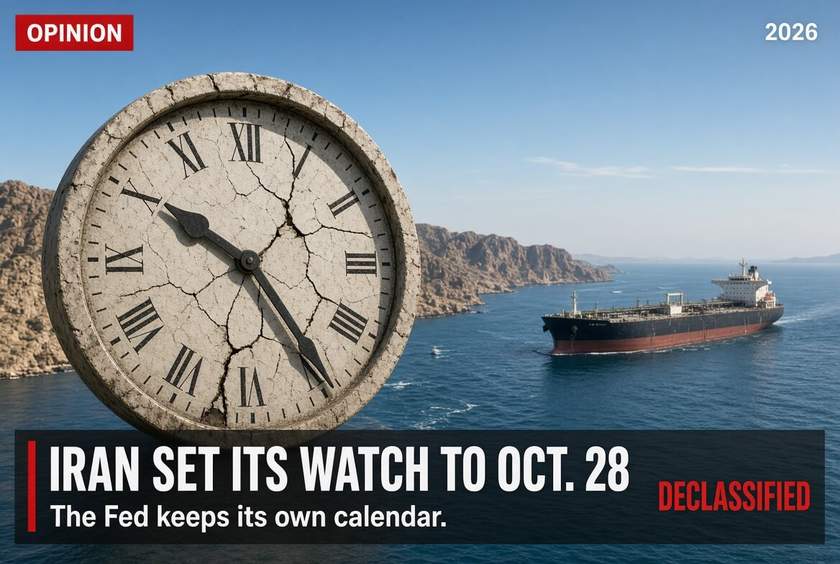
Iran has spent the past month waving pepper at the Federal Reserve. On Sept. 16, the day the Fed raised rates for the first time since 2023, Iran’s parliament speaker, Mohammad Bagher Ghalibaf, posted his “Straits Taylor Rule,” a central banker’s formula with two new terms bolted on, one for the Strait of Hormuz and one for the Bab el-Mandeb. The idea, as we wrote at the time, is that squeezing the straits raises oil, oil raises inflation, and a rule-following Fed raises rates on Americans whether it wants to or not. The Fed’s next decision is Oct. 28, six days before the midterms.
Eleven days from that vote, the fair question is whether the formula works. Here’s my read: at sea and at the pump it’s working about as well as Tehran could hope. At the Fed it looks set to miss the deadline, and the bond market did a share of Iran’s work on its own.
The tanker log reads like a countdown
Iran’s officials haven’t been coy about the goal. Two senior Iranian officials told Reuters this week that Tehran changed how and how often it attacks ships, with approval from the highest leadership. “The aim is to frustrate efforts by the United States and its allies to bring down global oil prices,” one said. The new tactics started about 10 days before that report, which puts them around the start of October. They named the midterms as the target. They didn’t name the Fed. But Ghalibaf’s formula runs straight through it, and the calendar puts the Fed’s vote in the last week of the campaign.
DeClassified Now’s Hormuz tracker shows what October has looked like since:
- At least 12 tanker attacks in the week of Sept. 28 to Oct. 5, the most of any week in the war, according to maritime security sources cited by Reuters.
- Six ships hit on Oct. 11 alone, five tankers and a container ship, the most in a single day of the war, per UKMTO’s delayed reports.
- Two ships sunk within about a day of each other, the GFS Pride and the bulk carrier Cape Dao.
- A tally of 23 attacks in October by mid-month, almost double the war’s monthly average, and attacks reaching 78 nautical miles northeast of Saudi Arabia’s Jubail, including one by rocket-propelled grenade from a small boat.
That’s a lot of pepper. And UKMTO itself says the true count is higher, because most ships that get hit now don’t report it.
The oil and inflation terms are doing their part
Oil responded on schedule. Brent touched about $110 a barrel on Oct. 16, the first time since May. Kpler put oil flows through Hormuz at 11.6 million barrels a day in the week to Oct. 13, about 68% of the prewar baseline. Picture a highway where one lane in three is closed and the tolls go up.
Then it reached the receipt. September’s consumer prices rose 0.6% in a month, and the annual rate climbed to 3.7% from 3.4%. Gasoline rose 9.1% and made up more than half of the monthly increase. Core prices, the ones the Fed watches most closely, ticked up to 2.6% from 2.4%. Consumers now expect 4.7% inflation over the next year. Fed Governor Christopher Waller said on Oct. 8 that he was worried the acceleration would lead consumers and businesses “to revise up their expectations for future inflation.” That sentence is more or less Ghalibaf’s formula, delivered in Istanbul by someone who votes.
Then the Fed declined to sneeze
Here’s where the formula hits a snag. On Oct. 16, Fed Chair Kevin Warsh sat down with the IMF’s Kristalina Georgieva in Bangkok and declined to preview October. “I don’t prejudge meetings,” he said. Traders took that as a no. Odds of an October hike, roughly 30% before he spoke, fell to somewhere between 13% and 17%, depending on whose snapshot you trust. Goldman Sachs now expects the Fed to pause in October and hike in December.
December is after the election. If you’ve ever ordered something for a birthday and had it show up the following week, you understand the problem with that timing.
The Fed also isn’t giving Iran sole credit. Its officials keep listing the AI investment boom, tariffs and service prices alongside oil. Iran is one of several hands on the thermostat, and not the only one the Fed is watching.
And the bond market went ahead without waiting. The 10-year Treasury yield hit 5.31% on Oct. 5, and the 30-year mortgage rate was 7.40% in Freddie Mac’s Oct. 15 survey, up from 6.27% a year earlier. On a $400,000 loan, that gap is roughly $300 a month. No vote was required. The tightening Ghalibaf wanted showed up anyway, delivered by bond traders instead of the people in the room.
The bigger bill is Washington’s
Mortgages are the part of the formula you can feel. The part Ghalibaf seems to enjoy most is the federal tab. In a Sept. 6 post, he took a jab at U.S. Treasury bonds and said America’s “biggest creditor” was dumping them, Iran’s state news agency IRNA reported. Our Oct. 4 piece drew the chain he was pointing at: oil feeds inflation, inflation feeds rates, and rates feed the interest bill on roughly $40 trillion of debt until lenders get nervous. Iran hasn’t called that its strategy. Its officials told Reuters the goal was oil prices and the midterms. But it’s the version of the formula that ends somewhere worse than a mortgage.
The bill is real. On Oct. 16, the Treasury reported a deficit of nearly $2 trillion for the fiscal year that ended Sept. 30, and net interest topped $1 trillion, up from $970 billion the year before, CNBC reported. That’s more than $2.7 billion a day. The Committee for a Responsible Federal Budget put interest at a record 3.4% of GDP and ranked it the government’s second-largest expense, behind only Social Security and ahead of defense. Picture a family whose credit card payment now costs more than the security system. In this house, the Pentagon is the security system.
Is the spiral turning? Slowly, and not only for Iran’s reasons. Yields did jump. The 10-year reached 5.31% and the 30-year 5.67% in early October, levels not seen in roughly two decades, and a weak five-year auction added to the pressure. But most of the debt was borrowed at older rates and rolls over a slice at a time, so a few months of high yields reach the interest bill gradually. Bonds also sold off in Japan, Britain and Germany, and the IMF warned this week that global public debt is heading above 100% of world GDP. Oil isn’t the only thing pushing up the cost of borrowing. By Oct. 16, the 10-year was back near 5.09%. Lenders are nervous. They’re also still lending.
“Unsustainable” is a word Washington’s budget has been wearing for years. It hasn’t stopped a single Treasury auction.
The case that the formula already won
Maybe the Oct. 28 vote never mattered much. Iran doesn’t need a hike that week. It needs Americans paying more to drive, borrow and refinance in the weeks before they vote, and they are. Markets price a December hike as close to certain. The Fed’s own minutes say most officials think another increase “would likely be appropriate by year end.” Mortgage rates are higher than a year ago, inflation expectations are rising, and a sitting Fed governor is publicly worried about exactly the spiral Ghalibaf drew. By that reading, a skipped October meeting is a scheduling detail. The formula said rates would rise, and they’re rising.
It may turn out right. But it also shows the formula’s weakest term is the one with Iran’s name on it. Iran can’t pick the date. And it’s paying full price while it waits. It shipped no crude by tanker in September under the U.S. blockade, according to preliminary Bloomberg estimates, and inflation at home is estimated at 70% to 90%. Washington says the blockade has cost it $25 billion in oil income. Iran is running a pressure campaign on a schedule set by the Federal Open Market Committee, and the committee didn’t agree to the schedule.
So check back on Oct. 28. If the Fed holds and oil stays near $110, Iran will have moved everything in its formula except the one variable it built the formula to move. It may still get its rate hike. It’ll just arrive the way most things from Washington do, after the election.
Sources
- DeClassified Now, “Iran Wrote a Formula to Move the Fed. Washington Is Answering With Oil Contracts.” (Oct. 4, 2026)
- DeClassified Now, Hormuz Tanker Attack Tracker (updated Oct. 17, 2026), with its underlying reporting from Reuters, UKMTO, AFP, The National, gCaptain, CBS News and Al Jazeera
- DeClassified Now, US Economic Outlook: Heading into Q4 2026 (updated Oct. 15, 2026), citing BLS, Treasury, Freddie Mac and University of Michigan data
- Clash Report, citing Reuters, “Iran Changes Hormuz Tactics to Keep Oil Prices High Before US Midterms” (Oct. 14, 2026)
- Al Jazeera, “US and Iran both claim control of Strait of Hormuz amid attacks on vessels” (Oct. 17, 2026)
- Federal Reserve, Governor Christopher J. Waller, “The Signaling Value of the Summary of Economic Projections” (Oct. 8, 2026)
- Briefs, “Warsh Holds Back on Rate Signal Amid Global Tightening” (Oct. 16, 2026)
- CoinGape, “Key Takeaways from Fed Chair Kevin Warsh’s IMF Fireside Chat” (Oct. 16, 2026)
- Investment House, “Warsh Said Nothing About October. Markets Priced It Anyway.” (Oct. 16, 2026)
- ZeroHedge, “Rate Hike Odds Tumble After Warsh Does Not Address October FOMC Meeting” (Oct. 16, 2026)
- CNBC, “U.S. budget deficit swells to almost $2 trillion for fiscal 2026, up 12% in a single year” (Oct. 16, 2026)
- Reason, “The federal government ran up a $2 trillion deficit in 2026” (Oct. 5, 2026), citing the Committee for a Responsible Federal Budget
- IRNA via GlobalSecurity.org, “Ghalibaf mocks Bessent for speculating drop in oil prices before US midterm elections” (Sept. 6, 2026)
- Axios, “Federal Reserve watches AI, tariffs, energy for inflation risk” (Oct. 6, 2026)
- InvestmentNews, “Core inflation comes in hot again” (Oct. 14, 2026)