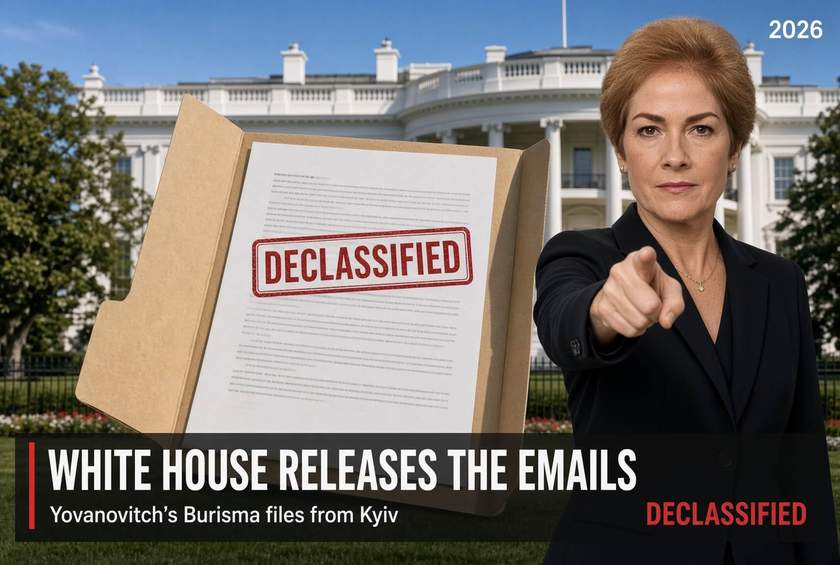
WASHINGTON — The White House Government Transparency Task Force has released 11 State Department email files about the Ukrainian gas company Burisma Holdings, drawn from the U.S. Embassy in Kyiv during Marie Yovanovitch’s time as ambassador. One of the 11 carries a declassification stamp. The other 10 are stamped “approved for public release” by Counsel to the President Scharf, dated Oct. 13, 2026, and seven of those already bear “UNCLASSIFIED” markings.
The single declassified file is a Nov. 22, 2016 email from George Kent, then the embassy’s deputy chief of mission. Its classification block names Yovanovitch as the classifying official and sets its declassification date as Nov. 22, 2026, five weeks after the release.
The task force presented the files as conflicting with Yovanovitch’s testimony in President Donald Trump’s first impeachment inquiry in 2019. Its chairman, John Solomon, holds the unpaid post while on leave as editor-in-chief of Just the News, which published the documents and its own report on them Oct. 16, according to an editor’s note on that report and a Washington Post profile of Solomon in August.
What the ambassador was sent, and what she asked
The emails show Burisma and its U.S. representatives repeatedly approaching the embassy, and Yovanovitch receiving or forwarding several of those exchanges.
In February 2017, Kent forwarded Yovanovitch a meeting request from J. Cofer Black, a former State Department counterterrorism coordinator who had joined Burisma’s board, under the line “The Burisma campaign of engagement continues.” A letter in Yovanovitch’s name, dated April 12, 2017, replied to Black. An embassy staff member who later found it on a shared drive noted it was a Word attachment and could not be certain it was signed and sent.
On Aug. 25, 2017, an embassy staff member emailed Yovanovitch a one-page summary of the case against Burisma’s owner, Mykola Zlochevsky. On Sept. 26, 2017, she forwarded Kent a request from the McCain Institute, which had been asked by Blue Star Strategies and a Burisma adviser to run prosecutor training that Burisma would fund. “Thoughts?” she wrote. Kent answered that the idea “would not pass the Washington Post sniff test.” On Oct. 6, 2017, Kent copied her on a detailed background note about the Zlochevsky case.
In January 2018, Blue Star asked for a meeting with the State Department desk on what it called “a visa situation.” An embassy colleague’s follow-up email that day referred to “the visa issue” Yovanovitch had raised that morning. She asked staff to put the “hi side” email, a reference to the classified system, on her chair.
In her closed-door deposition on Oct. 11, 2019, Yovanovitch was asked whether embassy staff briefed her on Burisma once she arrived in Kyiv. “I don’t recall that I was briefed on that,” she said, adding that she was “drinking from a fire hose” on arrival. She said she first learned of Burisma, and of Hunter Biden’s board seat, from a practice question while preparing for her Senate confirmation hearing.
The “big deal” quote isn’t in the transcripts
The White House’s summary of the release says Yovanovitch testified that the Biden-Burisma matter “just wasn’t a big deal.” Just the News has used the same wording since at least May 2020. Neither the House transcript of her Oct. 11 deposition nor the transcript of her Nov. 15, 2019 public hearing records her saying that about Burisma.
Her words in the deposition were that it “just wasn’t a big issue,” and separately that it “just wasn’t a front burner issue at the time.” At the public hearing, she said it “was not a focus of what I was doing in that 6-month period,” referring to the months before Trump took office. The phrase “a big deal” appears once in the deposition, in a passage about the pressure to remove Ukraine’s prosecutor general Viktor Shokin.
Kent told Congress much of this in 2019
Most of the Burisma history in the released emails was already in Kent’s sworn testimony. In his Oct. 15, 2019 deposition, released by the House the following month, Kent described the British court’s freeze of $23 million in Zlochevsky’s assets, the roughly $500,000 in State Department money spent supporting the FBI on the case, and the Ukrainian prosecutor general’s office closing it in December 2014.
He described a Feb. 3, 2015 meeting where he asked a deputy prosecutor general how much the bribe was and who took it, and said the official answered $7 million. He also testified that he had asked USAID to stop Burisma from co-sponsoring one of its contests and that an anti-corruption activist had criticized the Atlantic Council for accepting Burisma as a sponsor. The same complaint appears in a January 2017 email in the release.
The newly declassified Nov. 22, 2016 email adds Kent’s own wording from the time. Recounting a conversation earlier that year, Kent wrote that “someone in Washington needed to engage VP Biden quietly” and say that his son Hunter’s presence on Burisma’s board undercut the anti-corruption message the U.S. was advancing. In 2019, he testified that he had raised the same conflict-of-interest concern with someone on the vice president’s staff in early 2015 and was told there was no bandwidth for family issues while Beau Biden was dying of cancer. Just the News reported on the email while it was still classified.
A leaked Ukrainian file in the set
The release includes an April 2018 embassy summary of a document that purported to show Ukraine’s SBU security service investigating two anti-corruption officials, Artem Sytnyk and Gizo Uglava, for treason. The summary calls the document “possibly fake.” It says the case claimed Sytnyk and Uglava were U.S. intelligence informants and repeats its line that Burisma “was co-owned by Hunter Biden.” That line comes from the leaked document, not from embassy staff. A separate 2014 embassy readout in the same release records a Burisma adviser saying Zlochevsky owned 100% of the company and lists Hunter Biden among the notables invited onto its board. Asked by staff about the SBU document, Yovanovitch replied, “Where did we get this doc?”
We found no public response from Yovanovitch to the release as of Oct. 17. The task force previously released records on Special Counsel Jack Smith’s pen register applications for Susie Wiles’s phone, covered in DeClassified Now’s Plasmic Echo report. The files are posted on the White House election integrity page as a single ZIP archive, and the 2019 transcripts are on the House’s document site.
Sources
- White House Government Transparency Task Force, “Yovanovitch Burisma Corruption” document package (11 PDF files, stamped Oct. 13, 2026)
- White House, Election Integrity page, “Burisma Corruption” summary
- House Permanent Select Committee on Intelligence, deposition of Marie Yovanovitch (Oct. 11, 2019)
- House Permanent Select Committee on Intelligence, public hearing with Ambassador Marie Yovanovitch (Nov. 15, 2019)
- House Permanent Select Committee on Intelligence, interview of George Kent (Oct. 15, 2019)
- Just the News, “Impeaching Impeachment: Declassified memos challenge key witness testimony from 2019 Trump case” (Oct. 16, 2026)
- Just the News, “Impeachment Boomerang: Contacts exposed between US embassy, Hunter Biden-connected Ukraine firm” (May 12, 2020)
- The Washington Post via Editor & Publisher, “How a dogged D.C. journalist became Trump’s investigative reporter in the White House” (Aug. 24, 2026)
- DeClassified Now, “Declassified FBI Logs Show Plasmic Echo Tracked Wiles’s Phone Contacts” (Oct. 5, 2026)
Filed under: White House Government Transparency Task Force / Department of State