OPINION
The New Tesla Roadster Runs on Thin Air (Sort Of)
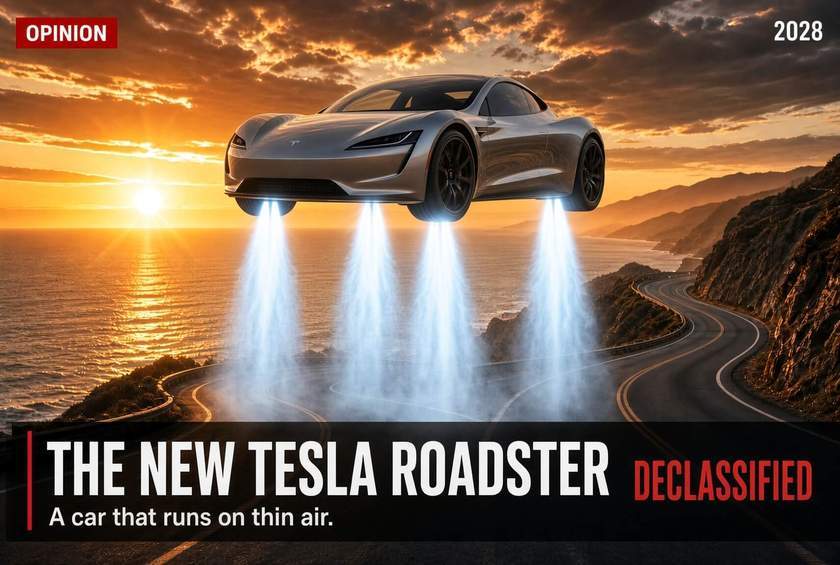
Tesla’s new Roadster uses plain air in two opposite ways. Fans pull air out from under the car to pin it to the road. Thrusters push air out the back to launch it off the road, underneath it’s still an electric sports car.
Most performance cars get downforce from wings, and wings come with a catch: they only work at speed. In a slow corner, or standing still, they do almost nothing.
The Roadster takes another route. Fans under the floor pull air out from beneath the car, and skirts around the edges seal the gap. With lower pressure underneath, the atmosphere above presses the car down with a force of up to twice its own weight. Tesla says that’s enough to hold the car upside down even when it isn’t moving.
The idea isn’t new. Brabham raced a “fan car” in Formula One in 1978, and it was banned almost immediately for being unfairly good. What’s new is putting the idea in a car you can reserve. Every version of the Roadster gets the fans. They’ll matter on every corner, while the upside-down trick is mostly for showing off.
A conventional car can only accelerate as hard as its tires can grip the pavement. Past that point, more power just means more wheelspin.
The thrusters skip that limit by pushing against the air instead of the road. An onboard pump fills carbon-fiber pressure tanks, the same kind SpaceX uses, with compressed air. When the valves open, the air leaves the nozzles at enormous speed and the car is shoved the other way. Nothing burns, and the tanks refill from the surrounding air.
On the Thrust model, rear nozzles bring 0–60 to under a second. On the single-seat Rocket model, nozzles all around the body give enough control for short hops, flips and midair rolls.
So far pubic “flying” show short hops, not commuting over traffic. It’s 600 litre tank duration demonstrations have been measured in seconds, not minutes, but there are conflicting reports on flight range.
The Rocket version isn’t approved for public roads, so for now its natural habitat is the racetrack, private land, and your wildest dreams. Don’t be surprised if it appears on upcoming movie sets.
Still, a car that can corner like it’s magnetized and leap like it’s caffeinated, powered by nothing more exotic than air? Not a bad way to spend time even with delays.
Production is targeted for 2028, and my insurance agent won’t give a quote until at least Monday.
SOURCES
Overview, trims, and the 2028 production date
- CBC News: Tesla unveils Roadster that can flip in the air and land using thrusters
- NBC News: Elon Musk shows off ‘flying’ Tesla Roadster after years of delays
- Click2Houston: Tesla unveils new Roadster with rocket-style thrusters
Suction fans (2G downforce, holding the car upside down even when parked)
- CellCog: Tesla Roadster Physics, Thrusters and Suction
- Motor Illustrated: Fan Downforce, Thrusters and a Flying Version
- InsideEVs: Tesla Just Revealed The Roadster With A Truly Insane Demo
Cold-gas thrusters (compressed air, carbon-fiber tanks, going past the tire grip limit)
- Electrek: Tesla unveils Cyberfied new Roadster that can kickflip
- The EV Report: Tesla Unveils Production Roadster With SpaceX Cold-Gas Thrusters
- Teslarati: How Tesla’s Roadster fan system and thrusters are built
Fine print (short hops only, Rocket version not road legal)