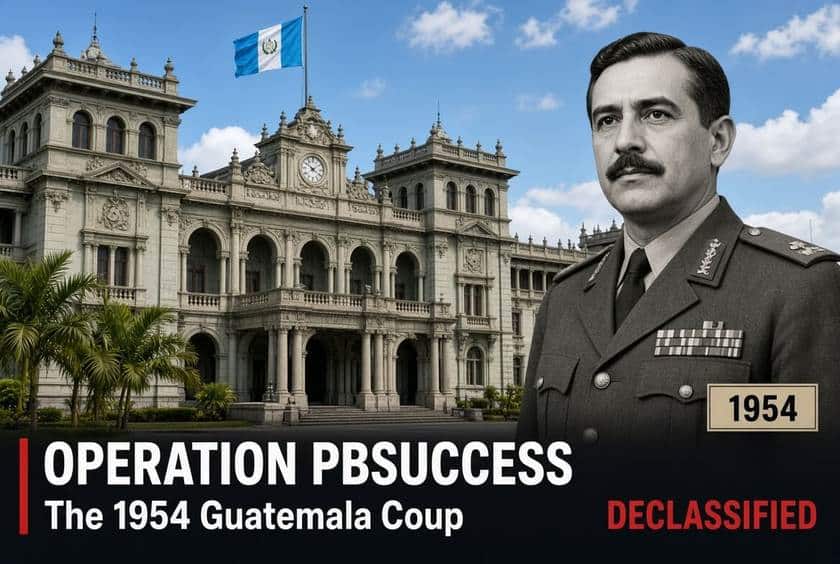
Operation PBSUCCESS was the Central Intelligence Agency’s covert program to remove Jacobo Arbenz Guzmán, the elected president of Guatemala, between late 1953 and June 1954. It combined a small exile invasion, an air campaign, clandestine radio broadcasts and pressure on the Guatemalan Army. Arbenz resigned on June 27, 1954. The agency’s own internal history, written in 1994 and declassified in 1997, is the fullest account of the operation from inside the CIA (Cullather, foreword).
The official record of PBSUCCESS took longer to assemble than the operation took to run. The State Department’s 1983 documentary volume on Guatemala omitted the CIA’s role entirely, and the Department later acknowledged that the compilation “was incomplete and flawed” (FRUS 1952–1954, Guatemala, preface). The documents that filled the gap were released in stages between 1997 and 2003.
Arbenz, Decree 900 and United Fruit, 1950–1953
Arbenz, an army officer and a leader of the 1944 revolution that ended the Ubico dictatorship, was elected president in November 1950 and inaugurated in March 1951 (Cullather, ch. 1 and Appendix A). On June 17, 1952, he issued Decree 900, an agrarian reform law that expropriated idle land on large private and government estates and redistributed it in plots of 8 to 33 acres. The CIA history records that U.S. aid officials at the time regarded the law as moderate and compared it to land programs the United States was sponsoring in Japan and Taiwan (Cullather, ch. 1).
The largest landholder affected was the United Fruit Company. The CIA timeline records the confiscation of 234,000 acres of the company’s land in 1953 (Cullather, Appendix A). The same history documents the company’s lobbying, including an approach by its lobbyist Thomas Corcoran to the State Department while Juan José Arévalo was still president, but treats Washington’s motives as a mix of commercial pressure and Cold War concern about the Guatemalan Communist party, the PGT, which the government legalized in 1952 (Cullather, ch. 1 and foreword).
PBFORTUNE, the 1952 precursor
The first plan predated the Eisenhower administration. In April 1952, Nicaraguan President Anastasio Somoza told U.S. officials that, given arms, he and the exiled Guatemalan officer Carlos Castillo Armas could overthrow Arbenz (Haines). After obtaining the agreement of Under Secretary of State David Bruce, Director of Central Intelligence Walter Bedell Smith approved the operation, code-named PBFORTUNE, on Sept. 9, 1952 (Cullather, ch. 1; Haines).
The agency assembled a shipment of confiscated contraband weapons, listed in the CIA history as 250 rifles, 380 pistols, 64 machine guns and 4,500 grenades, repackaged as farm machinery for shipment from New Orleans. Somoza spread word of the agency’s role among Central American officials. After the State Department learned that the cover was blown, Secretary of State Dean Acheson had Smith call off the operation on Oct. 8, 1952 (Cullather, ch. 1).
PBFORTUNE had lasted about a month.
Planning for PBFORTUNE had already produced lists of people to be removed. In January 1952, officers of the Directorate of Plans compiled a list of Guatemalan Communists whom a new government “would desire to eliminate immediately” after a successful coup (Haines).
Authorization and the LINCOLN station, 1953
On Aug. 12, 1953, the staff of the National Security Council concluded that the Arbenz government posed a threat sufficient to warrant covert action. The CIA history connects the decision to the agency’s standing after TPAJAX, the operation that overthrew Iranian Prime Minister Mohammad Mossadegh the same month (Cullather, ch. 2). On Dec. 9, 1953, Director of Central Intelligence Allen Dulles authorized $3 million for PBSUCCESS and placed Frank Wisner, the Deputy Director for Plans, in charge (Cullather, ch. 2).
The operation was run from a headquarters in Florida code-named LINCOLN, which opened shortly before Christmas 1953 and grew to more than a hundred case officers and support staff. The Directorate of Plans kept PBSUCCESS separate from the rest of the agency. The Deputy Director for Intelligence, Robert Amory, was never briefed (Cullather, ch. 2).
The Alfhem shipment, May 1954
On May 15, 1954, the Swedish freighter Alfhem arrived at Puerto Barrios carrying about 2,000 tons of Czechoslovak arms purchased by the Arbenz government. The ship had evaded U.S. efforts to track and delay it (Cullather, ch. 3).
The invasion, June 18–27, 1954
Castillo Armas’s force numbered 480 men, divided into four teams at staging areas near the border. On June 17, before the invasion began, Salvadoran police arrested the team assigned to Jutiapa and confiscated its weapons. Castillo Armas crossed the border at 8:20 p.m. on June 18, 1954 (Cullather, ch. 3). His air arm, supplied through the agency, consisted of three C-47 transports, six F-47 fighter-bombers, one P-38 and two light Cessnas (Cullather, ch. 3, illustration caption).
Militarily, the invasion went poorly. A garrison of about 30 soldiers at Gualán held off a rebel column in a 36-hour engagement, and the rebels’ largest force was defeated at Puerto Barrios (Cullather, ch. 3). The decisive pressure came from elsewhere.
Arbenz and his army chief, Col. Carlos Enrique Díaz, regarded the invasion as part of a larger U.S. plan to create a pretext for direct intervention. Meanwhile the clandestine Voice of Liberation radio station, code-named SHERWOOD, broadcast reports of rebel columns converging on the capital (Cullather, ch. 3).
On June 25, Arbenz told his Cabinet and union leaders that the Army was in revolt and proposed arming civilians. No weapons were distributed. At 8 p.m. on June 27, he announced his resignation and handed power to Díaz. Díaz announced that the Army would continue fighting Castillo Armas, and Ambassador John Peurifoy cabled Washington, “We have been double-crossed” (Cullather, ch. 3). Castillo Armas formally assumed the presidency on Sept. 1, 1954 (Cullather, Appendix A).
The CIA history records that some 75 detainees were killed and buried in mass graves in the Arbenz government’s final days (Cullather, ch. 3).
Assassination planning
A separate CIA History Staff study, completed by Gerald K. Haines in June 1995, examined proposals to kill Guatemalan officials under both PBFORTUNE and PBSUCCESS. It found that planning continued until Arbenz resigned, but concluded that the plans were abandoned and that no Arbenz officials or Guatemalan Communists were killed under them (Haines, summary). The 1997 release included a training manual, “A Study of Assassination,” and lists of individuals selected “for disposal,” with every name redacted (National Security Archive, Electronic Briefing Book No. 4). Because the names remain withheld, Haines’s conclusion cannot be checked against the lists themselves.
Aftermath, 1954–1957
A CIA team code-named PBHISTORY collected some 150,000 documents in Guatemala City after the coup, seeking evidence of Soviet direction of the Arbenz government (Cullather, ch. 4 and Appendix A). The new government soon needed financial support. The National Security Council, judging that its collapse “would be a disastrous political setback,” approved an aid package totaling $53 million (Cullather, ch. 4). Castillo Armas was assassinated on July 26, 1957 (Cullather, Appendix A).
Cullather’s assessment is that the operation’s apparent success fostered a belief in Washington that covert action was a cheap substitute for armed force, and that this complacency “proved fatal at the Bay of Pigs seven years later” (Cullather, foreword).
Release of the record
| Date | Release | Contents |
|---|---|---|
| 1983 | FRUS 1952–1954, Vol. IV | Guatemala compilation with no documentation of the CIA’s role |
| Feb. 1992 | CIA “openness” announcement | DCI Robert Gates names PBSUCCESS among operations to be reviewed for declassification |
| May 1997 | CIA release | About 1,400 pages, including the Cullather history and the Haines study |
| 2003 | FRUS 1952–1954, Guatemala (retrospective) | 287 documents; 2 withheld in full, 199 with excisions |
Sources for the table: FRUS 1952–1954, Guatemala, preface; Cullather, foreword; National Security Archive, Electronic Briefing Book No. 4. Related DeClassified Now entries cover Operation TPAJAX in Iran, 1953 and the Bay of Pigs, 1960–1961.
Operation PBSUCCESS, the CIA’s 1952-1954 campaign to oust Guatemala’s President Jacobo Arbenz, traced through the agency’s own history and the FRUS record.
Sources
- Nicholas Cullather, Operation PBSUCCESS: The United States and Guatemala, 1952–1954, History Staff, Center for the Study of Intelligence, Central Intelligence Agency, 1994; declassified 1997. CIA FOIA Electronic Reading Room, document 0000134974. Also available via the Internet Archive.
- Gerald K. Haines, “CIA and Guatemala Assassination Proposals, 1952–1954,” CIA History Staff Analysis, June 1995; released 1997.
- Kate Doyle and Peter Kornbluh, eds., “CIA and Assassinations: The Guatemala 1954 Documents,” National Security Archive Electronic Briefing Book No. 4, 1997, including “A Study of Assassination” and the “disposal” lists.
- U.S. Department of State, Office of the Historian, Foreign Relations of the United States, 1952–1954, Guatemala, ed. Susan Holly, 2003; preface.