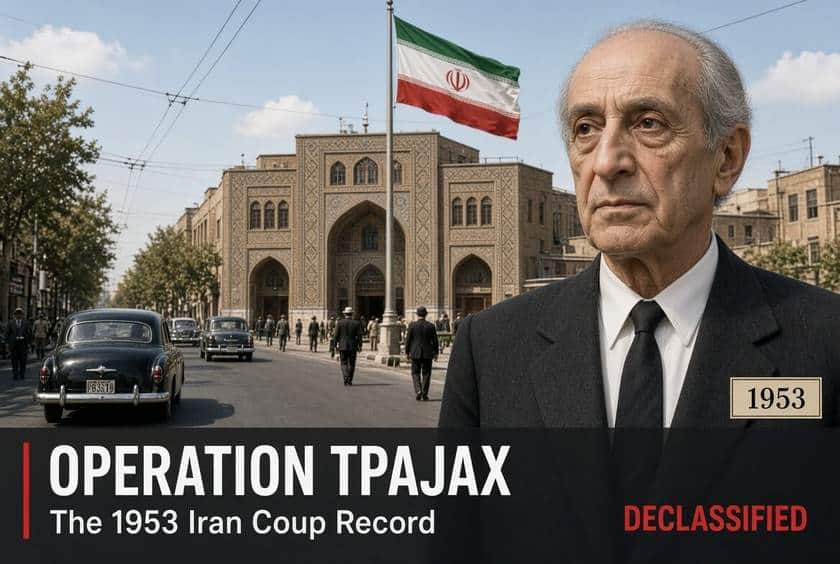
Operation TPAJAX was the covert action by the Central Intelligence Agency, planned with British participation, that ended with the removal of Iranian Prime Minister Mohammad Mosadeq on August 19, 1953. The principal published U.S. government record is Foreign Relations of the United States, 1952–1954, Iran, 1951–1954, a retrospective volume released by the State Department’s Office of the Historian in 2017 and edited by James C. Van Hook (FRUS 1951–54 Iran, preface). Its third chapter, “Planning and Implementation of Operation TPAJAX, March–August 1953,” prints Documents 169 through 308. This entry summarizes the operation as documented in that volume and in the CIA internal history released in 2013.
The 1989 volume and the retrospective that replaced its gap
The State Department first published a Foreign Relations volume on Iran for 1951–1954 in 1989. According to the preface of the 2017 volume, the 1989 volume documented the Anglo-Iranian oil dispute in detail but contained no documentation on the CIA’s role in U.S. policy toward Iran or on the covert action that removed Mosadeq. The omission drew criticism from historians and the press. In 1991, Congress passed legislation reaffirming that the series must be a “thorough, accurate, and reliable documentary record” and requiring agencies to give State Department historians full access to relevant records (preface; Public Law 102–138, sec. 198).
The retrospective volume was compiled under that mandate. Its declassification review began in 2004 and ended in 2014. The review withheld 10 documents in full, removed a paragraph or more from 38 documents, and made smaller excisions in 82 (preface, “Declassification Review”).
Planning, March–July 1953
On March 1, 1953, Director of Central Intelligence Allen W. Dulles sent President Eisenhower a memorandum describing the Iranian situation as “slowly disintegrating” since the assassination of Prime Minister Razmara in March 1951 (Document 169). The National Security Council discussed Iran at its 135th meeting on March 4 (Document 171).
The operational planning documents remain classified. A “Summary of Operational Plan” prepared in Nicosia on June 1, 1953, is listed in the volume with 8 pages not declassified (Document 214). An undated draft operational plan, which the editors identify as the “London Draft” of June 19, is listed with 29 pages not declassified (Documents 221, 225). Both are drawn from the CIA History Staff’s file CSHP 208, the classified study of TPAJAX by Donald Wilber, Overthrow of Premier Mossadeq of Iran.
The record of authorization is incomplete. Kermit Roosevelt, chief of the CIA’s Near East and Africa Division, wrote in his memoir Countercoup that he obtained high-level approval at a State Department meeting on June 25, 1953. The editors report that no official record of such a meeting has been found. They note that neither the Wilber study nor a second CIA study, Claude H. Corrigan’s The Battle for Iran, mentions it (Document 225). A chronology signed by Roosevelt and John Waller, chief of the CIA’s Iran Branch, and initialed by Dulles, gives July 11, 1953, as the date the State Department and the British Foreign Office authorized the operation. A handwritten addition to the chronology states that Dulles obtained the President’s approval the same day. The editors record that “no written authorization from the President has been found” (Document 225).
A communication received by Roosevelt on July 1, 1953, stated that the British Prime Minister had approved the plan (Document 232). On July 24, Secretary of State John Foster Dulles asked his brother by telephone whether the operation was still on. The transcript records Allen Dulles’s answer that it had been cleared directly with the President and remained active (Document 251).
The first attempt, August 15–16
The first attempt took place on the night of August 15–16, 1953. The Tehran station’s military situation report of August 17 records that Colonel Nassiri went to Mosadeq’s residence with the Shah’s decree (firman) dismissing the Prime Minister and was arrested (Document 270). The same report states that the chief of staff, General Riahi, had been warned about seven hours in advance, and that the station had been cut out of the military preparations on the night of August 13 (Document 270).
On August 16, the son of General Zahedi showed correspondents from the Associated Press and The New York Times a decree signed by the Shah, dated August 13, appointing Zahedi prime minister (Document 266). The Shah left the country the same day. The embassy reported that his flight appeared to leave Mosadeq the victor (Document 268). The Shah reached Rome on August 18 (Document 279).
Headquarters orders the operation discontinued, August 18
On August 18, CIA headquarters cabled the Tehran station that the State Department’s tentative view was that the operation “has been tried and failed.” The cable reported a British position against continuing. It concluded that, absent strong contrary recommendations from the station and Ambassador Loy Henderson, operations against Mosadeq should be discontinued (Document 278).
August 19
On August 19, the station cabled headquarters asking for stronger public support for the Shah (Document 285). Acting Director of Central Intelligence Charles P. Cabell reported to Eisenhower that forces proclaiming loyalty to the Shah had virtually occupied Tehran, that Mosadeq and Riahi were cut off from communications, and that Zahedi had returned to the city and broadcast proclamations (Document 295). The same afternoon, Deputy Director for Plans Frank Wisner met Foreign Operations Administration Director Harold Stassen on economic aid to the new government. Stassen advised that the request for aid should come from Zahedi or the Shah, addressed to the President (Document 282).
At a CIA meeting on August 28, 1953, Roosevelt explained the gap in the station’s reporting between Sunday morning, August 16, and Wednesday afternoon, August 19. He said he had to choose between reporting and acting, and chose to act (Document 307).
| Date (1953) | Event | FRUS document |
|---|---|---|
| March 1 | Allen Dulles memorandum to Eisenhower on Iran | 169 |
| June 1 | Operational plan summary, Nicosia (8 pages withheld) | 214 |
| July 1 | Roosevelt told the British Prime Minister has approved the plan | 232 |
| July 11 | Authorization date in the CIA chronology; no written presidential authorization found | 225 |
| Aug. 15–16 | First attempt; Nassiri arrested delivering the firman | 270 |
| Aug. 16 | Shah leaves Iran; Zahedi decree shown to AP and New York Times | 266, 268 |
| Aug. 18 | Headquarters orders operations discontinued absent strong contrary advice | 278 |
| Aug. 19 | Royalist forces take control of Tehran; Zahedi broadcasts | 295 |
| Aug. 28 | CIA meeting reviewing TPAJAX | 307 |
Cables known only from transcriptions
The original CIA operational cables for TPAJAX no longer exist. According to the volume’s “Sources” chapter, they appear to have been destroyed in an office purge in 1961 or 1962, before the Near East Division moved to the CIA’s new headquarters building. Copies survived on microfilm in the CIA Cable Secretariat until a National Archives-approved records schedule of 1977 authorized their destruction after 20 years. State Department historians had obtained hand-typed transcriptions of the microfilmed cables in the late 1970s while preparing the 1989 volume, but were not cleared to publish them then. The 2017 volume prints 21 of the transcribed cables and cites 7 more in footnotes (FRUS 1951–54 Iran, “Sources”). Documents 263, 278, 285 and 287 are among those printed from the transcriptions.
The CIA’s 2013 acknowledgment
On August 19, 2013, the National Security Archive posted CIA records obtained through the Freedom of Information Act, including a less-redacted copy of the internal history The Battle for Iran, dated to the mid-1970s. The Archive described a passage in it as the CIA’s first formal acknowledgment of its role. The passage states that the coup was carried out “under CIA direction as an act of U.S. foreign policy” (National Security Archive, Electronic Briefing Book 435). The National Security Archive published an overview of the 2017 FRUS volume on its release (Electronic Briefing Book, June 15, 2017).
Sources
- U.S. Department of State, Office of the Historian, Foreign Relations of the United States, 1952–1954, Iran, 1951–1954, ed. James C. Van Hook (Washington: Government Publishing Office, 2017). Preface; “Sources”; Documents 169, 171, 214, 221, 225, 232, 251, 263, 266, 268, 270, 278, 279, 282, 285, 287, 295, 307.
- U.S. Department of State, Office of the Historian, Preface and “Sources”, FRUS 1951–54 Iran.
- U.S. Department of State, Office of the Historian, “Planning and Implementation of Operation TPAJAX, March–August 1953” (Documents 169–308).
- U.S. Department of State, Office of the Historian, Document 278, Telegram From the Central Intelligence Agency to the Station in Iran, August 18, 1953.
- U.S. Department of State, Office of the Historian, Document 225, Editorial Note.
- National Security Archive, “CIA Confirms Role in 1953 Iran Coup,” Electronic Briefing Book No. 435, August 19, 2013.
- National Security Archive, “Iran 1953: State Department Finally Releases Updated Official History of Mosaddeq Coup,” June 15, 2017.