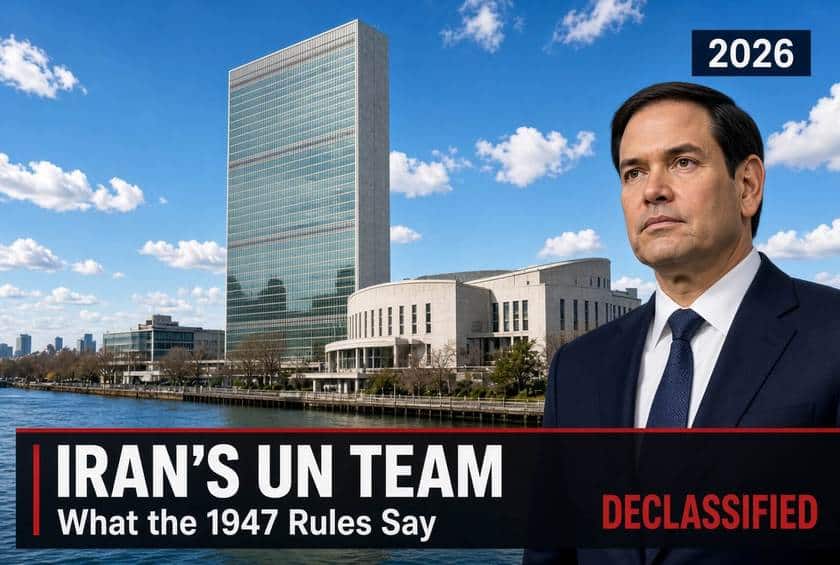
Two versions of the same departure are now on the record. In Washington’s, Secretary of State Marco Rubio told Iran’s delegation on Monday to leave New York immediately, after ceasefire talks on the sidelines of the U.N. General Assembly went nowhere.
One U.S. official said Rubio had concluded the Iranians “overstayed their welcome.” In Tehran’s, Foreign Minister Abbas Araghchi and his team simply left when they always planned to, on a schedule handed to the State Department on Sept. 17.
Both can’t be fully right, and the gap matters more than it might seem. The United States hosts the United Nations under a 1947 treaty that limits what it can do to foreign delegates, including when and how it can make them leave. Neither side’s account, so far, shows whether those rules were ever triggered.
What each side says happened
Axios first reported the order. Two U.S. officials, speaking to the Associated Press on condition of anonymity, said Rubio told the Iranians on Monday that Araghchi and his delegation had to leave immediately. According to one of them, Rubio had determined that the Iranians had “overstayed their welcome” and that they should go because the high-level U.N. meetings were over.
Araghchi had stayed on in New York after President Masoud Pezeshkian left the previous week. The AP reported that some accounts had Araghchi planning to stay until Wednesday. The delegation left very early Tuesday, the AP reported. Axios, as cited by Jordan News, reported that it boarded a 1:20 a.m. flight to Doha.
Iran’s U.N. mission answered on Wednesday on its official X account. Its post said the delegation “left New York on Monday evening,” in line with the itinerary it had given the State Department on Sept. 17, and accused the department of spreading “baseless and worthless news.” The AP’s timing and the mission’s differ by a few hours. Neither side has released the Sept. 17 itinerary or any written order.
We found no on-the-record statement from Rubio himself. The “overstayed their welcome” line is one unnamed official’s account of Rubio’s reasoning, not a quote from Rubio.
The talks that stalled
The delegation’s extended stay was tied to diplomacy over the war that began with U.S. and Israeli strikes on Iran on Feb. 28. Weekend meetings between Iranian officials and Qatari mediators made little progress on reopening the Strait of Hormuz, ending the fighting and restarting nuclear negotiations, the AP reported.
Reuters reported that Iran said it had received a U.S. response to its latest proposal, and that the two sides agree on some ceasefire steps but not on their order. DeClassified Now covered Iran’s earlier seven-day Hormuz proposal on Sept. 26.
Section 13 of the Headquarters Agreement
The 1947 Agreement between the United Nations and the United States regarding the Headquarters of the United Nations is the legal basis for every foreign delegation’s presence in New York. Section 11 bars federal, state and local authorities from imposing “any impediments to transit” to or from U.N. headquarters for representatives of member states. The agreement says that obligation applies regardless of the relations between those governments and Washington.
Section 13(b) deals directly with making someone leave. U.S. residence laws may not be used to require a protected person to depart “on account of any activities performed by him in his official capacity.” If a delegate abuses the privilege through activities outside official duties, the United States can start proceedings, but only with the Secretary of State’s prior approval, given “only after consultation” with the delegate’s government. That government has the right to appear in the proceedings. Delegates with full diplomatic immunity can be required to leave only through the customary procedure for diplomats accredited to the United States.
The same section also gives Washington room. Section 13(d) says the United States keeps “full control and authority” over who enters the country and the conditions of their stay, except as the agreement provides. The agreement also anticipates visas valid only for travel to headquarters and stays in its “immediate vicinity.”
The mechanism is clear on paper. What isn’t public is whether it was used. A formal removal under Section 13 would require a consultation with Iran and a decision by the Secretary of State. Iran’s account, that it left on its own schedule, would mean no removal was needed. The U.S. account describes an instruction, not a proceeding. We could not find any statement from the U.N. Secretariat or the U.N. committee that handles host-country disputes on the episode as of this writing.
Restrictions on Iran’s delegation this year
This year’s visit was already restricted before the talks broke down. Washington issued visas to Pezeshkian, Araghchi and a core delegation but denied them to several members, including some of the president’s media team, according to Al Jazeera and the Times of Israel, citing Iranian state media. The delegation’s movements and purchases in New York were also limited.
The purchase rules date from last year. In September 2025, the State Department barred Iranian officials in New York from buying at wholesale clubs such as Costco without permission, and required approval for luxury goods worth more than $1,000 and cars worth more than $60,000, CNN and NBC News reported at the time.
When Washington and the U.N. have clashed over who gets in
| Year | Who | What Washington did | What followed |
|---|---|---|---|
| 1988 | Yasser Arafat, PLO | Secretary of State George Shultz refused a visa on Nov. 26, citing PLO terrorism | The General Assembly moved its Palestine debate to Geneva, with only the U.S. and Israel opposed. Arafat spoke there on Dec. 13. |
| 2025 | Iranian diplomats | Shopping limits at wholesale clubs and on luxury goods | Rules took effect for the 2025 General Assembly |
| 2025 | Mahmoud Abbas and about 80 Palestinian officials | Rubio revoked or denied visas before the General Assembly | The Assembly voted 145-5 to let Abbas speak by video |
| 2026 | Iran’s delegation | Visas denied to several members; Rubio’s reported order to leave | Iran says it left on schedule |
In the 1988 case, the U.N.’s own record describes the Headquarters Agreement as containing clear provisions against denying invited persons access to headquarters, while Washington cited a security reservation in the 1947 U.S. law that approved the agreement. That disagreement over how far the security reservation reaches has never been formally settled.
What is confirmed and what isn’t
Confirmed: Iran’s delegation has left New York, and U.S. officials say Rubio instructed it to go after the talks stalled. Iran’s mission has publicly denied being expelled.
Not confirmed: whether any formal step under Section 13 was taken, and what the Sept. 17 itinerary said. The ceasefire talks themselves are continuing through mediators, and the U.S. and Iranian accounts may change as more officials speak on the record.
The U.S. says Rubio ordered Iran’s UN delegation out of New York; Iran says it left on schedule. We read the 1947 treaty rules on removing UN delegates.
Sources: Agreement between the United Nations and the United States regarding the Headquarters of the United Nations, June 26, 1947, Sections 11 and 13 (as reproduced in the notes to 22 U.S.C. § 287, Cornell Legal Information Institute); Associated Press, “Rubio orders visiting Iranian UN delegation to leave NYC ahead of schedule,” Sept. 30, 2026; Washington Examiner, citing Axios, “Rubio demanded Iranian delegation leave US after talks stalled,” Sept. 30, 2026; The Media Line, “Rubio Orders Iranian UN Delegation To Leave US After Talks Stall”; Jordan News, “Axios: Rubio Asked Iranian Delegation to Leave New York”; Just Security, Early Edition, Oct. 1, 2026 (summarizing Reuters on the ceasefire exchange); Al Jazeera, “Iran delegation to present narrative of resilience, diplomacy at UNGA,” Sept. 22, 2026; Times of Israel, “US refuses visas for several members of Iranian delegation”; CNN, “US is blocking Iranian diplomats in US from shopping at Costco,” Sept. 22, 2025; NBC News, “U.S. bars Iran’s diplomats from shopping at Costco without permission,” Sept. 2025; Yearbook of the United Nations 1988, Question of Palestine (excerpts); Boston Globe, “Arafat to Speak As UN Talks Shift to Geneva Today,” Dec. 12, 1988 (via Global Policy Forum); Diplomacy and Law, “UN Headquarters Agreement: Can the United States Deny Visas to Foreign Leaders Attending the United Nations?”; Al Jazeera, “UN approves video address by Palestine’s Abbas after US visa refusal,” Sept. 19, 2025; Haaretz, Sept. 19, 2025; DeClassified Now, “Iran’s 7-Day Offer, Trump’s No,” Sept. 26, 2026.