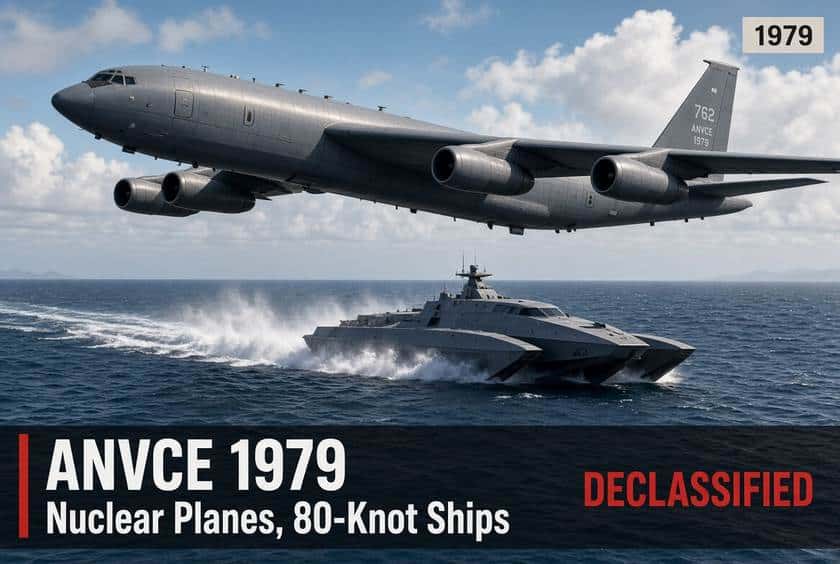
The airplane in Figure IV-4 weighs 560 tonnes at takeoff, carries a helium-cooled reactor in the middle of a three-deck fuselage, and is designed to stay on station for 15 days. Navy planners drew it in 1979, 18 years after President Kennedy cancelled the government’s nuclear aircraft program. They also put it in writing that they had never checked whether the reactor would work.
The drawing is part of the Advanced Naval Vehicles Concepts Evaluation, or ANVCE, a four-volume study prepared by the office of the Chief of Naval Operations and dated December 1979. On Sept. 23, the Navy released 939 pages of it to John Greenewald of The Black Vault, who had asked for the full report three years earlier.
We read the summary and the 616-page technical volume, then checked what became of the vehicles the study recommended. Some were built and served for decades. One major program was gone by the time the report reached its readers.
A Pentagon order to look at everything
The study began with a budget note. In February 1975, the Pentagon’s research chief told the Navy to evaluate “other ANV concepts which offer possible alternatives” to the surface effect ship, a fast craft riding on a cushion of air trapped between two rigid sidehulls. The Navy turned that into a project directive in July 1975. Submarines and carrier aircraft were off the table. Nearly everything else that could carry a weapon across or above the sea was on it.
Over the next four years the project ran more than 200 studies, tests and experiments, according to the summary volume. It examined nine kinds of vehicle (six the Navy classed as surface craft and three as aircraft) and produced 23 detailed “point designs.” The contractor list in Volume 1 runs from Boeing, Grumman and three Lockheed divisions to MIT, Stevens Institute and British hovercraft builders.
The reactor nobody checked
The nuclear patrol plane, designated A/L(N), was the study’s answer to a simple problem. A conventional turboprop could stay aloft about a day before its fuel load made it too big to be practical. The fossil-fueled version the Navy sketched already weighed 204 tonnes. Liquid hydrogen bought roughly one extra day. The technical volume concludes that a nuclear plane had no endurance limit “other than crew limits.”
So the Navy drew one. Table IV-3 gives it a cruise speed of 407 knots, a ceiling of 35,000 feet, a payload of 88 tonnes and 15 days on station. Four high-bypass turbofans hang beneath a high wing. The reactor is a graphite-moderated, gas-cooled design with a liquid-metal secondary loop, and the document notes much of its element fabrication would borrow from NERVA, the nuclear rocket program. For safety reasons, the plane would take off and land on ordinary JP-5 jet fuel.
Then comes the caveat.
The project “did not undertake an in-depth analysis of the technical feasibility” of lightweight nuclear propulsion, Volume 2 says. It assumed the technology would work and studied what the Navy could do with it. The summary volume repeats the point in one sentence. The same assumption carried over to a surface ship, discussed below.
The record on that assumption was already long. The U.S. Air Force’s own history of the effort describes 15 years of work and about $1 billion spent before the Kennedy administration cancelled the Aircraft Nuclear Propulsion program in early 1961. ANVCE’s technical volume says its design followed technology “developing since about 1960.” It doesn’t mention that the program behind that technology had been shut down.
An aircraft carrier on a bubble of air
The largest designs in the study were carriers. The SES CV was an 11,165-tonne surface effect ship meant to sustain 58 knots in sea state 3 and carry 17 aircraft. Moving it took 360,000 horsepower. Its nuclear twin, the SES CVN, used the same hull shape and the same assumed lightweight reactor, came in lighter at 9,862 tonnes, and could hold 65 knots with what the table lists as unlimited range. A third carrier rode on a SWATH hull, two submarine-like hulls under a wide deck. It used a conventional pressurized-water reactor, weighed 28,549 tonnes and carried 29 aircraft at 29 knots.
For scale, the study itself notes its 10,000-tonne SES carrier would hold about a fifth of the aircraft on a 90,000-tonne carrier.
Speed cost its cube
The project’s most durable finding may be a line the summary volume admits it never documented in full. Within each concept, “the cost varied approximately as the cube of the speed.” A conventional ship hits a practical wall between 30 and 40 knots. Past that, the only way to go faster at a sane price is to lift the hull out of the water on foils, fans or air cushions, and each of those carries its own cost penalty.
The analysts also gave up on the head-to-head comparison they had set out to make. Early cost-effectiveness rankings “could bring about more confusion than enlightenment,” Volume 1 says, because a 30-knot SWATH ship and a 200-knot wing-in-ground-effect craft would never fight the same way. The project fell back on a qualitative method keyed to the Naval Intelligence Support Center’s projection of the threat the fleet would face around the year 2000.
The 80-knot ship it told the Navy to slow down
One ship in the study was more than a drawing.
The Navy was already building toward a 3,000-tonne surface effect ship meant to exceed 80 knots, with a new bow seal, new waterjet inlets, new lift fans and development engines. ANVCE flagged the risk. It recommended restricting the ship to 50 knots in any sea state until testing was complete, and studying a 50-knot version, which its analysis suggested could cut the platform’s investment cost in half.
The program didn’t last long enough to take the advice. A 1990s survey of surface effect ship development by naval engineers David Lavis and Kenneth Spaulding says the 3,000-ton program was discontinued in 1979, after more than $400 million in Navy investment going back to 1967. Other accounts date the cancellation to 1980. Either way, when the Chief of Naval Operations’ office sent the summary volume out with a cover letter dated March 17, 1980, the letter was still recommending further analysis of the 3,000-ton class.
What the Navy built
We matched the study’s main recommendations against what the fleet later received.
| Concept | What ANVCE said | What happened |
|---|---|---|
| Air cushion landing craft | A 150-tonne, 50-knot craft carrying one main battle tank was “low risk.” Cut cost, not chase speed. | The LCAC. First delivered 1984, 91 built through 2001, carrying 60 tons at over 40 knots. |
| Hydrofoil | Fit the Pegasus-class boats with variable-geometry foils for 70-80 knot dashes | Six PHMs served at foilborne speeds of 40-plus knots. All were decommissioned in July 1993. |
| 3,000-tonne surface effect ship | Cap at 50 knots until tested; study a cheaper 50-knot version | Program discontinued around 1979-80 |
| SWATH ship | Pursue simple designs of 1,000 to 3,000 tonnes | USNS Victorious, a 3,384-ton SWATH sonar ship, delivered Aug. 13, 1991 |
| Nuclear patrol plane | Feasible for 4 to 15 days on station, assuming the reactor works | No program |
The landing craft is the closest match, partly because the study’s designs already carried the LCAC name. Its two versions, 145 to 156 tonnes with 55 to 62 tonnes of payload, sit close to the craft the Navy fielded in the 1980s.
Still blacked out, and not
The release is not complete. The Navy’s response letter says the main text of Volume 4 and the Volume 3 appendices are still being digitized for later release. Within the pages that did come out, the summary volume’s three cost tables are blacked out in full under FOIA exemption (b)(1), meaning the Navy considers them properly classified today. The report’s own cover sheet had scheduled it for declassification review on Dec. 31, 1999.
The privacy redactions are less consistent. The Navy withheld the names of the project’s officers and contractors under exemption (b)(6) on the preface page. The same preface appears again one page later, with every name legible. We are not reprinting them. The report’s Defense Technical Information Center number is printed on its first page, ADC022514, with distribution limited to the Defense Department and its contractors.
Primary source: Chief of Naval Operations (OP-96), Advanced Naval Vehicles Concepts Evaluation (ANVCE) Project, Volumes 1-4, December 1979, released Sept. 23, 2026 (The Black Vault), including Volume 1, Summary (PDF), Volume 2, Technical Evaluation (PDF) and the Navy’s FOIA response letter, DON-2023-004852 (PDF). Full context: Bernard J. Snyder, Aircraft Nuclear Propulsion: An Annotated Bibliography, U.S. Air Force History and Museums Program, 1996 (PDF); David R. Lavis and Kenneth B. Spaulding Jr., “Surface Effect Ship (SES) Developments Worldwide” (PDF); U.S. Navy fact file, Landing Craft, Air Cushion; Mark R. Bebar, “U.S. Navy Patrol Hydrofoil – Missile (PHM) Program,” International Hydrofoil Society, 2019 (PDF); Naval History and Heritage Command, Victorious (T-AGOS-19).