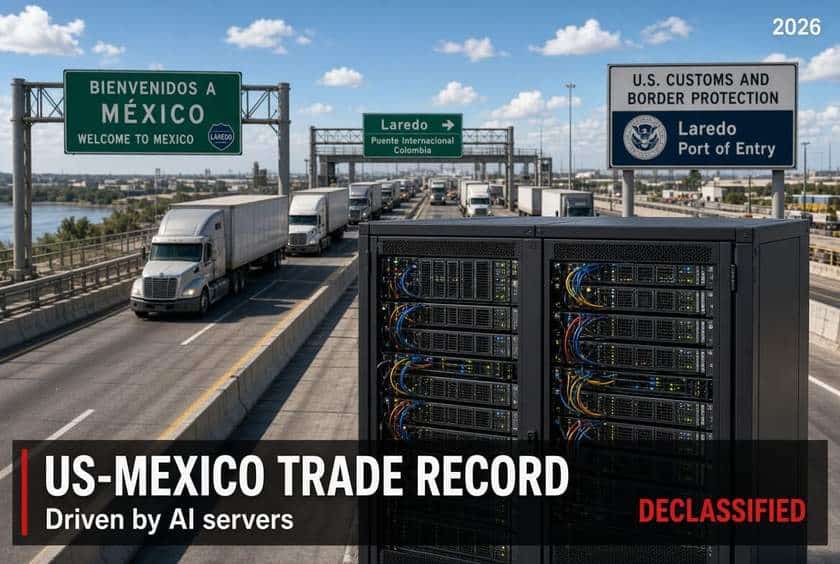
Mexico sold the United States $62.2 billion worth of goods in September, the most in any single month on record, according to Census Bureau figures released Nov. 4. That was 40% more than a year earlier. Through the first nine months of 2026, goods trade between the two countries reached $779.2 billion, and the U.S. goods deficit with Mexico hit a record $184 billion.
Those numbers came in a year when Washington put tariffs on Mexican cars, steel and aluminum and refused to renew the trade agreement that ties the two economies together. Most of the explanation fits in a single customs category, HS 8471, where the servers that fill American AI data centers are classified.
A slow spring, then a record summer
For the first three months of the year, nothing looked unusual. U.S. imports from Mexico ran 5.2% ahead of early 2025, a normal year. Then the line broke away. July, August and September each topped $60 billion, and the third quarter came in almost 36% above the same months last year.
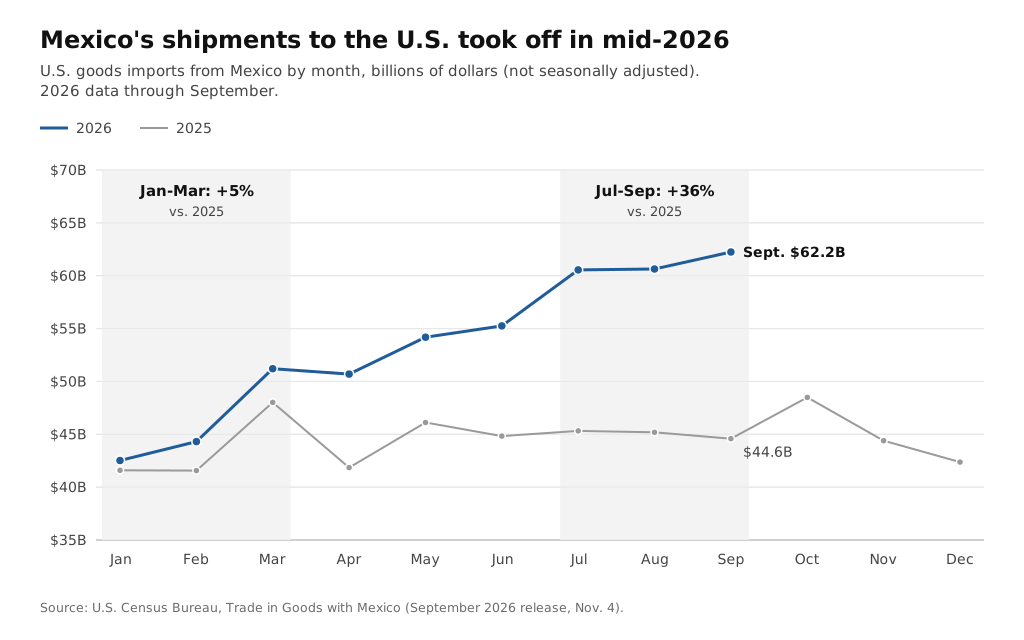
The full-year total is close to settled. If October through December merely repeat last year’s figures, two-way goods trade for 2026 lands at about $999 billion. No country has come near that with the United States. The Census Bureau’s tables, which go back to 1985, top out at $796.5 billion for Canada in 2022 and $690.3 billion for China the same year. Mexico has already passed China’s best year, with a quarter left to go.
Mexico’s own statistics agency, INEGI, counts the same trade differently and reports a much smaller surplus with the U.S. The two countries’ figures have never matched exactly. The U.S. numbers are used here throughout.
Subtract the servers
Daniel Covarrubias took the Census data apart by product in his newsletter, The Bridge, with analysis by the Texas Center for Border Economic and Enterprise Development at Texas A&M International University in Laredo. His period is the 12 months through August. U.S. imports from Mexico rose $74.4 billion over that stretch, to $599.2 billion (a total that matches the Census country tables to the decimal).
Computers, servers, phones, network gear and computer parts accounted for $77.2 billion of that increase.
That is more than the entire gain.
Cars, trucks and auto parts fell $7.9 billion, and every other product from Mexico, combined, rose just $5.1 billion.
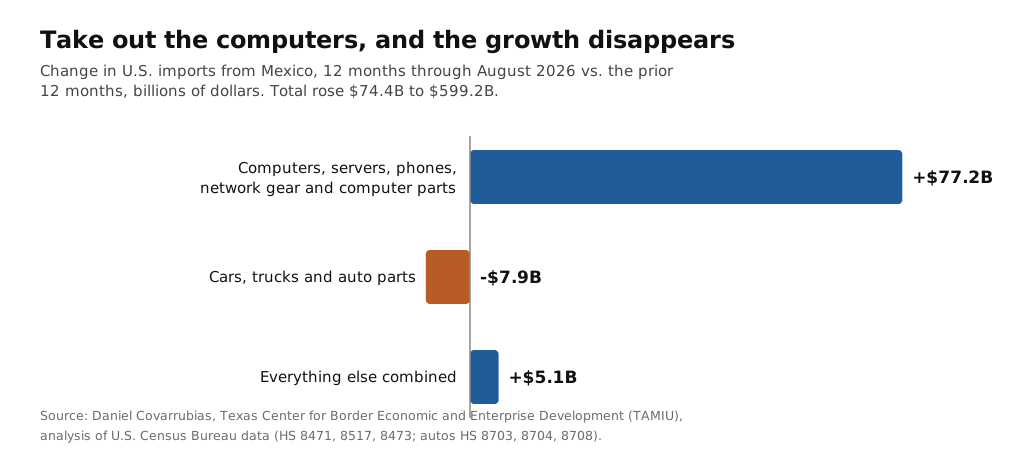
Covarrubias calls what’s left “core trade,” borrowing the idea of core inflation. By his count, U.S. imports from Mexico excluding those three electronics lines were $432.1 billion in the 12 months through August, down 0.6% from a year earlier. They had fallen 1.6% the year before that. Outside electronics, then, Mexican sales to the U.S. have been flat to shrinking since early 2025, and that is before adjusting for inflation.
Other tallies point the same way, though they use different baskets and periods. Mexico’s central bank data, as reported by Milenio and Mexico Business News, put AI-related equipment exports at $105.8 billion from January through May, ahead of vehicles for the first time. Banco Base, a Mexican bank, calculated that without computers, Mexico’s total exports in 2025 would have shrunk by about half a percent instead of growing 7.6%.
More boxes, and pricier ones
Is the boom real, or is it inflation? Mostly real, at least for servers. U.S. customs data compiled from UN Comtrade by Ossiano Capital, a trade-finance firm, counted 22.0 million HS 8471 units arriving from Mexico in 2025, up from 15.2 million in 2024. The average declared value rose too, from $3,184 to $4,079 a unit. So the count of machines went up by about 45%, and each one was worth more, consistent with a shift toward expensive AI hardware.
The border’s busiest crossing shows the same pattern from the ground. Northbound trucks at Laredo barely moved, about 2.97 million over the 12 months through August, essentially the same count as the year before. Each truck carries more value now. Covarrubias’s dollars-per-truck index rose 17%, and about four-fifths of that increase came from computers. Fernando Alba, a deputy economy minister in Chihuahua, told the Financial Times that one truck of servers equals a thousand cars.
Built in Ciudad Juárez, mostly made in Asia
The servers are put together largely by Taiwanese contract manufacturers. Foxconn, Quanta, Wistron, Pegatron and others run lines in Ciudad Juárez, across the river from El Paso, and around Guadalajara and Monterrey. Racks that can weigh more than two tonnes are assembled from imported parts and trucked north, according to Financial Times reporting quoted on the International Economic Law and Policy Blog.
Very little of the value is Mexican.
A UBS report put imported inputs at more than 95% in Mexico’s export-oriented computer and electronics manufacturing, as Mexico News Daily reported in September. Industry estimates given to the Financial Times put realistic Mexican content at 3% to 7% of a server’s value, against about 39% for a car assembled in Mexico. Mexico’s deputy minister of foreign trade put the figure for electronics exports overall at 7% to 8%, Mexico News Daily reported Sept. 24. Researchers from the Atlantic Council who toured a server plant this year asked how many of its more than 2,000 suppliers were Mexican. None were, they wrote in July, apart from packaging, transport and services.
The parts come from Asia in volume. Mexico’s imports from Taiwan reached $43.9 billion in the first half of 2026, up about 200%, according to Banxico data cited by Covarrubias. Some of the flow also runs south from the United States. U.S. exports of computer parts to Mexico rose from $17.2 billion to $31.0 billion in a year, by his count, and “two-way trade” counts both the boards going south and the finished servers coming back.
Why the tariffs didn’t touch them
Cars from Mexico face a 25% Section 232 tariff. Data-processing machines paid an effective rate of 0.02% in the first quarter, according to customs broker Grupo KROM’s reading of Census data. The gap explains a lot. Computers and servers have entered the U.S. duty-free at the general rate since the country implemented the WTO’s Information Technology Agreement in 1997, so they never needed USMCA treatment to cross at zero.
They also qualify under USMCA anyway. Most products in the agreement use a “change in tariff classification” test rather than a regional-content percentage, and the Atlantic Council analysis found that the rule for servers excludes only finished computers as inputs. A server built entirely from Chinese or Taiwanese boards, memory and chassis still counts as North American.
The one new U.S. duty that can reach a server is the 25% Section 232 tariff on certain advanced chips and products containing them, in force since Jan. 15. Covarrubias and Ossiano both describe it as narrow. By Covarrubias’s reading, it applies only to chips in two performance bands and waives servers for U.S. data centers adding more than 100 megawatts of new AI load.
The USMCA fight is mostly about cars
On July 1, U.S. Trade Representative Jamieson Greer said the United States would not renew the USMCA in its current form, which leaves the agreement in force but subject to annual reviews. The third U.S.-Mexico negotiating round, held in Mexico City the week of July 20, covered economic security, labor, agriculture, electronic payment services, steel and aluminum, and automobiles, according to USTR’s joint statement with Mexican Economy Secretary Marcelo Ebrard. Computers and servers weren’t on the published list.
A fourth round was supposed to happen in Washington in September. It hasn’t. As of Nov. 15, neither government had announced a date, according to the International Compliance Professionals Association’s review tracker. Ebrard said Nov. 4 that the round had waited for the U.S. election.
Some trade-press reports say Washington wants tougher origin rules for electronics. We found no published U.S. proposal that targets servers. The Atlantic Council authors argue Mexico should offer one itself, a phased regional-content rule for computers that would push server makers to buy more Mexican or U.S. components. Even if one is adopted, a server that fails the USMCA test would still enter at the same zero general rate, as Covarrubias notes.
What would slow it down
Servers cross because a handful of U.S. companies are spending heavily on data centers. That spending is the variable to watch, more than the trade talks. UBS expects growth in that capital spending to slow from 76% this year to 25% in 2027, as Covarrubias reported. Slower growth would mean a slower climb in the trade figures, not a fall, unless spending actually drops.
October figures are the Census Bureau’s next release. The fourth U.S.-Mexico round still has no date.
The monthly figures are in the Census Bureau’s Trade in Goods with Mexico table. Covarrubias’s product breakdown is “Subtract the Servers”, and the rules-of-origin analysis is the Atlantic Council’s “Mexico can turn USMCA pressure into an industrial opportunity.” For how U.S. tariffs have played out in Canada’s auto and steel plants, see our earlier piece on Stelco and Stellantis.
Sources
- U.S. Census Bureau, Trade in Goods with Mexico (monthly, through September 2026)
- U.S. Census Bureau, Trade in Goods with Canada and with China (annual peaks)
- USTR, Ambassador Greer statement on the USMCA joint review (July 1, 2026)
- USTR, Joint statement of Ambassador Greer and Secretary Ebrard (July 2026)
- Daniel Covarrubias (TAMIU), “Subtract the Servers,” The Bridge
- Atlantic Council, “Mexico can turn USMCA pressure into an industrial opportunity” (July 23, 2026)
- Ossiano Capital, Mexico-US computer and server trade (HS 8471), from UN Comtrade data
- International Economic Law and Policy Blog, “Implications of Increasing Mexican Exports of AI Data Servers to the United States” (August 2026)
- Mexico Business News, “US AI Boom Reshapes Mexico’s Export Map”
- Grupo KROM, “Mexico’s Exports to the U.S. Shift as Computers Rise and Auto Shipments Fall”
- La Jornada via Mexico Solidarity Media, “Mexico’s Exports to the US Soared 40 Percent in September” (Nov. 4, 2026)
- Mexico News Daily, “Taiwan imports fuel Mexican tech exports” (UBS report, Sept. 3, 2026)
- International Compliance Professionals Association, USMCA Joint Review Tracker