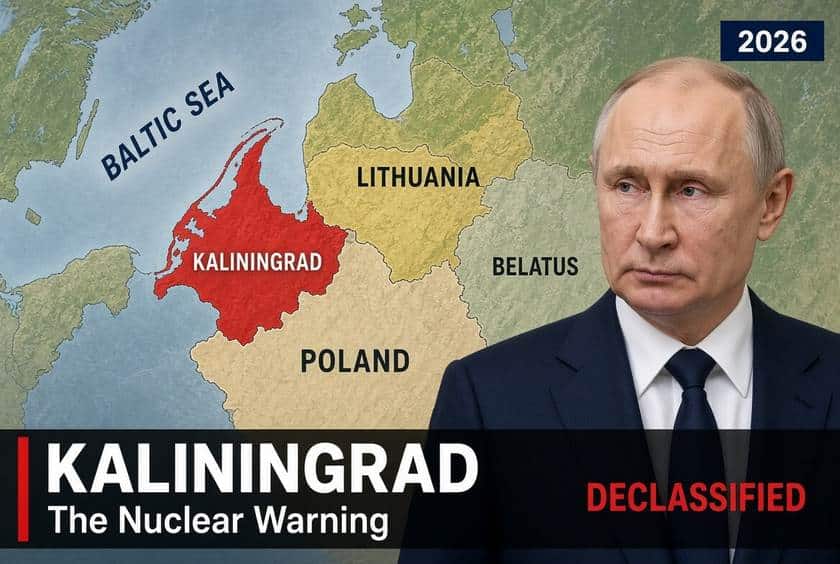
Russia told NATO this week that it would be ready to use “the entire arsenal of forces and capabilities at its disposal, including nuclear weapons” if the alliance tried to cut off Kaliningrad, the Russian exclave wedged between Poland and Lithuania on the Baltic Sea. The warning went further than the bomb. The note, as quoted by the Kyiv Independent, raised the possibility of strikes on “decision-making centers” in alliance countries from the outset of a conflict.
The Russian Embassy in Ireland posted the statement on Tuesday, according to TASS and the Associated Press. On Wednesday, Reuters reported that a written version had been sent to NATO itself, and the alliance confirmed it had received it, the AP reported. The Kyiv Independent described the document as a non-paper, an informal diplomatic note. Its central claim is that Moscow has information NATO “is preparing an air and naval blockade” of the region. The embassy cited this “information” without offering evidence or naming its source, the Kyiv Independent noted. NATO spokesperson Allison Hart said the alliance is not targeting Kaliningrad, the AP reported.
Kremlin spokesman Dmitry Peskov said it was natural for Russian diplomats to try to remind “the hotheads in Europe” about Russia’s policy documents, according to the AP. One of those documents is public, and we read it. Russia’s nuclear doctrine, signed by Vladimir Putin as Decree No. 991 on Nov. 19, 2024, does name the scenario Moscow is now describing. It just doesn’t put it where the warning implies.
Paragraph 15, item zh
The doctrine, formally the Fundamentals of State Policy of the Russian Federation on Nuclear Deterrence, sorts the world into two lists. Paragraph 15 is a list of “military dangers,” things that could grow into threats and that nuclear deterrence exists to head off. Item zh (the Cyrillic letter ж) reads, in our translation, “actions of a potential adversary aimed at isolating part of the territory of the Russian Federation, including blocking access to vitally important transport communications.” The same paragraph lists, as item i, large-scale military exercises near Russia’s borders.
Neither item appeared in the 2020 version. Analysts at the Swedish Defence Research Agency (FOI), comparing the two texts, noted that the blockade clause was new in 2024 and suggested Sweden’s and Finland’s entry into NATO may have sharpened Moscow’s worry about the sea route to Kaliningrad.
The second list is the one that matters for the warhead. Paragraphs 18 and 19 set out the conditions under which Russia may move to nuclear use. Paragraph 19 names five, among them reliable word of a ballistic missile launch at Russia, a nuclear or other weapon-of-mass-destruction attack, an attack that would disable its ability to retaliate, and a massed launch of aircraft, missiles or drones crossing its border. Both paragraphs also cover conventional aggression against Russia or Belarus that “creates a critical threat to their sovereignty and/or territorial integrity.”
A blockade is not on that second list by name. For this week’s warning to match the doctrine’s text, Moscow would have to treat an isolation of Kaliningrad as aggression that critically threatens Russia’s territorial integrity. Paragraph 20 leaves that decision to the president. This week’s note tells NATO in advance that Moscow would read it that way.
Two other clauses help explain the note’s reach. Paragraph 10 says aggression by any member of a military coalition will be treated as aggression by the coalition as a whole. Paragraph 11 says an attack by a non-nuclear state with the support of a nuclear state counts as a joint attack by both. Lithuania and Poland have no nuclear weapons of their own. Under those paragraphs, that wouldn’t spare them.
Rutte: “Stop the nuclear threats”
NATO answered on two levels. In a written response, spokesperson Allison Hart said, “We strongly denounce the threat of force, including any irresponsible nuclear rhetoric,” and called on Russia to end its war in Ukraine, according to the AP and the Kyiv Independent. Speaking at the Euronews Defence and Space Summit in Brussels on Wednesday, Secretary General Mark Rutte said the alliance is defensive and told Moscow to stop the nuclear threats, calling them “not helpful,” Euronews reported. Al Jazeera quoted him as saying Putin knows he can never win a direct confrontation with NATO.
The AP noted that NATO allies have held a series of military exercises in the Baltic region in recent months, with more planned for October. The alliance also runs Baltic Sentry, a mission protecting undersea cables and pipelines, which it announced in January 2025 after a string of cable incidents, including damage to a subsea link reported by Finland on Christmas Day 2024. Peskov, per the same report, called recent European remarks about Kaliningrad “rampant.”
Three earlier Kaliningrad scares
The blockade claim isn’t new. It has surfaced each time the exclave’s supply lines or its defenses came up in public, and the language has escalated with each round.
| Date | What happened | Moscow’s response |
|---|---|---|
| June 2022 | Lithuania stopped rail transit of EU-sanctioned goods (coal, metals, cement and others) to Kaliningrad from June 18 | Security Council secretary Nikolai Patrushev promised measures with “serious negative consequences” for Lithuanians |
| July 2025 | U.S. Army Europe commander Gen. Christopher Donahue said NATO could take down Kaliningrad’s defenses from the ground faster than ever before | Duma foreign affairs chief Leonid Slutsky said an attack would bring retaliation including nuclear weapons |
| Nov. 2025 | NATO exercises in the Baltic region | Deputy Foreign Minister Alexander Grushko said NATO drills were rehearsing Kaliningrad’s isolation |
| Sept. 2026 | No specific trigger named; the embassy cites increased NATO and EU military activity, including exercises | Note to NATO raising nuclear use and strikes on “decision-making centers” |
The 2022 episode is the only one in which a supply line to Kaliningrad was actually restricted. It ended through paperwork rather than force. On July 13, 2022, the European Commission issued guidance saying EU sanctions did not ban rail transit of goods between mainland Russia and the exclave, as long as the goods were for Kaliningrad’s own needs. Lithuania’s state rail freight company resumed carrying the sanctioned goods on July 22, 2022.
What is confirmed and what is not
Confirmed by Russian and NATO statements on the record: Moscow sent a written warning to NATO, its embassy in Ireland published a parallel statement, both raise nuclear use if Kaliningrad is isolated, and NATO has rejected the claim of a blockade plan. Not confirmed by any source we found: the “information” about a NATO blockade that Moscow cites. We could not find the full text of the note sent to NATO published anywhere. The quoted lines come from the embassy statement and from reporting by Reuters and the AP on the note itself.
The story is still moving. NATO’s October exercises have not started, and the Kremlin has not said whether the note will be followed by any change in Russia’s force posture in the exclave, where it already bases nuclear-capable Iskander missiles and the Baltic Fleet’s headquarters. Earlier DeClassified Now coverage of NATO-Russia nuclear signaling includes our archive entry on Able Archer 83 and the 1983 war scare.
Sources:
- President of the Russian Federation, Decree No. 991, “Fundamentals of State Policy of the Russian Federation on Nuclear Deterrence,” Nov. 19, 2024, paragraphs 10, 11, 15, 18, 19 and 20 (Russian, PDF)
- Kremlin, announcement of Decree No. 991, Nov. 19, 2024
- TASS, “Russian Embassy warns Moscow ready to use nuclear weapons to defend Kaliningrad,” Sept. 29, 2026
- Associated Press via ABC News, “Russia warns NATO of a possible nuclear response if Kaliningrad is cut off,” Sept. 30, 2026
- Kyiv Independent, “Russia sends NATO new nuclear threat over Kaliningrad as tensions rise,” Sept. 30, 2026
- Al Jazeera, “Russia warns NATO of possible nuclear response if Kaliningrad is cut off,” Sept. 30, 2026
- Euronews, “Rutte responds to Moscow’s nuclear threats,” Oct. 1, 2026
- Swedish Defence Research Agency (FOI), “Russia’s Updated Basic Principles for Nuclear Deterrence,” FOI Memo 8829
- NATO SHAPE, Baltic Sentry
- Al Jazeera, “NATO launches new Baltic Sea mission to protect undersea cables,” Jan. 14, 2025
- The Moscow Times, “Moscow Vows ‘Serious Consequences’ for Lithuania Over Kaliningrad Rail Ban,” June 21, 2022
- The Moscow Times, “EU Says Lithuania Must Allow Rail Transit of Russian Goods to Kaliningrad,” July 13, 2022
- LRT, “Lithuanian Railways resumes transit of sanctioned goods to Kaliningrad,” July 2022
- Kyiv Independent, “US general says NATO could seize Russia’s Kaliningrad ‘unheard of’ fast,” July 2025
- Kyiv Independent, analysis of Gen. Donahue’s remarks, July 2025
- Kyiv Post, “Moscow Says NATO Rehearsing Kaliningrad Blockade,” Nov. 5, 2025