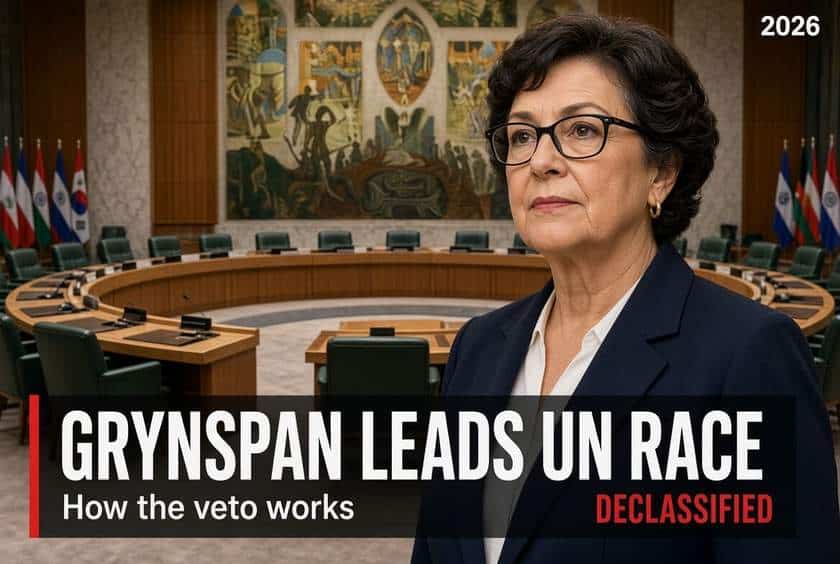
Rebeca Grynspan of Costa Rica led the UN Security Council’s eighth secret straw poll for the next secretary-general, drawing 12 “encourage” votes and three “discourage” votes, according to unofficial results. The Council hasn’t confirmed those numbers and doesn’t intend to. Each poll stays sealed, and the public tallies come from leaks.
The figures were reported by Al Jazeera on Sunday, citing the 1 for 8 Billion campaign, which pushes for a more open selection. SWI swissinfo.ch reported the same numbers on Nov. 10. Argentina’s Rafael Grossi, who heads the International Atomic Energy Agency, came second with nine encourage, four discourage and two no opinion. Guyana’s Carolyn Rodrigues Birkett was third, with eight encourage, five discourage and two no opinion, according to Al Jazeera.
António Guterres’s term ends Dec. 31, 46 days from now. No successor has been recommended, and nobody knows yet whether those three discourage votes include a veto from one of the five permanent members. That depends on a different kind of ballot, which the Council hasn’t used since mid-October.
A vote the UN records but won’t release
The General Assembly president’s office keeps an official page tracking the selection. After each round, it says, the Council president announces that a poll has taken place, and “the results are not published.” The page doesn’t report them either. Security Council Report, an independent group that tracks the Council, said before the Nov. 5 poll that the Council again wasn’t expected to release results.
The secrecy is older than any of the candidates’ careers. The Council began taking straw polls by secret ballot in 1981 to break a deadlock, and diplomats have leaked the results to reporters ever since. In 2016, the UN ran its most public selection yet, with published nominations and televised candidate debates. Even then, the Assembly president was told only that polls had taken place, and the results he wasn’t given came out through leaks. Louis Charbonneau, UN director at Human Rights Watch, told swissinfo’s Inside Geneva podcast that “the best analogy to it is the selection of the Pope, completely untransparent.”
Nine votes and no red ballot
The UN Charter gives the whole process one sentence. Article 97 says the secretary-general “shall be appointed by the General Assembly upon the recommendation of the Security Council.” The General Assembly has never turned down a candidate the Council recommended, so the real contest happens among the Council’s 15 members. This year that means the five permanent members (the United States, China, Russia, Britain and France) plus Bahrain, Colombia, the Democratic Republic of the Congo, Denmark, Greece, Latvia, Liberia, Pakistan, Panama and Somalia.
A candidate needs at least nine encourage votes and no veto. The ordinary straw poll can’t show the second part. Every member casts the same plain ballot, so a candidate with three discourage votes could be three elected members or one permanent member who would sink the bid in a formal vote.
The color-coded poll answers that question. Permanent members vote on colored paper, red under guidelines the Council wrote down in 1996, so the count shows whether any of the five discouraged a candidate. It still doesn’t say which one. In 2016, a single color-coded round on Oct. 5 settled the race. Guterres was the only candidate with no permanent-member discourage vote, and the Council recommended him the next day.
This year’s only color-coded poll, on Oct. 16, settled nothing. Every candidate drew discourage votes from permanent members, according to Security Council Report. Grynspan, Grossi and Rodrigues Birkett got two each. The Council went back to plain ballots for the seventh and eighth rounds. Security Council Report wrote on Nov. 4 that if no more candidates entered, members could return to colored ballots for the next poll. Swissinfo said that could happen “in the coming days.” No date has been announced.
Eight names, two of them late arrivals
The field changed after the color-coded round showed every front-runner carrying permanent-member opposition. Senegal’s Macky Sall withdrew in October. Burundi had nominated him, and he drew three permanent-member discourage votes on Oct. 16. Two new candidates then entered. The United Arab Emirates nominated Lana Zaki Nusseibeh on Oct. 21, and Türkiye nominated Feridun Hadi Sinirlioğlu on Nov. 1, four days before the eighth poll. Michelle Bachelet, the former Chilean president, dropped out in September after Brazil and Mexico withdrew their nomination.
| Candidate | Country | Nominated | Latest reported poll |
|---|---|---|---|
| Rebeca Grynspan | Costa Rica | March 3 | 12 encourage, 3 discourage |
| Rafael Grossi | Argentina | Nov. 26, 2025 | 9 encourage, 4 discourage, 2 no opinion |
| Carolyn Rodrigues Birkett | Guyana | June 15 | 8 encourage, 5 discourage, 2 no opinion |
| Lana Zaki Nusseibeh | UAE | Oct. 21 | Not reported |
| Feridun Hadi Sinirlioğlu | Türkiye | Nov. 1 | Not reported |
| Olara Otunnu | Uganda | July 24 | Not reported |
| María Fernanda Espinosa | Ecuador (nominated by Antigua and Barbuda) | May 11 | Not reported |
| Ivonne A-Baki | Ecuador (nominated by Tonga) | Aug. 17 | Not reported |
Poll figures are the unofficial eighth-poll results reported by Al Jazeera and swissinfo. Nomination dates are from the UN’s official selection page and Security Council Report, and are 2026 unless marked.
Grynspan’s position has improved steadily. In the seventh poll on Oct. 30 she drew 11 encourage and four discourage, which Security Council Report called the strongest result by any candidate so far. If she or anyone else wins, it would be a first. No woman has held the job in the UN’s 81 years.
When the Council couldn’t agree
If the Council hasn’t agreed by Dec. 31, the Charter says nothing about what happens. Asked whether Guterres would stay on, Al Jazeera’s UN correspondent Gabriel Elizondo said Guterres expects to be home in Portugal by Jan. 1. “Nobody knows because that’s never happened before,” Elizondo said.
The record does offer three precedents.
In October 1950, the Soviet Union vetoed Trygve Lie’s reappointment in a 9-1-1 Council vote. The General Assembly went around the Council. On Nov. 1, 1950, it voted 46-5-8 on Resolution 492 (V) to extend Lie’s term by three years, with no Council recommendation. Only the five Soviet-bloc members voted no. It’s the one time the Assembly kept a secretary-general in office without the Council’s backing.
In 1981, China vetoed Kurt Waldheim’s bid for a third term 16 times over six weeks, while the United States blocked Tanzania’s Salim Ahmed Salim. The secret straw poll was invented to get out of that deadlock. Javier Pérez de Cuéllar of Peru emerged in December, and the Assembly approved him on Dec. 15, about two weeks before the term began.
In November 1996, the United States vetoed Boutros Boutros-Ghali’s second term alone, in a 14-1 vote. Boutros-Ghali suspended his candidacy on Dec. 5. The Council recommended Kofi Annan on Dec. 13, and the Assembly appointed him on Dec. 17, two weeks before he took office.
The 1996 calendar is the closest match to this year’s. Richard Gowan of the International Crisis Group told swissinfo there was a fear the year would end without agreement, but added that it was not game over.
The next step is a ninth straw poll, possibly color-coded, on a date the Council hasn’t announced. A formal recommendation would come by resolution in a private meeting, and the General Assembly would then vote to appoint.
Sources
- Al Jazeera, Edna Mohamed, “Secret votes and vetoes: How will the next UN chief be picked?” (Nov. 15, 2026). Used for: eighth-poll figures (citing 1 for 8 Billion), Council membership, Elizondo quote.
- SWI swissinfo.ch, Imogen Foulkes, “Secretary General race is ‘existential’ for UN” (Nov. 10, 2026). Used for: unofficial latest-poll figures, Charbonneau quote, Gowan remarks, possible color-coded poll.
- Security Council Report, “Eighth Security Council Straw Poll on UN Secretary-General Candidates” (Nov. 4, 2026). Used for: eighth-poll date and ballot type, results not released, possible return to colored ballots, sixth-poll opposition to Grynspan, seventh-poll result, Sinirlioğlu nomination, recommendation procedure.
- Security Council Report, “Seventh Security Council Straw Poll on UN Secretary-General Candidates” (Oct. 29, 2026). Used for: sixth-poll permanent-member discourage votes, Sall withdrawal, Nusseibeh nomination.
- President of the UN General Assembly, “Selection and Appointment of the Next Secretary-General” (as at Oct. 22, 2026). Used for: results not published, nomination and withdrawal dates, term dates.
- Charter of the United Nations, Chapter XV, Article 97.
- UN Dag Hammarskjöld Library, General Assembly resolutions, 5th session. Used for: Resolution 492 (V), Nov. 1, 1950, vote 46-5-8.
- Wikipedia, “1950 United Nations Secretary-General selection”. Used for: the Soviet veto vote and three-year extension.
- Wikipedia, “1981 United Nations Secretary-General selection”. Used for: China’s 16 vetoes, the first straw polls, Pérez de Cuéllar’s appointment.
- Wikipedia, “1996 United Nations Secretary-General selection”. Used for: the 14-1 vote, the 1996 straw-poll guidelines, Annan’s recommendation and appointment dates.
- Wikipedia, “2016 United Nations Secretary-General selection”. Used for: the 2016 color-coded poll, leaked results, Resolution 2311.