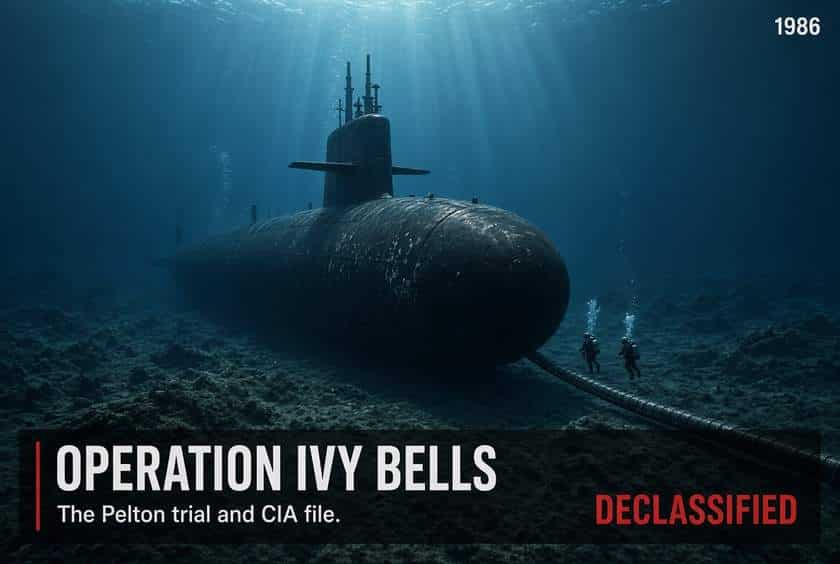
Operation Ivy Bells was a U.S. intelligence program that collected Soviet military communications by tapping an undersea cable in the Sea of Okhotsk, using American submarines. The U.S. government has not declassified the operation itself. Its code name and outline entered the public record in 1985 and 1986 through the espionage prosecution of Ronald W. Pelton, a former National Security Agency employee who sold information about it to the Soviet Union.
The documentary record has two parts. The first is the court record of United States v. Pelton, preserved in the Justice Department’s 1988 Supreme Court brief and the Fourth Circuit’s 1987 opinion. The second is a set of newspaper and magazine articles on the case that the CIA clipped and filed in 1985 and 1986, and later released through its CREST database with declassification stamps dated 2012. Those clippings document the agency’s own effort, led by Director of Central Intelligence William J. Casey, to limit what the press reported during the trial.
The cable tap in published accounts
No released U.S. government document describes how Ivy Bells was built or run. Published accounts, chiefly Sherry Sontag and Christopher Drew’s 1998 history of submarine espionage, Blind Man’s Bluff, date the first installation to October 1971, by the specially modified submarine USS Halibut. In those accounts the cable linked the Soviet Pacific Fleet base on the Kamchatka Peninsula to the mainland.
Those details come from interviews and haven’t been confirmed by an official release.
What the 1986 record does establish is narrower. The Washington Post reported on May 21, 1986, citing unnamed sources, that the operation used American submarines, that the Soviets uncovered it after debriefing Pelton in Vienna, and that the device used in it had been recovered by the Soviets (Washington Post, May 21, 1986, CIA-RDP90-00965R000807570007-1). Time reported on June 9, 1986, that the Post had placed the submarines in the Sea of Okhotsk, off the Soviet east coast (Time, June 9, 1986, CIA-RDP91-00561R000100120008-0). The Post withheld its description of the technology. Executive editor Benjamin Bradlee said the omitted material would have told the Soviets nothing they did not already know (Washington Post, May 21, 1986).
Pelton’s contacts with the Soviets, 1980–1985
Pelton held what the Post described as a low-level NSA job. He resigned in July 1979 after declaring personal bankruptcy (Washington Post, May 21, 1986, citing the indictment). The government’s brief states that in January 1980 he “decided to sell classified information concerning NSA programs to the Soviet Union,” and that over the following three years he furnished information on several classified NSA operations and “received more than $35,000” (Brief for the United States in Opposition, Pelton v. United States, No. 87-6433, April 1988).
Court documents summarized by the Post place his first contact with the Soviet Embassy in Washington on Jan. 14, 1980, and a visit to the embassy the next day. His first trip to Vienna followed in October 1980, and a second in January 1983, when he was allegedly paid $15,000. He returned to Vienna in April 1985 but failed to meet his Soviet contacts (Washington Post, May 21, 1986). Time reported that the Soviets arranged contact through a pay phone at a suburban Virginia pizzeria, called at 9 p.m. on the last Saturday of each month, and that his payments totaled $35,000 plus up to $5,000 in expenses (Time, June 9, 1986). Prosecutors charged that he compromised five U.S. communications “projects,” identified at trial only as A through E (Time, June 9, 1986).
Yurchenko, the voice match and the Annapolis interview
The government’s brief states that Pelton’s activities “were discovered when a Soviet defector exposed him and NSA officials recognized petitioner’s voice on the recorded conversations” (Brief, No. 87-6433). The defector was Vitaly Yurchenko, a KGB officer who came to the United States in the summer of 1985 (Washington Post, May 21, 1986). Court records cited by the Post say Pelton’s voice was identified through FBI voice analysis and the testimony of several individuals. Time reported that recordings of two intercepted calls to the Soviet Embassy were played for the jury (Time, June 9, 1986).
On Nov. 24, 1985, FBI agents interviewed Pelton about a “national security matter” at a hotel in Annapolis, Maryland. They met him again that evening and, after advising him of his rights, arrested him on their superiors’ instructions (Brief, No. 87-6433; Washington Post, May 21, 1986). Time put the interrogation at about five hours. Pelton later argued that his statements were involuntary. U.S. District Judge Herbert Murray ruled them admissible before trial (Time, June 9, 1986).
The indictment charged him in part under 18 U.S.C. 798, the 1950 statute that applies specifically to classified communications intelligence (Washington Post, May 21, 1986). That same statute became the basis for Casey’s threats against the press.
“Ivy Bells” in open court and on NBC
The code name first surfaced at Pelton’s arraignment on Nov. 27, 1985, when defense attorney Fred Warren Bennett asked an FBI agent whether his client had been questioned about Ivy Bells (Associated Press, May 21, 1986, CIA-RDP91-00561R000100100092-9). NBC’s James Polk reported that evening that there were indications the name referred to a Navy eavesdropping operation. According to the Post, the broadcast drew no public comment and no threat of prosecution (Washington Post, May 23, 1986, CIA-RDP90-00965R000605140016-2).
The government’s response changed in May 1986, as the trial approached. Casey had already warned the Post that he would recommend prosecution if it published its account of the compromised technology (Washington Post, May 21, 1986). After NBC’s Today show mentioned the underwater program and its code name, Casey announced that the law “requires me to refer this matter to the Department of Justice” (Washington Post, May 23, 1986). The Associated Press reported that administration sources described the Justice Department as extremely reluctant to prosecute NBC. The statute had previously been used only against government employees, never against a news organization (Associated Press, May 29, 1986, CIA-RDP91-00561R000100100023-5).
The Casey–Odom statement of May 28, 1986
On May 28, 1986, after coverage of the trial’s first day, Casey and NSA Director Lt. Gen. William E. Odom issued a joint statement. It cautioned reporters “against speculation and reporting details beyond the information actually released at trial” (Associated Press, May 29, 1986). It added that such speculation and additional facts “are not authorized disclosures and may cause substantial harm to national security” (Washington Post, May 30, 1986, CIA-RDP91-00561R000100100017-2).
A senior White House official told the Post that Odom wrote the statement, Casey approved it, and national security adviser John M. Poindexter endorsed it. According to the same official, it was not cleared in advance by President Reagan or chief of staff Donald T. Regan (Washington Post, May 30, 1986). Odom’s draft had ended with a sentence warning that journalists could be prosecuted under the 1950 statute. That sentence was removed before release (Washington Post, May 31, 1986, CIA-RDP90-00965R000403710014-5).
Legal objections to the word “speculation” followed within a day. Casey told the Associated Press that if he had it to do over again, he might not use that word. Odom said nothing in the statement threatened prosecution for speculation (Associated Press via Baltimore Sun, May 30, 1986, CIA-RDP90-00965R000200710008-7).
No news organization was charged.
Verdict, sentence and appeal
A jury in the U.S. District Court for the District of Maryland convicted Pelton in 1986 of conspiracy to commit espionage, espionage and unauthorized disclosure of communications intelligence, and acquitted him on one count of attempted espionage. He received concurrent life terms on the espionage and conspiracy counts and a concurrent ten-year term on the disclosure count (Brief, No. 87-6433).
On appeal he challenged the use of evidence from surveillance under the Foreign Intelligence Surveillance Act. The Fourth Circuit rejected the challenge in United States v. Pelton, 835 F.2d 1067, with judgment entered Dec. 18, 1987. The court held that the Act’s safeguards adequately protected Fourth Amendment rights in foreign intelligence cases (Brief, No. 87-6433). The Solicitor General’s office opposed Supreme Court review in April 1988.
Pelton was released from federal prison on Nov. 24, 2015.
Contents of the CIA’s Pelton file
The CIA records on the case that are publicly available in its Electronic Reading Room are press clippings, not internal assessments. They include reporting from the Washington Post, the Associated Press, the Baltimore Sun and Time, collected by the agency in 1985 and 1986. Each carries a release stamp from 2012, several marked “Declassified in Part – Sanitized Copy.” None of the released items describes the operation’s technical design, its intelligence take, or a damage assessment of Pelton’s disclosures.
| Date | Event | Source |
|---|---|---|
| Oct. 1971 | First installation by USS Halibut, per published accounts | Sontag and Drew, Blind Man’s Bluff |
| July 1979 | Pelton resigns from NSA after bankruptcy | Washington Post, May 21, 1986 |
| Jan. 14–15, 1980 | First contact with and visit to the Soviet Embassy | Washington Post, May 21, 1986 |
| Oct. 1980 | First Vienna trip | Washington Post, May 21, 1986 |
| Jan. 1983 | Second Vienna trip; $15,000 payment alleged | Washington Post, May 21, 1986 |
| Summer 1985 | KGB officer Vitaly Yurchenko defects | Washington Post, May 21, 1986 |
| Nov. 24, 1985 | FBI interview in Annapolis; arrest | Brief, No. 87-6433 |
| Nov. 27, 1985 | “Ivy Bells” raised at arraignment; NBC report | AP, May 21, 1986; Washington Post, May 23, 1986 |
| May 28, 1986 | Casey–Odom joint statement to the press | AP, May 29, 1986 |
| 1986 | Conviction in U.S. District Court, Maryland | Brief, No. 87-6433 |
| Dec. 18, 1987 | Fourth Circuit affirms | Brief, No. 87-6433 |
| Nov. 24, 2015 | Pelton released from prison | Associated Press, Nov. 24, 2015 |
Sources
- U.S. Department of Justice, Office of the Solicitor General, Brief for the United States in Opposition, Ronald W. Pelton v. United States, No. 87-6433 (April 1988) (full text)
- United States v. Pelton, 835 F.2d 1067 (4th Cir. 1987)
- Bob Woodward and Patrick E. Tyler, “Eavesdropping System Betrayed,” Washington Post (May 21, 1986), CIA-RDP90-00965R000807570007-1, released 2012
- Associated Press, “Reports on U.S. Submarine Spying on Soviets 25 Years Old” (May 21, 1986), CIA-RDP91-00561R000100100092-9, released 2012
- George Lardner Jr., “Earlier Spy Reports Went Unprosecuted,” Washington Post (May 23, 1986), CIA-RDP90-00965R000605140016-2, released 2012
- Michael J. Sniffen, “CIA and NSA Chiefs Appeal for Media Cooperation in Keeping Spy Secrets,” Associated Press (May 29, 1986), CIA-RDP91-00561R000100100023-5, released 2012
- Eleanor Randolph and George Lardner Jr., “Reagan Security Adviser Endorsed Warning Media,” Washington Post (May 30, 1986), CIA-RDP91-00561R000100100017-2, released 2012
- Associated Press, “Casey, NSA Chief Appeal to Media,” Baltimore Sun (May 30, 1986), CIA-RDP90-00965R000200710008-7, released 2012
- George Lardner Jr., “Administration Seems to Soften Press Warning,” Washington Post (May 31, 1986), CIA-RDP90-00965R000403710014-5, released 2012
- William R. Doerner, “Spilling Some Very Big Beans,” Time (June 9, 1986), CIA-RDP91-00561R000100120008-0, released 2012
- Sherry Sontag and Christopher Drew with Annette Lawrence Drew, Blind Man’s Bluff: The Untold Story of American Submarine Espionage (PublicAffairs, 1998)
- Associated Press, report on Pelton’s release from federal prison (Nov. 24, 2015)