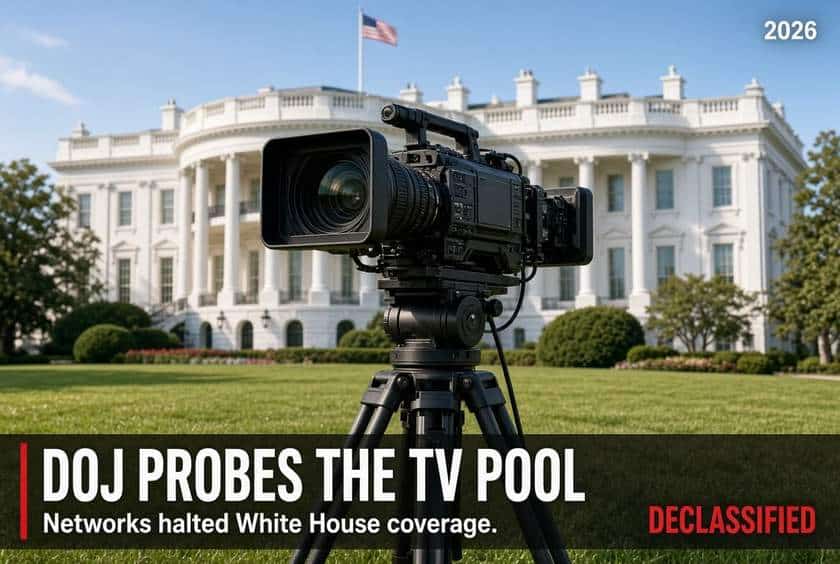
WASHINGTON — The Justice Department’s Antitrust Division is investigating ABC, CBS, CNN, Fox News and NBC over their decision last month to stop providing pooled television coverage of President Trump. “Group boycotts among commercial competitors can violate the Sherman Act,” department spokesperson Emily Covington said in a statement Saturday. The New York Times first reported the probe.
The department sent civil investigative demands on Friday, a Justice Department official told NBC News. Two people with knowledge of the matter told CNN that lawyers for some of the networks received demands that day for documents about the pool, including how it was formed and how it has operated recently. ABC said it had not been notified but expected to be, according to NBC News and Deadline.
The five networks declined to comment or did not respond on Saturday. The White House did not immediately respond to NBC’s request for comment.
Four days without a TV pool
The probe concerns a stretch in late September. On September 18, Trump announced on Truth Social that he was “banning” CNN, MS NOW and Politico from the White House. The three outlets say their reporters were turned away and had their hard passes deactivated that weekend, according to the court order that later restored them. CNN was due to serve as the primary TV pooler on Monday, September 21, but the White House schedule released the night before no longer listed it, Deadline reported.
The primary pool rotates among the five networks. They share its costs and take turns supplying video of the president to one another and to other outlets in places too small for the full press corps, such as the Oval Office and Air Force One. CNN’s lawsuit says it pays 20 percent of the costs and that more than 1,000 local stations receive the pool feed through it.
That Monday, the pool’s chair, Fox News Washington bureau chief Bryan Boughton, emailed the other networks that the pool would stop covering events designated as pool coverage of the president, because the White House was preventing CNN from doing its assigned turn. “There will be no replacement pool put in place,” he wrote, according to Variety, which cited CNN’s Kaitlan Collins. Deadline published the same email. The five networks said in a joint statement that “the public has a vital interest in receiving accurate, independent information about its government.”
The suspension lasted about four days, according to Deadline. CNN described it as several days. It overlapped with the state visit of Chinese President Xi Jinping, according to Deadline and CBS News, and Deadline reported that there was much less video of the ceremonies as a result. Print, photo and radio pool coverage continued, as did the secondary TV pool, Deadline reported at the time.
On September 24, U.S. District Judge Timothy Kelly ordered the White House to restore the three outlets’ credentials, and network pool coverage resumed. The networks are deciding coverage day by day and have agreed not to fill in for CNN on days the administration blocks it, NPR reported. The White House has kept CNN and Politico out of the Oval Office and off Air Force One, according to CBS News.
What the government told Judge Kelly about the pool
The Justice Department is also defending the ban in Kelly’s courtroom, and its filings there address the pool directly. In an October 2 brief opposing a preliminary injunction, department lawyers argued that CNN has no constitutional right to take part in the primary network pool. “The entire point of a pool is that all participants receive the information provided equally,” they wrote. Any harm to the other networks, the brief said, was “self-inflicted,” since those outlets aren’t parties to the case.
The White House’s stated reason for the ban rests on secrecy. Letters sent to the three outlets on September 22 said they had violated standards of “professionalism and decorum,” including by “publishing sensitive or classified information.” CBS News reported that the letters cited stories about the White House ballroom, the war with Iran and the Republican midterm convention.
Kelly found that the record didn’t back that up, at least so far. His order says the government offered “no declarations or other support,” classified or unclassified, explaining how any of the stories damaged national security. Its two declarants were senior Defense Department officials with no direct knowledge of how reporters work in the White House, he wrote, and in most cases the reporters who wrote the cited stories didn’t hold hard passes. He granted the restraining order on due process grounds, applying two D.C. Circuit rulings, Sherrill v. Knight (1977) and Karem v. Trump (2020), which hold that a White House hard pass can’t be pulled without due process.
The restraining order was set to run until October 8, the day Kelly heard arguments on a longer-term injunction. He extended it through Tuesday, October 13, to give himself time to decide. He is expected to rule by then, according to NPR and Deadline.
When a boycott is speech and when it’s restraint of trade
A civil investigative demand comes before any lawsuit. Federal law lets the attorney general or the head of the Antitrust Division serve one on anyone believed to hold material relevant to a civil antitrust investigation, and it can require documents, written answers or oral testimony. No case has been filed. The department’s statement describes the inquiry as an investigation to determine whether the networks broke the law.
News organizations have lost antitrust cases before. In Associated Press v. United States (1945), the Supreme Court upheld a Sherman Act judgment against AP membership rules that let newspapers keep their competitors from joining. Justice Hugo Black wrote that the First Amendment gives no immunity to “a combination to restrain trade in news and views.”
Boycotts have landed on both sides of the line. In NAACP v. Claiborne Hardware (1982), the Court held that the nonviolent parts of a civil rights boycott of white merchants in Claiborne County, Mississippi, were protected by the First Amendment. Eight years later, in FTC v. Superior Court Trial Lawyers Association, it ruled that Claiborne did not shield a group of lawyers who stopped taking court appointments in Washington until the city raised their pay, because that boycott’s aim was economic advantage for the people taking part.
Jonathan Kanter, who ran the Antitrust Division under President Biden, told CNN that any antitrust claim would run into Supreme Court precedent protecting civil rights-era boycotts as speech. “It’s literally freedom of speech,” he said.
Bruce Brown, president of the Reporters Committee for Freedom of the Press, said the investigation “appears to be a pretext for seeking records from the networks,” according to Deadline. His group, joined by the White House Correspondents’ Association and dozens of news organizations, filed a friend-of-the-court brief supporting the banned outlets in Kelly’s court. CNN and Deadline both reported that Trump ally Laura Loomer had publicly urged an antitrust case against the networks last month.
An antitrust demand aimed at a media group has been blocked before. In August 2025, U.S. District Judge Sparkle Sooknanan granted Media Matters for America a preliminary injunction against a Federal Trade Commission civil investigative demand, issued in an inquiry into advertiser boycotts of X. She found the demand was likely retaliation for the group’s protected speech.
Kelly’s ruling on the preliminary injunction is due by Tuesday, when the restraining order expires. Our Opinion section’s earlier take on the ban is A Press Ban in Search of a Reason.
Primary sources: Temporary restraining order, Cable News Network, Inc. v. Trump, No. 26-cv-3287 (D.D.C. Sept. 24, 2026) and the case docket.
Sources
- Judge Timothy J. Kelly, Temporary Restraining Order, Cable News Network, Inc. v. Trump, No. 1:26-cv-03287 (D.D.C. Sept. 24, 2026), ECF No. 24. Used for: the Sept. 18 announcement, the outlets’ account of the weekend, the Sept. 22 letters, the national security findings and the due process grounds.
- Docket, Cable News Network, Inc. v. Trump, via CourtListener. Used for: the Oct. 8 hearing, the extension of the order through Oct. 13 and the Reporters Committee’s amicus filings.
- Defendants’ opposition to motion for preliminary injunction, ECF No. 43 (Oct. 2, 2026), p. 24. Used for: the government’s arguments about the network pool.
- Defendants’ opposition to motion for temporary restraining order, ECF No. 16 (Sept. 22, 2026). Used for: the wording of the White House letters.
- Complaint, ECF No. 1 (Sept. 21, 2026). Used for: how the network pool works, CNN’s cost share and the local stations’ feed.
- 15 U.S.C. § 1312, civil investigative demands (Cornell LII). Used for: what a civil investigative demand is and who can issue one.
- Associated Press v. United States, 326 U.S. 1 (1945), NAACP v. Claiborne Hardware Co., 458 U.S. 886 (1982) and FTC v. Superior Court Trial Lawyers Ass’n, 493 U.S. 411 (1990). Used for: the Supreme Court precedents.
- NBC News, “Justice Department investigating major TV networks over suspending pool coverage of Trump” (Oct. 10, 2026). Used for: the DOJ statement, the Friday demands and the networks’ responses.
- CNN, “Trump’s DOJ probes major TV networks over response to White House ban of CNN” (Oct. 10, 2026). Used for: the scope of the document demands, the length of the suspension, Kanter’s comments and Loomer.
- Deadline, “DOJ Launches Investigation Of Networks For Suspending TV Pool Amid Trump’s Ban On CNN” (Oct. 10, 2026). Used for: the length of the suspension, the Xi visit, ABC’s response, Brown’s statement, Loomer, the expected ruling and the Media Matters case.
- CBS News, “Justice Department investigating TV networks over suspension of press pool after Trump media ban” (Oct. 10, 2026). Used for: the stories cited in the letters, the Xi visit and the continuing Oval Office and Air Force One restrictions.
- NPR via OPB, “Justice Department investigates TV networks, citing possible anti-trust violations” (Oct. 11, 2026). Used for: the networks’ day-by-day arrangement and the expected ruling.
- Reuters, “Justice Department probes TV networks over Trump pool boycott” (Oct. 10, 2026) and The Associated Press via FOX 5 Atlanta (Oct. 11, 2026). Used for: confirming the DOJ statement and the resumption of pool coverage.
- Variety, “Major TV Networks Suspend White House Pool Coverage of Trump in Protest of His CNN Ban” (Sept. 21, 2026) and Deadline, “Networks Halt TV Pool Coverage Of Trump In Protest Of President’s Ban On CNN” (Sept. 21, 2026). Used for: the Sept. 21 schedule change, Boughton’s email, the joint statement and the pools that kept working.
- Bloomberg, “FTC Reined in by Judge for Retaliating Against Media Group” (Aug. 15, 2025). Used for: the Media Matters ruling.