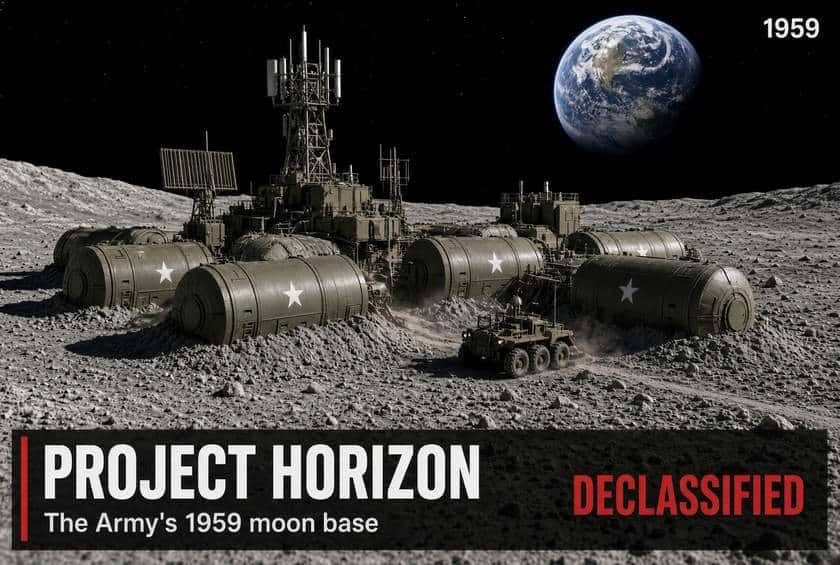
Project Horizon was a 1959 U.S. Army feasibility study for a permanent, manned military outpost on the Moon. Prepared by the Army Ballistic Missile Agency (ABMA) at Redstone Arsenal, Alabama, it proposed landing two men on the lunar surface in April 1965 and housing a garrison of 12 there by November 1966, at an estimated cost of $6 billion over eight and a half years (Project Horizon Report, Vol. I, pp. 7-8). The proposal went no further than the study.
The March 1959 tasking from Lt. Gen. Trudeau
The study was ordered by Lt. Gen. Arthur G. Trudeau, the Army’s Chief of Research and Development, in a letter to the Chief of Ordnance dated March 20, 1959 (Trudeau letter, Vol. I front matter). Trudeau wrote that he considered the “expeditious development” of a lunar outpost “to be of critical importance to the U.S. Army of the future,” and that the Army Chief of Staff had given the idea an “enthusiastic endorsement.” He also wrote that no additional money was available, so the study had to be paid for from funds the Chief of Ordnance already held (Trudeau letter, para. 3-4).
The tasking restricted circulation. No contact with agencies outside the Army was to be made until the Department of Defense had seen the preliminary results, and “no public release will be made concerning this project” (Trudeau letter, para. 4).
Responsibility passed to the Army Ordnance Missile Command and then to ABMA’s Future Projects Design Branch, joined by representatives of all seven Army technical services (Vol. I, pp. 1, 5). According to the Army’s Space and Missile Defense Command historian, Wernher von Braun appointed Heinz-Hermann Koelle to lead the work, and the team published its multi-volume report on June 8, 1959 (Lang, 2017).
The stated requirement
An attached draft requirement stated the case directly: “There is a requirement for a manned military outpost on the moon.” The outpost was to “develop and protect potential United States interests on the moon,” to develop moon-based surveillance of the Earth and space and communications relay, and to serve as a base for exploration and “for military operations on the moon if required” (Draft Requirement, para. 1).
The requirement speculated further. It said “moon-based weapons systems against earth or space targets may prove to be feasible and desirable” and that military operations on the Moon would be difficult for an enemy to counter. It anticipated a unified space command, under which the portion of space “encompassing the earth and the moon, will be considered a military theater” (Draft Requirement, paras. 3-4).
The justification rested on timing. The report cited Soviet broadcasts announcing that Soviet citizens would celebrate the 50th anniversary of the October Revolution, in 1967, on the Moon, and stated that the U.S. intelligence community agreed the Soviet Union might accomplish a manned landing “at any time after 1965” (Vol. I, p. 3). The draft requirement warned that a Soviet base built first might lead Moscow to “claim the moon or critical areas thereof” and to portray a later American outpost as a hostile act (Draft Requirement, para. 5, “Degree of Urgency”). The report’s first conclusion was that “it is imperative for the United States to establish a lunar outpost at the earliest practicable date” (Vol. I, p. 4).
The plan and its schedule
The plan relied on the Saturn I rocket, then in development under an Advanced Research Projects Agency order, and a proposed successor, the Saturn II. The report assumed the Saturn I would be fully operational by October 1963 (Vol. I, p. 7). Its schedule ran as follows (Vol. I, pp. 7-10):
| Date | Planned event |
|---|---|
| January 1965 | Cargo deliveries to the lunar surface begin |
| April 1965 | First manned landing, by two men, who would stay to verify the site and the cargo |
| July 1965 | Construction crew of nine arrives |
| November 1966 | Outpost ready for occupancy, manned by a task force of 12 |
| December 1966-1967 | First operational year, with 64 more launches |
The buildup called for 61 Saturn I and 88 Saturn II launches through November 1966, an average of 5.3 a month, delivering about 490,000 pounds of cargo to the Moon (Vol. I, p. 7). By the end of 1967, by the report’s count, 229 Saturn launches would have put 252 people into Earth orbit, 42 of whom would have gone on to the Moon and 26 returned; booster recovery would reduce the number of Saturn boosters needed to 73 (Vol. I, transportation section). The Army history describes the construction phase as 75 Saturn II launches carrying 245 tons of material (Lang, 2017). The 245 tons matches the report’s 490,000 pounds. The launch count does not match Volume I’s figures.
The outpost itself was to be built from buried cylindrical metal tanks 10 feet in diameter and 20 feet long, covered with lunar material. Two nuclear reactors would power the construction camp, and two more would be added for the completed base. Empty cargo and propellant containers would store bulk supplies, “weapons,” and oxygen and nitrogen. The construction quarters would later become biological and physical science laboratories (Vol. I, pp. 9-10). The report placed the likely site within 20 degrees of latitude and longitude of the Moon’s optical center, pending a mapping program (Vol. I, p. 8).
The $6 billion total averaged about $700 million a year, which the report put at less than 2 percent of the annual defense budget (Vol. I, p. 8).
Transfer to NASA and classification history
As responsibility for space programs shifted to the National Aeronautics and Space Administration, officials had the report revised for a “strictly civilian mission,” according to the Army history. On March 25, 1960, ABMA’s commander, Maj. Gen. John B. Medaris, was told that the Secretary of the Army had sent the study to the Secretary of Defense, who forwarded it to NASA “for such use as may be desired.” Project Horizon did not proceed beyond the feasibility study (Lang, 2017).
The report’s chapters carry Secret markings, and individual paragraphs of the tasking letter are marked Secret or Confidential. A stamp on the released copy shows the Trudeau letter was regraded unclassified by authority dated September 21, 1961 (Trudeau letter). Volume I is titled “Summary and Supporting Considerations.” A second volume, “Technical Considerations and Plans,” held the detailed engineering, fiscal-year funding breakdown, and legal analysis (Vol. I, p. 5). The copy cited here is Volume I only.
The first manned lunar landing, NASA’s Apollo 11, took place on July 20, 1969 (NASA, Apollo 11 mission page). No permanent outpost on the Moon was built.
Sources
- U.S. Army, “Project Horizon: A U.S. Army Study for the Establishment of a Lunar Outpost,” Vol. I, “Summary and Supporting Considerations” (June 1959), with Lt. Gen. Arthur G. Trudeau’s letter of March 20, 1959 and the draft requirement. Copy posted by The Black Vault (PDF, 58 pp.). Used for: the tasking, requirement, justification, schedule, launch and cargo figures, outpost design, cost and classification markings.
- Sharon Watkins Lang, “SMDC History: Project Horizon: ABMA explores a lunar outpost,” U.S. Army Space and Missile Defense Command (June 8, 2017). Used for: the report’s publication date, Koelle and von Braun’s roles, the civilian revision, the March 25, 1960 transfer to NASA, and the Army’s launch figures.
- NASA, “Apollo 11” mission page. Used for: the date of the first manned lunar landing.