OPINION
You ever notice how the reason for something tends to show up after the something? A kid breaks a lamp, and a few minutes later you learn there was a very serious wasp. Nobody saw the wasp. But by dinnertime the wasp has become the whole story.
Which brings us to the White House press ban.
Friday: no reason
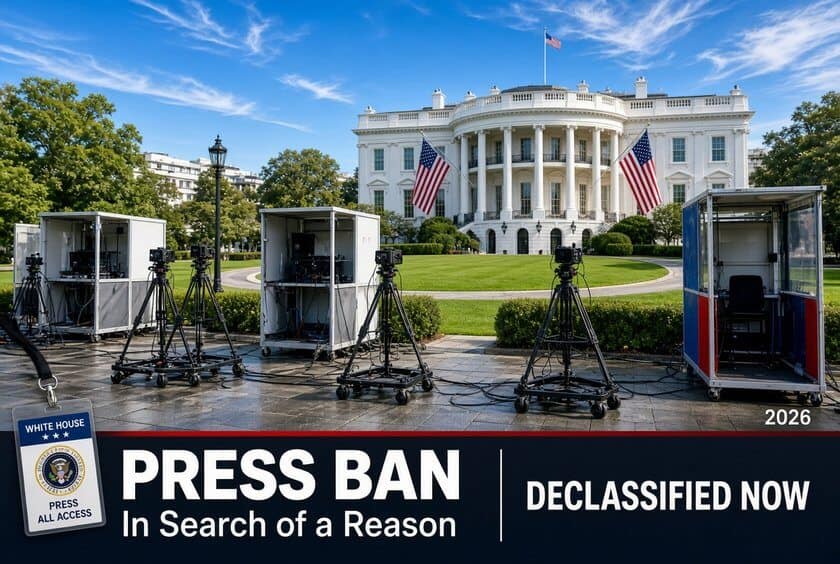
On Friday, September 18, President Trump announced that CNN, MS NOW and Politico were barred from the White House. Asked why then, he said there was no particular reason for the timing and that the decision wasn’t about any specific story. It was about roughly two years of coverage he considers unfair. The outlets, he told reporters, purposely write negative news. On Saturday, their reporters — people holding permanent press passes — were turned away at the gate and had their badges deactivated or taken.
That is at least an honest reason, as reasons go. A president doesn’t like how he’s being covered, so he stops letting those reporters in. Plenty of people have felt that way about the news. Most of them don’t own the building.
Monday and Tuesday: national security
On Monday the three outlets sued. That morning the president posted that fake news “is a threat to our National Security.” Late Tuesday, the Justice Department filed its defense, and the reason had grown up considerably. The outlets, it said, had failed to maintain the standards expected of people with White House access, including by publishing sensitive or classified information. Access to the White House, the department wrote, “is a privilege — not a right.” That night the White House sent each outlet a letter listing stories it objected to.
According to NPR, those stories covered a variety of subjects: plans for a “top secret” bunker under the East Wing ballroom, talks with Iran, and whether the vibes at the recent Republican convention in Dallas were “very bad.” I had not previously understood convention vibes to be a matter for the Joint Chiefs.
The outlets’ lawyer, Ted Boutrous, told the court that only one of the CNN stories cited was written by a reporter who actually held a permanent White House pass — the bunker story — and that her pass was renewed over the summer, months after that story ran. He called the rest “garden variety reporting.” The Justice Department also filed sworn statements from Pentagon officials saying leaks slowed after the Pentagon restricted reporters last year, and that the same would happen here.
Judge Timothy Kelly, a Trump appointee who heard the Jim Acosta press-pass case in 2018, held a 45-minute hearing Wednesday. He said it did not appear the White House had given the reporters the due process that court precedent requires before pulling a permanent pass. He also pressed the outlets on whether a national security reason could ever justify cutting off a reporter. He has not ruled.
The other side
Here is the strongest case for the White House, and it isn’t nothing. The White House is not a public park; presidents have always decided who gets in, and an appeals court has already let this administration keep the Associated Press out of restricted spaces like the Oval Office and Air Force One.
A bunker under the president’s house is exactly the kind of thing a government might reasonably want kept quiet. The government’s own classification rules list the security of the president among the reasons information can stay secret for decades, and on September 11 the panel that decides classification appeals kept that category of information redacted in the 9/11 Commission records it released.
The Pentagon officials’ sworn statements say restricting reporters has reduced leaks. None of that is frivolous, and it is fair to note the outlets have been given until 5 p.m. Friday to contest the decision. The trouble is the order of events. The same appeals court said the White House can’t shut journalists out of spaces generally open to the press because of their viewpoint — and on Friday the president described his reason in terms of the coverage itself, before anyone had mentioned national security at all.
So we have a ban that, on Friday, had no reason. By Monday it had a reason. By Tuesday it had a legal brief, a stack of letters and two sworn statements from the Pentagon. By 5 p.m. Friday, the reporters may finally get to argue with it.
I don’t know yet how the judge will rule. But I do know that when the explanation arrives four days after the decision, it’s worth asking which one came first. Usually it’s the lamp.
Sources:
- NPR, “CNN, MS NOW and Politico sue Trump after being barred from White House,” David Folkenflik, Sept. 21, 2026 (link) — Trump’s Friday remarks and Monday Truth Social post; ban on permanent pass holders
- CBS News, “CNN, MS NOW and Politico sue to restore White House access,” updated Sept. 23, 2026 (link) — ban timeline, Trump’s “no reason” remarks, Justice Department filing and quotes, Sept. 25 deadline, Pentagon declarations, AP appeals ruling
- NPR, “Judge considers restoring journalists’ access to White House after Trump’s ban,” Juliana Kim, Sept. 23, 2026 (link) — hearing, stories cited in the White House letters, Trump’s Friday quote
- CNN, “Key moments from hearing on White House ban of CNN, MS NOW and Politico,” Tierney Sneed and Hannah Rabinowitz, Sept. 23, 2026 (link) — Judge Kelly’s remarks, the hard-pass reporter and badge renewal, Boutrous’s arguments
- Information Security Oversight Office, “ISCAP Declassification of Records Relating to 9/11,” Sept. 11, 2026 (link) — information withheld to protect the security of the president and other protectees