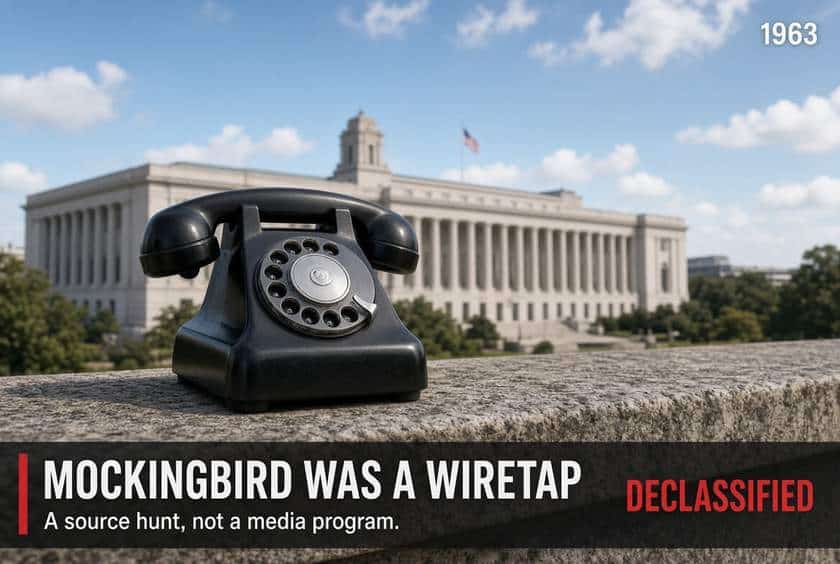
For three months, CIA security officers listened around the clock to the home and office phones of two Washington columnists, Robert S. Allen and Paul J. Scott. The agency’s own summary of the operation says it identified the people talking to them: 12 senators, six members of Congress, a White House staff member, people in the Vice President’s office and an assistant attorney general. The CIA called it Project Mockingbird.
Mention “Mockingbird” online today and you’ll get a different story. “Operation Mockingbird,” in its popular form, was a sweeping Cold War program in which the CIA recruited editors and reporters and steered what Americans read. The name still comes up. Director of National Intelligence Tulsi Gabbard was asked in a July 2025 interview whether “this operation” was still going on. She answered that people in the intelligence community “weaponize intelligence by leaking it to their friends within the mainstream media,” according to Snopes’ transcript.
The documented Mockingbird ran the other way, with the CIA tapping reporters’ phones to find out who was feeding them.
What the Family Jewels say
Project Mockingbird appears on the Office of Security’s list in the “Family Jewels,” the 1973 compilation of questionable CIA activities that the agency released in 2007. The entry is short. It says the office “installed telephone taps on two Washington-based newsmen who were suspected of disclosing classified information obtained from a variety of governmental and congressional sources,” from March 12 to June 15, 1963.
A one-page summary later in the file fills in the chain of approval. The columnists had been “frequently quoting” classified CIA material, “including Top Secret and Special Intelligence.” Three lines were tapped, one at the office the two men shared and one at each of their homes. A telephone company official connected them as a personal favor to the CIA’s Director of Security, Col. Sheffield Edwards. Edwards’s authority came from Director of Central Intelligence John McCone. McCone, the summary says, acted “in coordination with” Attorney General Robert Kennedy, Defense Secretary Robert McNamara and the head of the Defense Intelligence Agency, Gen. Joseph Carroll.
Inside the CIA, only three officials outside the Office of Security are recorded as knowing about it: the deputy director, the inspector general and the general counsel.
By the agency’s count, the taps worked. Over the life of the operation the columnists took information from 13 other newsmen (12 identified), 12 senators and six members of Congress (all identified), 21 congressional staff members (11 identified) and 16 government employees. The summary adds that the two men “actually received more classified and official data than they could use.” They passed some of it to other reporters, so many leaks that ran under other bylines started with their sources.
The CIA’s records disagree on the year
The Family Jewels date the taps to 1963. A separate CIA summary of the operation, approved for release in January 2020 and posted by The Black Vault after a FOIA request, puts it a year earlier.
That memo says a routine review of the columnists’ daily syndicated column “in early 1962” showed classified material, sometimes code word material, behind “a high percentage of their columns.” The Director of Security got his orders from the DCI “in March 1962.” The memo then describes overheard conversations it dates to mid-March and May 1962, and attaches a list of the newsmen’s contacts headed 1962. It says the taps were stopped to coincide with the retirement of the Director of Security.
McCone became director in November 1961, so either year is possible. The two CIA accounts can’t both be right, and the released records we read don’t resolve it.
The 2020 memo also explains why it was Scott the officers came to focus on. Scott gathered most of the sensitive material, “in highly accurate form,” and left it for Allen to rewrite. Allen’s rewrites garbled it, which the memo’s author first blamed on “Col. Allen’s regular state of intoxication” before giving another reason that remains redacted. The sources listed in the memo run from “The Speaker of the House” to “a priest.”
The project failed at its stated goal. “MOCKINGBIRD was not successful during its three months of operation,” the memo says, in identifying the columnists’ source or sources inside the CIA.
Where “Operation Mockingbird” came from
The media-control version of Mockingbird first appeared in “Katharine the Great,” Deborah Davis’s 1979 unauthorized biography of Washington Post publisher Katharine Graham, according to Snopes. We found no CIA document that uses the name for a program to influence the American press.
That doesn’t mean the CIA left the press alone. The Senate’s Church Committee examined exactly that question in its 1976 final report, and its findings are on the record.
Until February 1976, the report says, the CIA “maintained covert relationships with about 50 American journalists or employees of U.S. media organizations.” Those Americans were part of a network of several hundred people around the world who gathered intelligence for the agency and at times tried “to influence foreign opinion through the use of covert propaganda.” More than a dozen U.S. news organizations and publishing houses had provided cover for CIA officers abroad, a few of them without knowing it.
The report’s own count wobbles. The same book refers to “about 50” and “approximately 50” relationships in its main text, and “more than 50” later on. Either way, the committee recorded that fewer than half would end under the new rules George H.W. Bush announced as CIA director in February 1976. It noted that his ban covered accredited correspondents and not freelancers or other “unaccredited” Americans working for U.S. media.
The committee’s stated worries were twofold. One was “fallout,” propaganda placed in the foreign press that found its way back to American readers. The other was what covert relationships did to the credibility of every American reporter abroad. In 1977, Carl Bernstein reported in Rolling Stone that more than 400 American journalists had secretly carried out assignments for the CIA over 25 years, citing documents on file at CIA headquarters.
Primary source: CIA, “Family Jewels,” 1973, released 2007 (MORI DocID 1451843), pp. 4 and 20. Full context: CIA FOIA release F-2021-00660, including the Project Mockingbird summary (C02353962, approved for release Jan. 14, 2020) and Church Committee Final Report, Book I, pp. 191-198.
Sources
- CIA, “Family Jewels” (1973; released June 2007), National Security Archive copy. Used for: the Project Mockingbird entry, dates, approval chain, witting officials and the tally of the newsmen’s sources.
- CIA FOIA release F-2021-00660, via The Black Vault (January 2021). Used for: the CIA Project Mockingbird summary memo naming Allen and Scott, its 1962 dates, Scott’s role and the operation’s failure to find the CIA source.
- The Black Vault, “Project Mockingbird / Operation Mockingbird”. Used for: the history of the CIA releases.
- U.S. Senate Select Committee to Study Governmental Operations with Respect to Intelligence Activities, Final Report, Book I, “Foreign and Military Intelligence” (April 1976). Used for: the CIA’s relationships with U.S. journalists, the Bush policy, the cover arrangements and the “fallout” concern.
- Snopes, “Examining claims Tulsi Gabbard said alleged CIA plot ‘Operation Mockingbird’ never ended” (Aug. 7, 2025). Used for: Gabbard’s interview remarks and the origin of the “Operation Mockingbird” name in Davis’s book.
- Carl Bernstein, “The CIA and the Media,” Rolling Stone (Oct. 20, 1977), with Rolling Stone’s Sept. 1977 press release, Internet Archive. Used for: Bernstein’s 400-journalist figure.