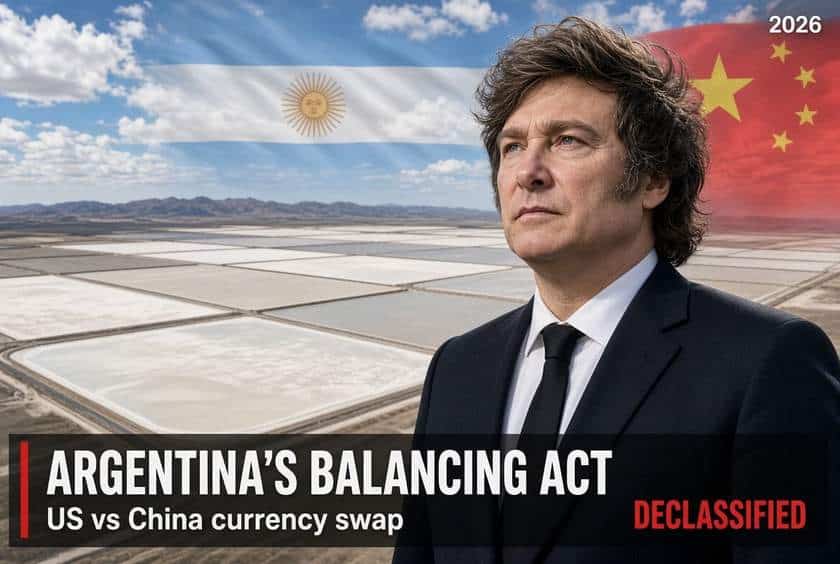
Argentina’s economy minister, Luis Caputo, told investors in October that if the country can’t refinance its dollar bonds at home next year, “we could use the China swap,” the Buenos Aires Times reported, citing Bloomberg. He was referring to a credit line from China’s central bank worth about US$19 billion, the same line Washington spent much of 2025 pressing President Javier Milei to wind down. In the same interview, after a JPMorgan investor event at the IMF and World Bank meetings in Bangkok, Caputo said the US$20 billion swap line with the U.S. Treasury was still an option too.
Six days later, on Oct. 20, U.S. Ambassador Peter Lamelas said American financial support would continue past the 2027 election only if Argentina kept heading “to the right, not to the left,” according to the Buenos Aires Times, which credited AFP and Perfil.
Reports that Argentina is breaking from the United States overstate it.
Milei has kept both credit lines and is courting both governments’ money. This year he paid down almost everything Argentina had borrowed from China, renewed the Chinese line for longer than ever, and approved Chinese lithium projects his U.S. allies have objected to.
What a currency swap is, and why Washington objects
A swap line lets one central bank exchange its currency for another’s, giving it extra reserves to defend its own money or pay foreign debts. Argentina first signed one with the People’s Bank of China in 2009. The framework is now worth 130 billion yuan. In early 2023, under Milei’s predecessor, Argentina activated a 35-billion-yuan portion (about US$5 billion) that it could draw on without asking Beijing first.
U.S. officials saw it as leverage for Beijing. In April 2025, U.S. envoy Mauricio Claver-Carone called the arrangement “extortionate” and tied U.S. support to Milei distancing himself from China, the South China Morning Post reported. Treasury Secretary Scott Bessent said Milei was committed to getting China out of Argentina, though, as the Buenos Aires Times noted, he never said the swap itself had to end.
Argentina paid China back, then renewed the line
The drawn balance shrank fast. Infobae, citing Argentine central bank figures, reported the amounts below.
| Date | Drawn on China swap | Note |
|---|---|---|
| Early 2023 | 35 billion yuan activated (about US$5 billion) | Portion usable without prior approval |
| End of 2024 | 21 billion yuan in use | Milei’s first full year |
| Dec. 31, 2025 | 7 billion yuan (about US$1.03 billion) | After a year of repayments |
| Jan. 14, 2026 | US$679 million | About 90% repaid |
Then, on Aug. 5, one day before the old agreement expired, the central bank renewed the full 130-billion-yuan framework for five years instead of the usual three, Infobae and El Cronista reported. The activated portion stayed in force. Central bank president Santiago Bausili had said earlier in the year that there was no plan to eliminate it.
Argentina treated the U.S. line much the same way. The Treasury set it up in October 2025 through its Exchange Stabilization Fund, and Argentina drew US$2.5 billion. Bessent said on Jan. 9 that Argentina had repaid the draw in full, AP reported. Caputo said in October that the U.S. line remains an option.
Washington’s offer runs to 2027
Lamelas made his Oct. 20 comments at an Argentina-Texas Chamber of Commerce meeting in Neuquén, in Argentina’s oil and gas region. He said U.S. support money would be available until 2027 and that the U.S. was evaluating projects that could bring in up to US$20 billion through the Export-Import Bank, the U.S. International Development Finance Corporation and the State Department, the Buenos Aires Times reported. He gave no disbursement schedule. At the same event he warned that Chinese law forces companies to hand sensitive data to the Communist Party.
Chinese money is in the lithium projects
Milei’s flagship investment program, the Large Investment Incentive Regime (known by its Spanish initials, RIGI), offers incentives to big projects. Chinese companies have a stake in several of the lithium projects it has approved or is reviewing, according to Bloomberg Línea and La Política Online, both reporting in August.
| Project | Chinese partner | Investment | RIGI status |
|---|---|---|---|
| Cauchari-Olaroz expansion (Jujuy) | Ganfeng Lithium, with Lithium Argentina and Jujuy’s state company | US$1.17 billion to US$1.24 billion | Approved, June 2026 |
| Tres Quebradas (Catamarca) | Zijin Mining (100%, through Liex) | US$709 million | Approved, July 29, 2026 |
| Pozuelos-Pastos Grandes (Salta) | Ganfeng (67%) | US$3.0 billion | Pending |
| Jama (Jujuy) | CNGR Advanced Material | US$1.15 billion | Under evaluation |
| Litio Ángeles | Tibet Summit | US$726 million | Pending |
Infobae described Zijin’s subsidiary as the first Chinese-owned company to win approval from the program’s review committee. The government also rejected one Chinese bid, Ganfeng’s Mariana project in Salta, because work had started before the company formally applied.
Two different shares get quoted. Bloomberg Línea calculated that projects with Chinese participation account for about 70% of the lithium production capacity that companies have announced for approved and pending projects. It noted that doesn’t mean China owns 70% of those tonnes. A survey by the consultancy China Desk, reported by El Cronista on Oct. 27, put Chinese-linked projects at 72% of the lithium investment submitted to the program.
Trade is tilting toward the U.S.
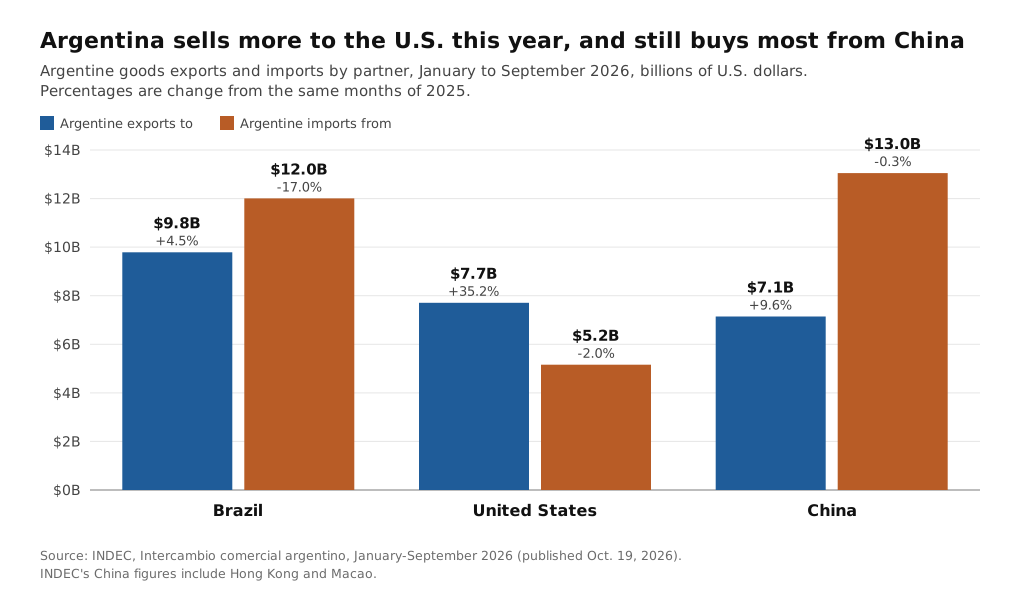
On trade, Argentina has moved the other way. From January through September, Argentina sold US$7.7 billion of goods to the United States, up 35.2% from a year earlier, according to the national statistics agency, INDEC. Sales to China rose 9.6% to US$7.1 billion. The U.S. was Argentina’s second-largest export market after Brazil, ahead of China.
Imports tell a different story. China supplied US$13.0 billion of goods in the same months, 23.3% of everything Argentina bought abroad and more than any other country, the Foreign Ministry’s trade center reported from INDEC data. Imports from the U.S. were US$5.2 billion.
Whether Argentina draws on the Chinese line again depends on its 2027 financing. Caputo paused issuance of the local-law dollar bonds in mid-August, and the country’s risk premium had climbed to about 600 basis points by October from 410 in early July, the Buenos Aires Times reported. Argentina holds a presidential election in 2027, the same year Lamelas said current U.S. support runs out.
The renewal was reported in detail by Infobae, and Caputo’s comments by the Buenos Aires Times. INDEC’s trade data is in its January to September report. For another country weighing U.S. and Chinese money this month, see our piece on Canada’s trade diversification.
Sources
- Buenos Aires Times (Bloomberg), “Argentina eyes tapping China swap to cover 2027 financing needs” (Oct. 14, 2026)
- Buenos Aires Times (AFP, Perfil), “Lamelas: US support beyond 2027 depends on Argentina’s move ‘to the right'” (Oct. 21, 2026)
- Infobae, “El BCRA renovó el swap con el Banco Popular de China por 5 años” (Aug. 5, 2026)
- El Cronista, BCRA renews China swap and extends the term to five years (Aug. 5, 2026)
- Buenos Aires Times (Bloomberg), “Argentina renews US$19-billion China swap for another five years” (Aug. 5, 2026)
- South China Morning Post via The Star, “Milei guts China currency lifeline after Trump ultimatum on financial ties” (May 24, 2026)
- AP, “US treasury secretary says Argentina has repaid its US credit line in a win for Milei” (Jan. 9, 2026)
- Bloomberg Línea, Chinese capital grows in RIGI mining investments (Aug. 18, 2026)
- La Política Online, Caputo grants RIGI to Chinese lithium miners (Aug. 18, 2026)
- Infobae, RIGI approval of US$709 million lithium project in Catamarca (July 29, 2026)
- Reporte Asia, China Desk survey on Chinese share of RIGI lithium investment (Oct. 28, 2026)
- INDEC, Intercambio comercial argentino, January to September 2026 (Oct. 19, 2026)
- Argentine Foreign Ministry, Centro de Economía Internacional, Intercambio Comercial Argentino, January to September 2026