Canada finished free trade talks with the Philippines in Manila on Nov. 14 and said talks with the ASEAN bloc were substantially concluded. Three days later in Shenzhen, Prime Minister Mark Carney and Chinese President Xi Jinping widened a tariff arrangement covering Canadian pork and seafood. Carney told Xi that Canada was “well ahead of schedule” on its goal of raising exports to China by half by the end of the decade, Reuters reported.
The trade figures mostly back him up. From January through September, Canada shipped $208.0 billion of goods to countries other than the United States, up 35% from the same months of 2025, according to Statistics Canada. Those markets took 31.2% of Canadian goods exports, up from 26.8%. The investment figures don’t match. In the first half of 2026, Americans supplied 77% of new foreign direct investment in Canada.
A record set in 2025, and topped this year
The shift started when U.S. tariffs arrived in March 2025. Global Affairs Canada’s annual State of Trade report says exports of goods and services to non-U.S. markets rose 11.1% last year, while exports to the United States fell 3.7%. That pushed the non-U.S. share to 32.8%, the highest since 1981. The goods side alone gained $32.8 billion, which the report calls the largest dollar increase on record.
The monthly goods share peaked in July 2026 at 34.0% (as revised; Statistics Canada first reported 33.7%), when exports to non-U.S. countries reached a record $25.6 billion. It then fell for two months, to 29.8% in September.
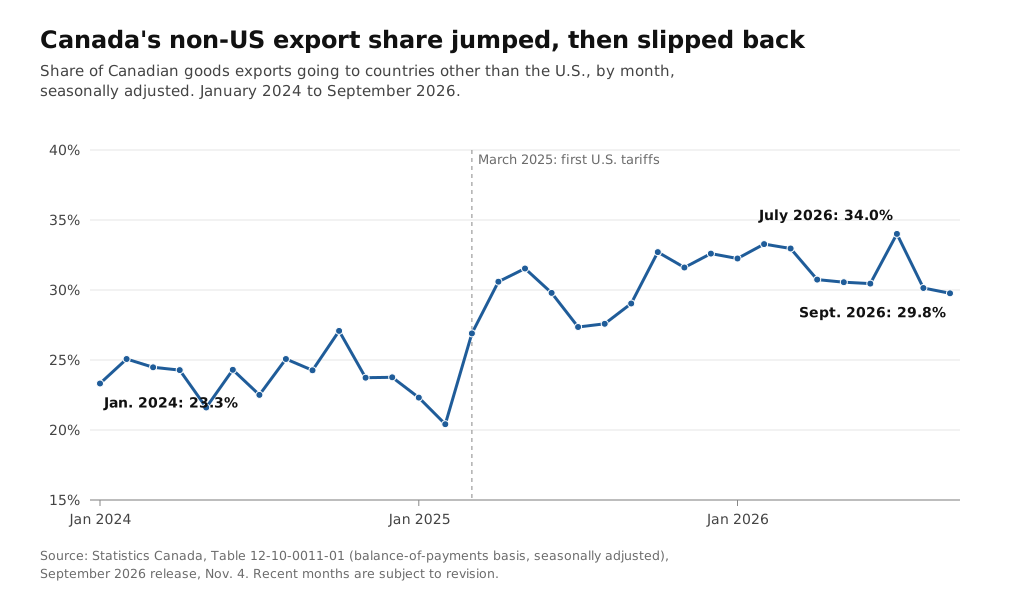
The dip doesn’t mean overseas sales collapsed. In September, Canada still sold about $23.4 billion of goods to non-U.S. markets, against $18.8 billion a year earlier. The share fell mostly because sales to the United States came back. U.S.-bound exports were up 8.9% for the first nine months, and in September they rose on crude oil and gold, Statistics Canada said. The United States still buys about 69% of everything Canada ships.
Much of the growth is gold stored in London
The largest single gain has little to do with new customers. Exports to the United Kingdom rose 50% in 2025, and Global Affairs Canada says gold was responsible for almost all of the increase in goods shipped there. London is one of the world’s largest over-the-counter gold markets and a major storage hub, and its vaults hold more than half of the gold backing exchange-traded funds. When investors get nervous, they buy those funds, the funds buy bullion, and Canadian mines ship it to London vaults.
Prices did most of the work. Canada’s gold exports reached $53.3 billion in 2025, its second-largest export after crude oil. The report says the growth was driven entirely by price, which rose 45.2%, while the volume exported fell 6.3%. Leave out unwrought gold, silver and platinum, the report adds, and exports of metal and mineral products would have fallen by $3.5 billion.
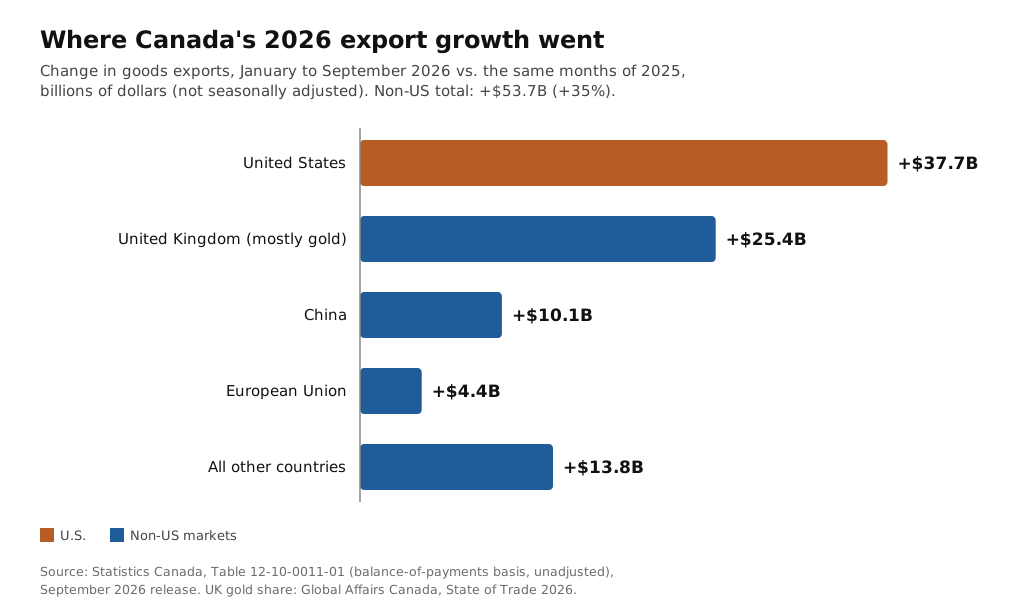
The pattern held in 2026. The U.K. accounted for $25.4 billion of the $53.7 billion rise in non-U.S. exports through September, nearly half.
Oil, canola and aluminum found other buyers
Outside gold, the gains are smaller but look more durable. Goods exports to the European Union rose 23.5% in 2025, a record. Global Affairs Canada traces much of that to crude oil from Newfoundland and Labrador shipped to the Netherlands, Germany, Italy and Spain. It also points to aluminum and canola seed. U.S. tariffs on aluminum and Chinese tariffs on canola cut sales in those two markets, and more went to Europe instead. The report calls that a potential case of trade diversion, meaning goods rerouted around tariffs rather than new demand.
China is the fastest-growing large market this year. Exports there rose 42.8% through September, to $33.8 billion. Reuters reported a 37% rise in Canadian crude shipments to China in 2026. Global Affairs Canada credits the expanded Trans Mountain pipeline to the Pacific coast for higher crude sales to Asia. Liquefied natural gas is new too. Natural Resources Canada counted about 130 LNG tankers sent to Asia between June 2025 and August 2026, carrying roughly 9.7 million tonnes.
Not every market moved the right way. In 2025, goods exports to India fell 26.3% and to Japan 2.7%, by Statistics Canada’s count, and exports to Mexico were flat.
The investment money is still American
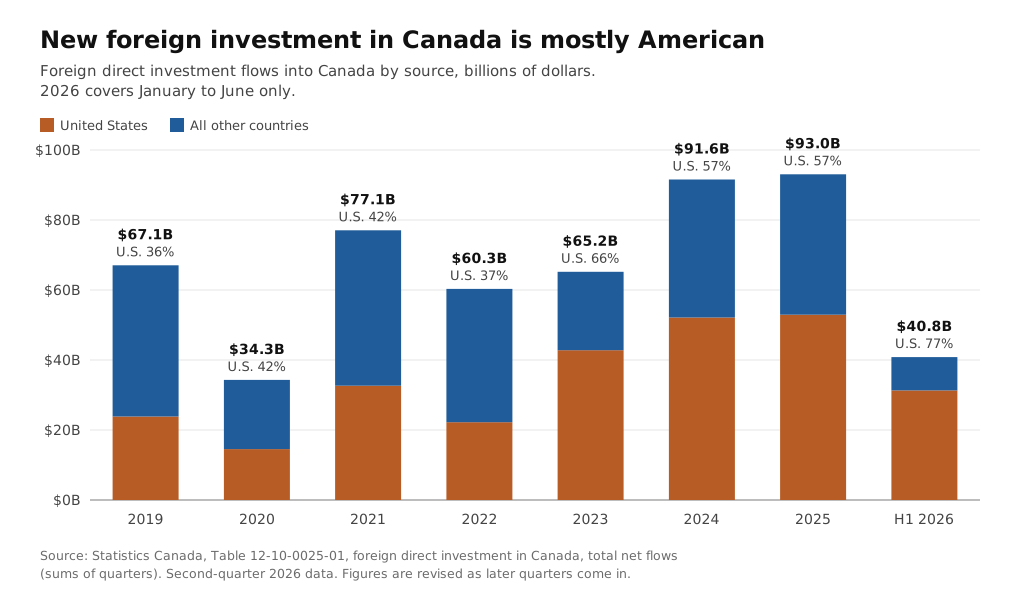
Foreign direct investment into Canada reached $93.0 billion in 2025, according to Statistics Canada, well above the 2015 to 2024 average of $57.8 billion that Global Affairs Canada cites. But U.S. companies supplied $52.9 billion of it, or 57%. In 2019, before the trade fight, Americans supplied about a third.
The first half of 2026 tilted further. Non-U.S. investors put $9.5 billion into Canada, down from $26.6 billion in the first half of 2025. U.S. investors put in $31.3 billion. (Quarterly investment figures are revised often. The Globe and Mail reported a $44.7 billion total for the half in September, against $40.8 billion in Statistics Canada’s current table. Both show more than two-thirds coming from the U.S.)
Where foreign money has poured in is bonds. Non-residents bought $104.0 billion of Canadian federal government bonds from January through July, against $13.8 billion in the same months of 2025, Statistics Canada reported. That’s lending to Ottawa, though, which doesn’t build plants or pipelines.
Canadian money has partly turned away from the United States. Canadian investors sold a record $31.0 billion of U.S. shares in July, mostly large tech stocks, after buying $78.1 billion in the first half of the year. Canadian companies’ direct investment in the U.S. fell 61% in 2025, Global Affairs Canada says, though Statistics Canada’s figures show it recovering to $31.0 billion in the first half of 2026.
The UAE’s $70 billion is waiting on projects
The biggest foreign pledge shows the problem. During Carney’s visit to Abu Dhabi in November 2025, the United Arab Emirates committed about C$70 billion (US$50 billion) to investment in Canada. In July, the Financial Times reported that the Major Projects Office, the federal agency set up to fast-track big projects, had told a UAE delegation in mid-June that Canada had no projects ready for the money. One Canadian official told the paper none of it had been deployed. Former Quebec premier Jean Charest, co-chair of the UAE-Canada Business Council, confirmed the substance: “at this point, we’re not ready,” he told the FT, adding that every investor got the same answer. A UAE official said such investments take time to review. We found no public report of UAE money being deployed since.
Carney’s investment summit in Toronto on Sept. 15 announced “nearly half a trillion dollars in new investment commitments.” Most of that total came from inside Canada. By the prime minister’s own breakdown, Canadian banks committed nearly $325 billion in financing, and Canadian pension funds and insurers about $100 billion.
Deals signed, concluded and still being drafted
Ottawa’s stated goal is to double non-U.S. exports by 2035. Several of the agreements meant to get there exist only on paper. The Philippines and ASEAN agreements are due to be signed in 2027, according to the government’s Nov. 14 announcement, which put Canada-ASEAN trade at $52.5 billion in 2025.
Under the Shenzhen arrangement, China will cut tariffs on about C$400 million of Canadian exports, including frozen pork and seafood, according to Carney’s office, as reported by Reuters. In return, Canada extends for two years its remission of tariffs on certain Chinese steel and aluminum products, which were set to expire at the end of 2026. China’s finance ministry also said the two central banks would revive a currency swap line, dormant since 2017, worth 200 billion yuan (about US$30 billion), with a test draw planned for 2027, the South China Morning Post reported.
With Europe, the shape of the relationship is still being negotiated. At a summit in Montreal on Oct. 29 and 30, Carney and European Commission President Ursula von der Leyen launched what they called an Alliance for the Future, and Carney said Canada wants to become the EU’s first associate member. The Globe and Mail later reported, citing unnamed sources, that the EU had dropped the associate-member label, with Germany the main objector. A Nov. 12 statement from Carney’s office still names it as the goal.
With Washington, there is no deal. Carney met President Trump in Shenzhen this week, and no agreement was announced.
Statistics Canada releases October trade figures on Dec. 8. The trade figures are in Statistics Canada’s Table 12-10-0011-01 and the investment flows in Table 36-10-0025-01. The gold analysis is in Box 1.4.1 of Canada’s State of Trade 2026. For the Shenzhen talks themselves, see our piece on Carney, Trump and Xi.
Sources
- Statistics Canada, Table 12-10-0011-01, international merchandise trade by principal trading partners (September 2026 data)
- Statistics Canada, The Daily, Canadian international merchandise trade, September 2026 (Nov. 4, 2026)
- Statistics Canada, The Daily, Canadian international merchandise trade, July 2026 (Sept. 3, 2026)
- Statistics Canada, Table 36-10-0025-01, flows of direct investment, quarterly
- Statistics Canada, The Daily, Canada’s international transactions in securities, July 2026 (Sept. 17, 2026)
- Global Affairs Canada, Office of the Chief Economist, Canada’s State of Trade 2026
- Financial Times, “Canada tells UAE it is not ready for its C$70bn investment” (July 6, 2026)
- Prime Minister’s Office, remarks at the 2026 Canada Investment Summit (Sept. 15, 2026)
- The Globe and Mail, “Foreign money is flooding into Canada. But a closer look reveals much of it is coming from the U.S.” (Sept. 11, 2026)
- Global Affairs Canada, Philippines and ASEAN free trade negotiations announcement (Nov. 14, 2026)
- Reuters via Business Day, “Canada and China extend trade deals as Xi meets Carney ahead of Apec summit” (Nov. 17, 2026)
- South China Morning Post, “China and Canada agree tariff, currency deal to boost ‘strategic partnership'” (Nov. 17, 2026)
- Natural Resources Canada, energy collaboration with Indo-Pacific countries (September 2026)
- CBC News, Carney says Canada is working to become an associate member of the EU
- The Globe and Mail, Canada and EU commit to “ever-closer association”
- Prime Minister’s Office, Nov. 12, 2026 statement on the European Political Community summit
- Canada’s National Observer, Carney says a U.S. deal is possible but not there yet (Nov. 19, 2026)