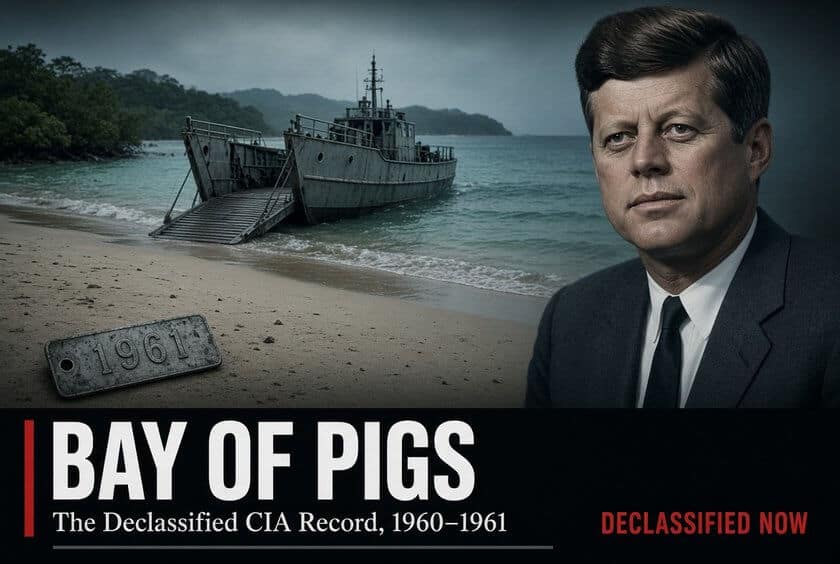
The Bay of Pigs operation was a covert CIA program, planned from 1960 and carried out in April 1961, to overthrow the government of Fidel Castro using a paramilitary force of Cuban exiles. The invasion failed. This entry summarizes the declassified planning papers, post-mortems and White House memoranda that document the operation and its aftermath. Each claim cites the document it is drawn from; full references appear in the Sources section.
Planning, 1960
The first meeting of the CIA’s Branch 4 task force on Cuba was held on March 9, 1960. According to the minutes, J.C. King, chief of the Western Hemisphere Division, told the group that unless Fidel Castro, Raúl Castro and Che Guevara could be removed together, the effort would be long and would succeed only through force [Doc. 1].
A CIA planning paper dated May 16, 1960, “A Program of Covert Action Against the Castro Regime,” set out the original program: a unified Cuban opposition, broadcasting facilities, and the training of paramilitary forces, all to be accomplished while avoiding any appearance of U.S. intervention. President Eisenhower authorized the program the following day. Its proposed budget was $4.4 million; by the time of the invasion, the budget had risen to $45 million [Doc. 2].
Cuban awareness, January 1961
The preparations were known to Cuban intelligence months in advance. A report by Cuba’s Ministry of the Armed Forces dated January 12, 1961, described exile training camps in Guatemala, Nicaragua and Florida. Cuban agents estimated that 48 B-26 aircraft were assigned to the attack, most of them unmarked, and reported nighttime parachute drills and live-fire training [Doc. 3].
Post-mortems, May–October 1961
The first detailed internal post-mortem was written by Col. Jack Hawkins, the operation’s paramilitary chief, and dated May 5, 1961. The 48-page report attributed the failure to poor CIA organization and to political constraints imposed by the Kennedy administration, including the cancellation of D-day airstrikes. Hawkins concluded that Castro could not be removed without the overt use of U.S. force, and recommended against further covert attempts unless accompanied by a military invasion [Doc. 4].
The CIA Inspector General, Lyman Kirkpatrick, produced a far more critical assessment after a six-month investigation. His “Inspector General’s Survey of the Cuban Operation,” dated October 1961, placed responsibility on the Agency itself, citing bad planning, inadequate intelligence, poor staffing, and the misleading of White House officials, including the President. It found that the Agency had no intelligence evidence that Cubans in significant numbers would join the invaders. On secrecy, it concluded: “Plausible denial was a pathetic illusion.” The released version includes a rebuttal prepared by the office of Deputy Director for Plans Richard Bissell [Doc. 8].
The Inspector General’s report was closely held. According to the National Security Archive, Director of Central Intelligence John McCone destroyed most of the 20 existing copies, and CIA Deputy Director Cabell warned in a December 1961 memorandum that the report could be used to attack the Agency as a whole. The report was declassified in the late 1990s following Freedom of Information Act requests by the Archive.
Proposals to reorganize the CIA, May–June 1961
President Kennedy asked White House aide Arthur Schlesinger Jr. to examine British intelligence arrangements for lessons relevant to reorganizing the CIA. Schlesinger’s memorandum of May 18, 1961, “How to Organize an Intelligence Service: The British Example,” identified continuous policy control over the clandestine service as the key feature of the British model, and argued that large-scale covert operations could not be kept secret [Doc. 5].
In a second memorandum, “CIA Reorganization,” dated June 30, 1961, Schlesinger proposed placing the Agency under the State Department and dividing its intelligence and operational functions between two new bodies, which he suggested calling the “Foreign Research Agency” and the “National Information Service.” That memorandum was declassified in full in the March 2025 release of records under the JFK Assassination Records Collection Act [Doc. 6].
The Goodwin–Guevara meeting, August 1961
On August 22, 1961, White House aide Richard Goodwin reported to Kennedy on a meeting with Che Guevara in Montevideo, Uruguay — the first back-channel dialogue between the two governments. According to Goodwin’s memorandum, Guevara said the invasion had been a political victory that allowed the Cuban government to consolidate, and indicated that Cuba sought a “modus vivendi” with the United States, while ruling out any change to its political system [Doc. 7].
The CIA–Mafia plot
A related effort ran in parallel with the invasion planning. A June 24, 1966, memorandum from the CIA’s director of security, Howard Osborn, summarized an operation authorized by Bissell to assassinate Castro through intermediaries in organized crime. Robert Maheu acted as a CIA cutout to approach Johnny Roselli and a figure identified as Sam Gold. The CIA’s Technical Services Division produced six poison pills, which were passed first to Cuban official Juan Orta and later to exile leader Anthony Verona. The memorandum states that the project was cancelled shortly after the Bay of Pigs [Doc. 9]. The National Security Archive notes that the plot was funded from the invasion budget.
Sources
- CIA, Minutes, “First Meeting of Branch 4 Task Force, 9 March 1960,” Secret, March 9, 1960. National Security Archive, Document 1.
- CIA, Planning Paper, “A Program of Covert Action Against the Castro Regime,” Secret Eyes Only, May 16, 1960. Document 2.
- Cuban Ministry of Armed Forces, Intelligence, “Report on Mercenary Camps and Bases in Guatemala, Nicaragua and Florida,” Confidential, January 12, 1961. Document 3.
- CIA, Clandestine Services History, “Record of Paramilitary Action Against the Castro Government of Cuba, 17 March 1960–May 1961,” Secret, May 5, 1961. Document 4.
- White House, Memorandum, “How to Organize an Intelligence Service: The British Example,” Secret, May 18, 1961. Document 5.
- White House, Memorandum, “CIA Reorganization,” Secret, June 30, 1961. Document 6.
- White House, “Memorandum for the President: Conversation with Commandante Ernesto Guevara of Cuba,” Secret, August 22, 1961. Document 7.
- CIA, Report, “Inspector General’s Survey of the Cuban Operation and Associated Documents,” Top Secret, October 1961. Document 8.
- CIA, Memorandum, “Maheu, Robert A.,” Secret Eyes Only, June 24, 1966. Document 9.
- National Security Archive, Briefing Book #920, “Cuba: The Bay of Pigs Invasion 65 Years Later,” ed. Peter Kornbluh, April 16, 2026. Briefing book.