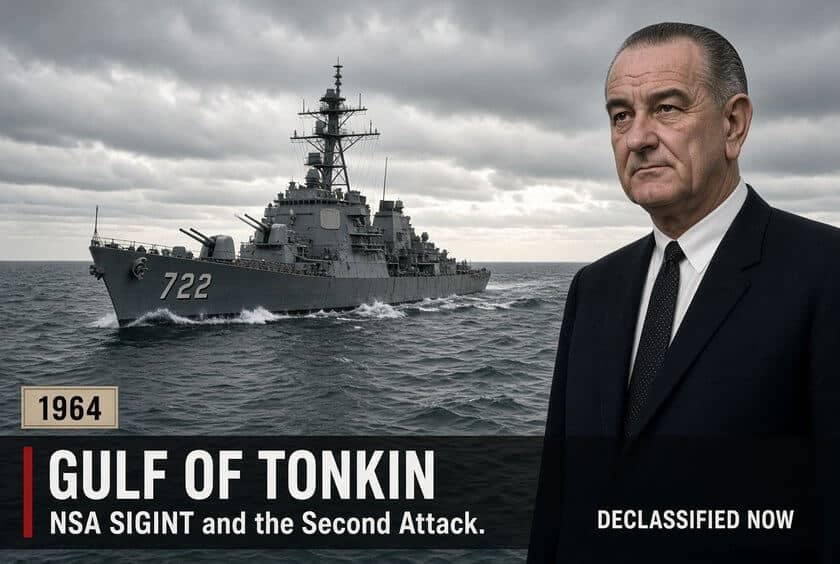
The Gulf of Tonkin incidents of August 2 and 4, 1964 were two reported naval clashes between U.S. destroyers and North Vietnamese torpedo boats off the coast of North Vietnam. The second reported clash was the basis for U.S. retaliatory air strikes and for the Gulf of Tonkin Resolution, which authorized expanded U.S. military action in Southeast Asia. A classified National Security Agency history, declassified in 2005, concluded from signals intelligence (SIGINT) that the second attack did not take place, and that NSA’s post-incident reporting presented the intercept evidence selectively [1].
Background: the Desoto patrol
In the summer of 1964 the destroyer USS Maddox conducted a signals intelligence patrol, code-named Desoto, along the North Vietnamese coast. The patrol commander was Captain John J. Herrick [1]. The NSA history records that North Vietnamese forces had been attacked in the same waters shortly before by South Vietnamese raiding craft, notably on the night of July 30–31, 1964 [1].
2 August 1964
On August 2, three North Vietnamese P-4 torpedo boats attacked the Maddox. The ship had been forewarned by SIGINT [1]. The NSA history treats this engagement as having occurred [1]. Two of the attacking boats were damaged [1]. The destroyer USS Turner Joy then joined the patrol [1].
4 August 1964
On the night of August 4, the Maddox and Turner Joy reported radar and sonar contacts and returned fire during several hours of maneuvering in poor weather [1]. Within an hour of the action, Herrick sent an after-action message stating that the “entire action leaves many doubts” apart from an apparent attempted ambush at the outset [1]. He recommended a thorough daylight air reconnaissance of the area [1]. The NSA history notes a later Pacific command report attributing many reported contacts and torpedo sightings to “freak weather” and “over-eager” sonar operators [1].
President Lyndon B. Johnson ordered retaliatory air strikes, which took place on August 5 [1]. On August 7, 1964, Congress passed the Gulf of Tonkin Resolution by votes of 416–0 in the House and 88–2 in the Senate [3].
What was classified
The detailed SIGINT record of both nights remained classified for four decades. NSA historian Robert J. Hanyok’s study, “Skunks, Bogies, Silent Hounds, and the Flying Fish: The Gulf of Tonkin Mystery, 2–4 August 1964,” was written for the agency’s classified journal Cryptologic Quarterly. The National Security Archive dates its publication to 2001 [1][4].
What was released
In late 2005, following Freedom of Information Act requests and pressure from historians, NSA released Hanyok’s article along with more than 140 formerly classified documents on the incidents. These included histories, chronologies, SIGINT reports and oral history interviews [2][4]. NSA had earlier released selected Gulf of Tonkin intercepts [4].
What the record revealed
Hanyok’s study reported two principal findings [1]:
- No attack on August 4. The SIGINT showed that North Vietnamese naval activity that night consisted of salvage operations on the two boats damaged on August 2, plus limited coastal patrols. The few intercepts read as evidence of an attack contained analytic errors and unexplained translation changes. The most important of them, which the study describes as the administration’s main proof, appears to have combined two unrelated messages into a single translation [1].
- Selective reporting. Nearly 90 percent of the available SIGINT relevant to August 4 was left out of NSA’s post-incident summaries and its final October 1964 report [1]. The agency’s official chronology cited only six of fifty-nine relevant SIGINT products, the six that could be read as showing hostile intent [1]. This chronology later served as NSA’s source book for congressional inquiries [1].
Hanyok wrote that the summaries issued from late August 4 onward were “deliberately skewed” to support the claim of an attack [1]. He also wrote that the notion of pressure from administration officials “simply cannot be supported” on the available evidence. In his account, NSA personnel believed the attack had happened and rationalized away the contrary evidence [1]. The study states that the exact “how” and “why” of the selective handling remain unknown [1].
Sources
- Robert J. Hanyok, “Skunks, Bogies, Silent Hounds, and the Flying Fish: The Gulf of Tonkin Mystery, 2–4 August 1964,” Cryptologic Quarterly, National Security Agency (declassified 2005; archived copy of the nsa.gov PDF).
- History News Network, “Tonkin Gulf Intelligence ‘Skewed,’ New Documents Reveal.”
- National Archives, Milestone Documents: Tonkin Gulf Resolution (1964).
- National Security Archive, Electronic Briefing Book No. 132: The Gulf of Tonkin Incident, 40 Years Later (with December 2005 update).