OPINION
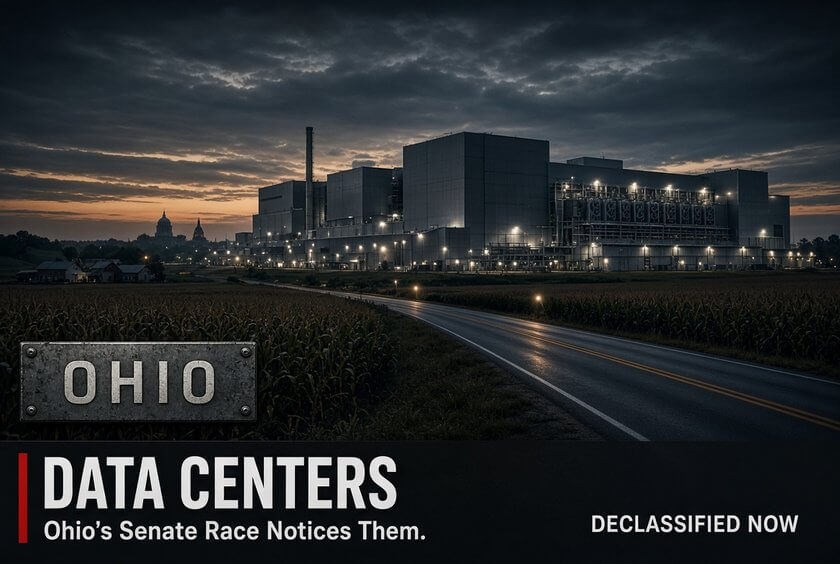
You ever notice that everybody wants their photos backed up, their movies streaming and their chatbot answering questions at two in the morning, and nobody wants the building where any of that happens to be anywhere near their house? It’s the cloud. It’s supposed to be up there somewhere. Nobody said it was going to be down the road.
Ohio’s Senate race has noticed. On September 3, Sen. Sherrod Brown’s campaign ran an ad saying his opponent, Sen. Jon Husted, “led the push to bring data centers to Ohio” and handed out billions of tax dollars to get them here. PolitiFact looked into it this week and rated it Mostly True. So let’s look at the receipts — all of them, from both sides of the aisle.
The push
Husted was Ohio’s lieutenant governor from 2019 to 2025, the years the data center boom really got going. In 2019 he publicly defended a sales-tax exemption for Google’s New Albany data center worth an estimated $43.5 million over 15 years. In 2023 he stood with Gov. Mike DeWine to announce Amazon Web Services’ $7.8 billion investment, and in 2025 he was there again when Amazon raised it to $10 billion. The formal approvals came from the Ohio Tax Credit Authority, not from Husted personally — a distinction his campaign would like you to remember, and one that an expert told PolitiFact is thinner than it sounds, since the authority works as an arm of the administration.
As for the “billions”: the Ohio Chamber of Commerce, not exactly a hostile witness, put state and local tax breaks for data centers at about $2.5 billion from 2017 through 2024. Some of the biggest deals were approved before Husted became lieutenant governor, under Gov. John Kasich — which is worth remembering, and which the ad doesn’t mention.
The bill
Here is my favorite number in the whole race. For 2025, the state forecast that the data center sales-tax exemption would cost about $136 million. According to the Ohio Department of Taxation, it actually cost $1.6 billion — nearly twelve times the estimate. That’s like budgeting $136 for groceries and coming home with a receipt for $1,600, and then being told the eggs were an investment. The legislature voted to end the break in its budget. The governor vetoed that.
The conversion
Now everybody is against it. Husted said in August that new data centers shouldn’t get tax breaks, though he still thinks local communities should decide what gets built, and in July he introduced a bill requiring large electricity users to pay for the grid upgrades they need. Brown, for his part, asked this summer why Ohio would spend tax dollars to lure data centers at all.
Both men arrive at this position with some tech money in their pockets. Federal Election Commission filings show Husted’s campaign has taken $22,000 this cycle from the political action committees of Google, Amazon, Microsoft and Oracle. Fox News, reviewing FEC records, reported that Google’s PAC has given Brown $20,000 over his career, along with more from people who lobby for the company. Neither sum is going to build a server farm. But it does suggest that the industry both candidates are running against has been, in its quiet way, running with both of them.
The voters, meanwhile, made up their minds some time ago. In an NPR/PBS News/Marist poll taken September 14 and 15, 65 percent of registered voters said they oppose building a data center in their own community, and 43 percent opposed it strongly. More than eight in ten Democrats were opposed. Republicans split almost evenly. NBC News and Fox News polls this month found much the same thing, at 69 and 71 percent.
The other side
It’s only fair to say what the data centers bring, because it isn’t nothing. An industry-backed study credited data centers with $11.4 billion in Ohio economic output in 2024, more than 106,000 jobs and $1.1 billion in state and local taxes; the Ohio Chamber’s own estimate of the jobs was somewhat lower. The building trades unions, usually reliable Democratic allies, have noticed the work: one statewide construction group spoke of “thousands upon thousands” of jobs, and the Cleveland Building Trades Council endorsed Husted. States compete for these projects with tax breaks whether anyone likes it or not, and supporters argue that a state that sits out simply watches the investment go next door. And a politician who changes position once the forecast turns out to be off by a billion dollars is doing what we generally ask politicians to do. Taking PAC checks from companies with big operations in your state is also how campaigns in both parties get paid for, legal and disclosed. None of that is a scandal. It’s just an inconvenient thing to put in an ad.
So here is where the race stands: one candidate helped bring the data centers and now wants them to pay their own way, the other wants them gone and cashed Google’s checks along the way, and two-thirds of the voters want them somewhere else. Which, when you think about it, is exactly where the cloud was supposed to be in the first place.
Sources:
- PolitiFact, “Jon Husted pushed for data centers and tax incentives in Ohio, as Sherrod Brown ads say,” Sept. 23, 2026 (link) — ad text, rating, Husted’s record, Google exemption, Ohio Chamber $2.5 billion estimate, Husted’s August 2026 position and Ratepayer Protection Act
- Signal Ohio, “Ohio data center tax break cost $1 billion more than expected in 2025,” Jake Zuckerman, May 21, 2026, citing the Ohio Department of Taxation (link) — $1.6 billion actual vs. $136 million forecast; legislative repeal and veto
- Signal Ohio, “Sherrod Brown attacks Jon Husted support of data centers in break with labor construction unions” (link) — Brown’s June 2026 comments, building trades positions, industry economic figures
- Federal Election Commission, receipts of Husted for Senate (C00896019) and Husted for OH Senate Republican Nominee Fund 2026 (C00895276) from the Google, Amazon, Microsoft and Oracle PACs, 2025–2026 (FEC candidate page)
- Fox News, “Dem’s data center attack in critical Senate race hits snag when money trail surfaces,” Sept. 2026, reviewing FEC records (link) — Google PAC contributions to Brown
- PBS News, “Voters don’t like data centers. They really don’t like them close to home,” NPR/PBS News/Marist poll of 1,280 registered voters, Sept. 14–15, 2026 (link)
- Fox News poll, Sept. 11–14, 2026 (link); NBC News Decision Desk poll, Sept. 2026, as reported by Forbes (link)