OPINION
You ever notice that everybody has a flashlight in the kitchen drawer, and nobody expects to need it? The batteries are probably dead. You don’t buy it because you think the lights will go out tonight. You buy it because the one night they do go out, you’d feel foolish without it.
Canada’s prime minister has apparently bought a flashlight. What makes it news is what it’s for.
What he said
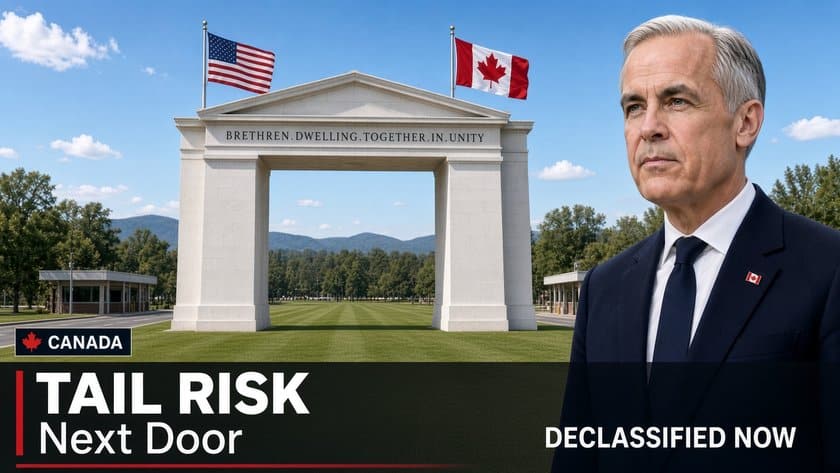
In an interview with The New York Times published Wednesday, Sept. 23, Mark Carney said he had studied the possibility of U.S.-led military action against Canada. According to the Canadian Press account of the interview, he called it an “extreme tail risk.” He framed it as ordinary risk management for someone in his job: not the expected outcome, but something it would be irresponsible not to prepare for. He declined to say what the examination actually involved. In the same interview he talked about reducing Canada’s reliance on Starlink and looking at alternatives to its F-35 order.
“Tail risk” is a finance term for an event that is very unlikely but very costly if it happens. Carney ran both the Bank of Canada and the Bank of England before he went into politics, so the vocabulary comes naturally. It is still a striking phrase to hear applied to the country on the other side of the world’s longest undefended border.
What the other side said
The man whose military would be doing the invading has, on the record, mostly agreed with the odds. Asked on NBC’s Meet the Press in May 2025 whether he would use military force against Canada, President Trump said it was “highly unlikely” and that he didn’t see it happening. In the same interview he kept up his talk of Canada becoming the 51st state. I haven’t found a White House response to Carney’s interview so far.
So the two leaders roughly agree on how likely this is. They disagree only on whether it’s worth a flashlight.
What we don’t know
The details that have been circulating, including how quickly Canada’s conventional defences might be overrun and what irregular tactics might follow, did not come from Carney. They come from a Globe and Mail report in January 2026 that cited unnamed federal officials. The prime minister confirmed only that the risk was studied, not what the study said. Anyone telling you Canada has an invasion plan in a binder somewhere knows more than the public record does.
The case that this is just prudence
The strongest argument for Carney is simple and fair. A head of government whose largest neighbour and closest ally has repeatedly mused about annexing his country would be negligent not to think through the worst case, however remote. Militaries plan for contingencies they hope never happen; that’s most of what contingency planning is. Saying so plainly, instead of pretending the question never came up, is arguably more honest than the alternative. The counter to that is also real: saying it out loud to a major American newspaper carries a cost with an ally Canada still depends on for trade and defence, and it lands well at home at a moment when standing up to Washington is popular. Both things can be true at once.
What it tells us
I don’t think this makes Carney alarmist, or Trump a threat on the evidence of one prime minister’s risk register. What it does show is how far things have moved. Two countries that spent the last century treating a shared border as a punchline about lumberjacks and hockey now have a leader who talks about his neighbour in the language of low-probability disasters, and a president who answers the question with “unlikely.”
Canada still keeps a flashlight in the drawer. That it’s now willing to say so is the news.
Sources:
- The Canadian Press (via Lethbridge Herald) — Carney says he studied risk of U.S.-led military action in New York Times interview, Sept. 23, 2026
- Global News — Carney says he studied risk of U.S.-led military action in NYT interview
- CBC News — Carney tells NYT he studied risk of U.S.-led military action in Canada
- The Canadian Press (via CP24) — Trump says ‘highly unlikely’ U.S. ever uses military force to annex Canada, May 4, 2025
- Anadolu Agency — Canada drawing up plans for hypothetical US attack: report (summarizing The Globe and Mail, January 2026)
- Mark Carney — career background (Bank of Canada, Bank of England)