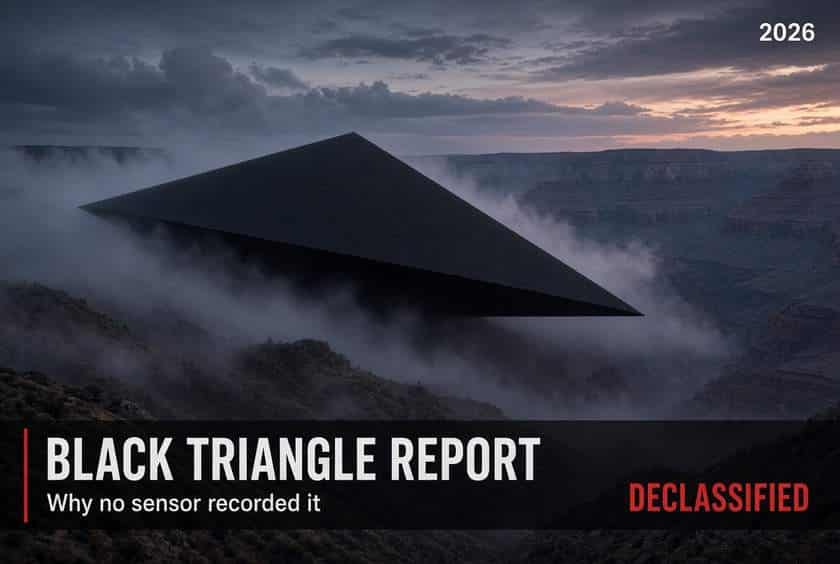
The best-equipped witnesses in the Pentagon’s latest UFO release had their cameras pointed the wrong way. On a June evening this year, two federal special agents were on a hilltop observation post at a national security site in the western United States, with tripod-mounted thermal and optical sensors aimed east. The black triangle they reported came up over a ridge to the west.
Their account is in two files from the seventh batch of UAP records, which the Department of War posted on Oct. 23 under its PURSUE program. One is the agents’ own signed statement, attached to an FBI interview form. The other is a memorandum from the Pentagon’s All-domain Anomaly Resolution Office, AARO, written after its investigators debriefed them. Most coverage has focused on the silence and the speed. We read both documents for something more basic. What did the agents have to record it with, and why didn’t any of it work?
A call from the next post over
The alert came from a third official. The agents’ statement says a colleague at Observation Post 6, “several miles to the west,” radioed in a detection of a “thermally elevated aerial object” on a bearing of 251 degrees. The numbering implies at least six posts, though the files don’t say how many were staffed that night. AARO’s memo describes the work as “routine observation support” and says the weather was close to ideal, with clear skies and the sun just below the horizon.
The two agents ran to the western side of their hilltop. According to AARO, terrain made it impossible to move the main tripod-mounted thermal system quickly, so they went with what they could carry. One took binoculars and a handheld thermal monocular, and the other followed seconds later. In their statement they describe “a substantial, nonreflective, dark black triangular object most resembling a delta wing drone,” rising vertically over a ridge about 3.2 miles away. Through the handheld device it read warmer than the air around it, evenly across the whole airframe, with no visible exhaust.
Then it flew off fast. The agents’ statement says it was “approaching our position” as it descended, and AARO’s memo has it banking down into a canyon. The agents wrote that they lost sight of it about 1.5 miles out. Neither agent heard anything.
Where the sensors were
The AARO memo is unusually frank about the gaps. “No instrumented speed measurement was obtained,” it says. The speed estimate, which the agents compared to a military fighter jet, comes from how far the object moved along the ridge before it disappeared. The infrared view was lost because the acceleration outran the handheld monocular’s narrow field of view. The range, 1.4 to 3.2 miles, was worked out afterward against terrain features, and the size was judged against trees on the ridge.
That leaves the witnesses’ eyes and one handheld screen.
The memo also says no electromagnetic interference or anomalous readings turned up on personal or agency equipment. It doesn’t say whether the long-range thermal gear at the other post, the one that made the first detection, recorded anything. Neither file includes sensor data, photographs or video. A ground search of the canyon the next morning found no wreckage, scarring or damaged vegetation.
The FBI file does carry pictures. Nine pages show the same dusk scene, with a small black triangle placed at different points as it rises, crosses the ridge and drops toward the canyon. They aren’t photographs. CBS News described them as illustrations, and IBTimes UK noted that they reuse a single mountain image with the shape moved from frame to frame. The files don’t say who made them. Fox News Digital reported asking AARO whether the images show the actual encounter.
Two versions of the same minutes
Neither file says the two documents describe the same event, but the details match closely, from the third official’s thermal callout to the ridge and the canyon. Several outlets, including IBTimes UK and Fox News, noted the main difference. The two accounts don’t agree on how long it lasted.
| Detail | Agents’ signed statement (FBI) | AARO debrief memo |
|---|---|---|
| Time of first callout | About 7:23 p.m. (“1923 hours”) | 8:23 p.m. (“2023L”) |
| Wingspan | About 9 to 15 feet | 13 to 15 feet |
| Climb above the ridge | About 200 feet | 200 to 300 feet, over about 10 seconds |
| Hover | Not mentioned | About 20 seconds, with no drift |
| Total duration | “Approximately three seconds” | More than 30 seconds across three phases |
| What it was called | “Delta wing drone,” “unmanned aerial system” | “Unidentified craft” |
The language shifts too. The agents wrote about a drone-like object. AARO’s memo describes “absolute acoustic silence,” a “continuous (seamless), featureless surface,” and a move from hover to high speed with no “observable acceleration ramp.” It also opens with a caveat that the report reflects “the reporter’s interpretation at the time of the event” and shouldn’t be read as conclusive about the object’s features or performance.
Neither file explains the one-hour difference or the gap in duration.
AARO also recorded why the agents rejected the obvious answer. Both have “extensive operational experience” with unmanned aircraft, including work with government agencies and academic studies, and they said even a small drone or quadcopter at 1.4 miles would have been clearly audible from that hilltop. Neither file says whether anyone checked for drone flights in the area that evening.
Not the first triangle in these files
The Pentagon said AARO considers the case worth further investigation because of its “close alignment” with other reported incidents in the western United States, CBS News reported. The files list it as unresolved, which the Department of War defines as a case where the government can’t make a definitive determination. Earlier releases included federal agents’ reports of orange orbs over two days in 2023, according to CBS, and a helicopter crew’s orange orbs in late 2025, which we compared in an earlier piece.
An earlier FBI record in the series describes a very different triangle. In an October 2025 interview, a witness described a solid black triangle with a red light in each corner, coming out of a stationary cloud, that he thought could be as big as the parking lot he was standing in. The June object, by both new accounts, was at most about 15 feet across.
Read both files yourself. Primary sources: the Release 7 document archive, which contains FBI-UAP-D043 (the agents’ statement and the nine illustrations) and DOW-UAP-D176 (the AARO memo). Full context: the Department of War’s PURSUE release page.
Sources
- Federal Bureau of Investigation, FD-302, “Unidentified Aerial Object Observation Report” (FBI-UAP-D043, 2026), in the PURSUE Release 7 archive. Used for: the agents’ statement, the 7:23 p.m. time, Observation Post 6, the bearing, size, distance and three-second duration, and the nine illustration pages.
- All-domain Anomaly Resolution Office, memorandum for record, “Witness Debrief: Unidentified Anomalous Phenomena (UAP) Observation” (DOW-UAP-D176, 2026), in the same archive. Used for: the sensor positions, the three phases, the absence of an instrumented speed measurement, the ground survey, the collector note and the opening caveat.
- Department of War, PURSUE release page (archived Oct. 24, 2026). Used for: the Oct. 23 release date, the file descriptions and the definition of unresolved cases.
- FBI-UAP-D030, FD-302, “Large Triangle with Red Lights,” mirrored by The Black Vault. Used for: the earlier triangle account.
- CBS News, “New UFO files include details of strange triangular craft” (Oct. 23, 2026). Used for: the June date, the 28 files, the illustrations and AARO’s “close alignment” assessment.
- IBTimes UK, “Pentagon Files Detail Silent Black Triangle” (Oct. 2026) and IBTimes UK, “Pentagon UFO Files Detail FBI Agents’ Report of Silent Black Triangle” (Oct. 2026). Used for: the reused landscape image and the duration and time discrepancies.
- Fox News, “New Pentagon UFO files detail FBI agents’ sighting of silent triangular object” (Oct. 2026). Used for: the duration discrepancy and the comment request to AARO.
- EarthSky, Paul Scott Anderson, “Pentagon UAP files part 7: Silent black triangles” (Oct. 25, 2026). Used for: corroboration of the release details and AARO’s assessment.