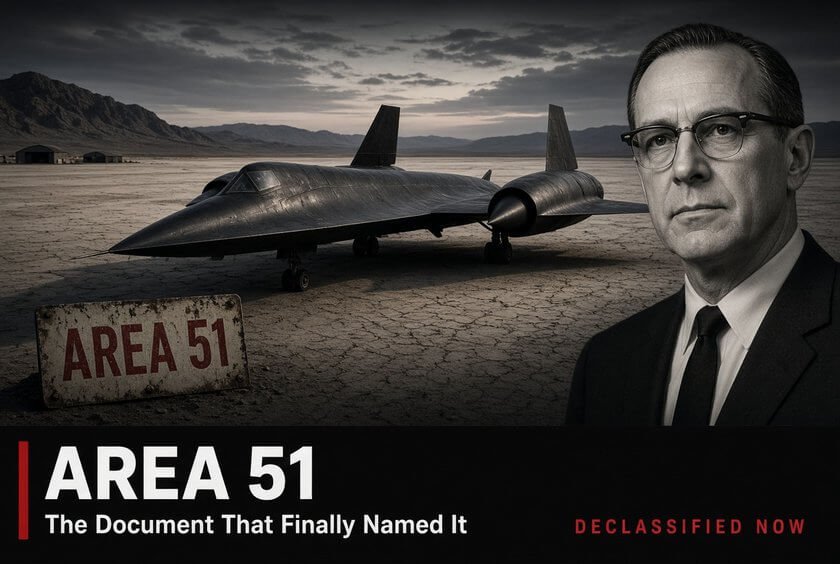
The U-2 reconnaissance aircraft entered flight testing in 1955 at a dry lakebed in southern Nevada known as Groom Lake, selected earlier that year by CIA officer Richard Bissell, Air Force Col. Osmund Ritland, and Lockheed engineer Kelly Johnson during an aerial survey. The site’s existence was classified, and even after its broad outlines became public knowledge through popular culture, no U.S. government document used its now-familiar name — Area 51 — or confirmed its location. That changed only in 2013, when a Freedom of Information Act request forced the restoration of redactions the CIA had made to its own internal history of the program eleven years earlier.
The document at the center of the release is “The Central Intelligence Agency and Overhead Reconnaissance: The U-2 and OXCART Programs, 1954–1974,” a classified agency history written by CIA historians Gregory Pedlow and Donald Welzenbach. National Security Archive senior fellow Jeffrey Richelson first obtained a version in 2002; every reference to Area 51 had been blacked out. His 2005 FOIA request specifically challenging those redactions produced, in 2013, a version with the references restored — the first official U.S. government document to name Area 51 and place it at Groom Lake. The National Security Archive published the history alongside more than 60 supporting records on October 29, 2013.
A 1961 CIA Inspector General memo included in the release warned that the still-new facility “appears to be extremely vulnerable…against unauthorized observation” (Document 1, Oct. 1961) — a concern that shaped decades of subsequent security measures at the site.
Area 51 supported two successive reconnaissance aircraft programs before shifting toward other work. The U-2 flew first; the CIA’s Project GUSTO, seeking a faster and harder-to-detect successor, produced the Lockheed A-12, codenamed OXCART, the first of which arrived in December 1961. In 1968 and 1969, the site hosted a different kind of testing: HAVE DOUGHNUT, a 310-page Defense Intelligence Agency evaluation of a Soviet MiG-21 obtained from Israel after an Iraqi pilot’s defection, flown against U.S. aircraft to assess Soviet fighter capability (Document 50, Aug. 1969). Related programs, HAVE DRILL and HAVE FERRY, put a MiG-17 through a comparable evaluation the same year.
Area 51 also became a proving ground for stealth technology. The theoretical foundation traced to Soviet physicist Pyotr Ufimtsev’s 1962 paper on radar wave diffraction, translated into English in 1971 (Document 10a-c); Lockheed engineer Denys Overholser’s recognition of its applications later became known within the company as its “Rosetta Stone” breakthrough. Kelly Johnson’s own work on radar cross-section reduction followed by the mid-1970s (Document 11), leading to the HAVE BLUE demonstrator, first flown in 1977, and the F-117 Nighthawk, which flew in June 1981, was declared operational in October 1983, and was not publicly acknowledged until November 1988. A CIA assessment from February 1984 concluded the Soviet Union had lacked a comparable stealth research program through the 1970s but had begun “intensified research” by the early 1980s (Document 40, Feb. 1984).
The F-117’s combat record complicates its reputation. A General Accounting Office evaluation of the Gulf War air campaign found the aircraft achieved a 41 to 60 percent bomb-hit rate, against a Defense Department claim of 80 percent (Document 23, June 1997).
Formal management of Area 51 transferred from the CIA to the Air Force in August 1976 (Document 6). The site’s legal secrecy has been separately reinforced since: both the Clinton and Bush administrations issued environmental exemptions — in January 1996 and September 2003, respectively — shielding it from disclosure requirements connected to hazardous-waste litigation brought by former site workers (Documents 8-9).
Sources
- Gregory Pedlow and Donald Welzenbach, “The Central Intelligence Agency and Overhead Reconnaissance: The U-2 and OXCART Programs, 1954–1974,” declassified 2013 — nsarchive2.gwu.edu
- Defense Intelligence Agency, “HAVE DOUGHNUT” MiG-21 evaluation, Aug. 1969 (Document 50)
- CIA, Soviet stealth capability assessment, Feb. 1984 (Document 40)
- General Accounting Office, Gulf War air campaign evaluation, June 1997 (Document 23)
- Full briefing book: National Security Archive, “The Area 51 File: Secret Aircraft and Soviet MiGs,” ed. Jeffrey T. Richelson, Oct. 29, 2013