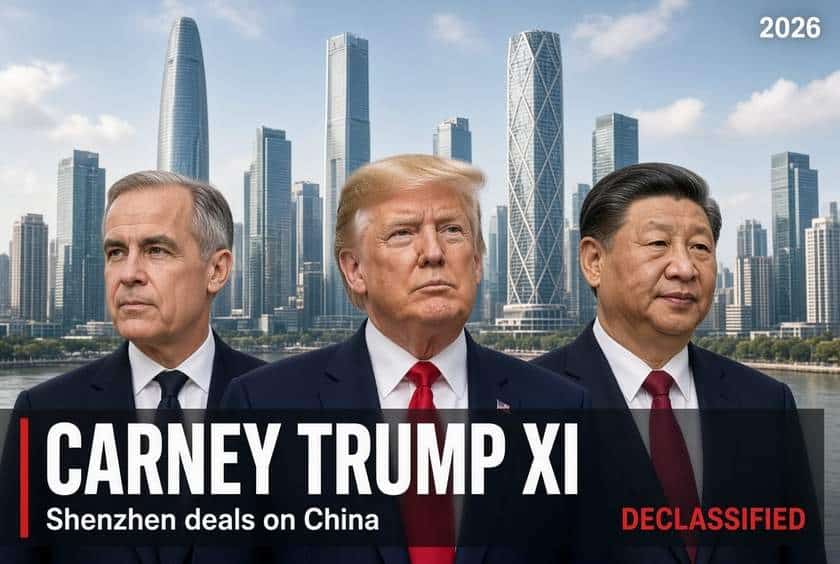
Updated Nov. 19, 2026: Added the Trump-Xi-Putin “Declaration toward Peace,” China’s readout of the Trump-Xi meeting, and what the Shenzhen meetings did and didn’t settle on trade. The Nov. 17 comparison follows below.
President Donald Trump, Chinese President Xi Jinping and Russian President Vladimir Putin issued a four-point “Declaration toward Peace” on Thursday, Nov. 19, after their first three-way meeting, held in Shenzhen on the sidelines of the APEC summit. The text, published by China’s Xinhua news agency and by the Kremlin, covers United Nations reform, oil supplies, international courts and nuclear risk. It says nothing about trade, Ukraine, Iran or Taiwan. Trump also met Xi for about an hour before the trilateral, CBS News reported, but neither government announced a trade outcome, and the U.S.-China tariff truce still expires Jan. 10, 2027. That leaves Canada’s Nov. 17 deal with Xi, covered below, as the only signed trade package to come out of Shenzhen this week.
What the declaration says
According to the full text carried by Xinhua, the three leaders committed to reform the U.N. so it “can respond more effectively to global challenges.” They said they would increase the production and supply of refined petroleum products for all nations and stressed the importance of stable energy flows. They called the principle of state consent and the immunity of state officials of paramount importance, and said the International Criminal Court and similar bodies “must not abuse their jurisdiction.” On nuclear weapons, they repeated that a nuclear war cannot be won and must never be fought, and said they would hold a dialogue on reducing nuclear risks and preventing proliferation. The text sets out no mechanism or timeline for any of it. The White House distributed the same text to reporters under the title U.S.-Russia-China Heads of State Declaration toward Peace. Xinhua’s version lists China first, and the Kremlin version CBS quoted is worded slightly differently.
The meeting lasted about an hour and a half, CBS and the Kyiv Independent reported. Trump held about 40 minutes of talks with Putin beforehand, the Kyiv Independent reported, and Putin said afterward that Russia would not negotiate following Ukraine’s strikes on the Crimean Bridge, according to CBS. Xi described U.S.-China relations as “stable and improved,” CBS reported.
Trade: no announcement
Trump said he and Xi spoke for two hours on Wednesday, with trade and tariffs the main topics, and that he would ask China to do more for American farmers, CBS reported. Neither side released a readout announcing a truce extension, new tariff cuts or the “30 billion for 30 billion” arrangement Beijing raised at the Board of Trade’s first meeting. Analysts quoted by CNBC and Al Jazeera before the summit had expected few concrete outcomes. Trump also said he and Xi felt strongly that oil has to flow through the Strait of Hormuz, CNBC reported, without quoting him directly.
China’s Foreign Ministry readout of the Thursday meeting says the two leaders agreed to draw up an action plan for what Beijing calls a “constructive relationship of strategic stability,” and that the two sides should step up communication on trade. It gives no figures or deadlines. The readout also has Trump saying the United States does not support Taiwan independence, wording the White House hasn’t confirmed.
Carney, by contrast, left with tariff relief on about C$400 million a year in pork and seafood. The details of that deal and the U.S.-Canada dispute behind it are below.
Prime Minister Mark Carney and Chinese President Xi Jinping agreed Tuesday, Nov. 17, in Shenzhen to extend China’s tariff relief to about C$400 million a year in Canadian frozen pork and seafood, with Canada widening tariff refunds on Chinese steel and aluminum in return. President Donald Trump is due in the same city Thursday for his own meeting with Xi and the first three-way summit with Xi and Russian President Vladimir Putin, which China’s Foreign Ministry confirmed Monday.
The visits come as a senior Trump adviser has again accused Ottawa of getting too close to Beijing. “Are u really threatening to play China off the U.S.,” Trump trade adviser Peter Navarro posted on X on Monday, after Carney said Canada could turn to Chinese automakers if U.S. trade talks fail.
Side by side, as of Nov. 19
| Item | Canada and China | U.S. and China |
|---|---|---|
| Leader meetings in 2026 | Two (Beijing in January, Shenzhen on Nov. 17) | Trump-Xi talks in Shenzhen on Nov. 18 and 19, plus the first Trump-Xi-Putin summit; they had met three times since October 2025 before this week, per CNBC |
| Latest agreement | Pork and seafood relief through 2028; 32 more Chinese steel and aluminum items eligible for refunds | No new trade deal; Trump and Xi agreed to draft an action plan on relations (Chinese readout); tariff truce still expires Jan. 10, 2027. Nov. 19 three-way “Declaration toward Peace” with Russia (no trade terms) |
| Other commitments | 2027 trade mission and a “Year of e-Commerce” | Board of Trade, which held its first meeting Nov. 13 |
| Open question | Chinese investment in Canadian auto plants | A proposed “30 billion for 30 billion” reciprocal tariff cut, and whether the truce is extended before Jan. 10 |
What Canada got, and what it gave
China will suspend additional tariffs on C$116 million in frozen pork cuts and C$285 million in fish and seafood, including cold-water shrimp, prawns, Greenland halibut, mollusks and sea cucumber, Carney’s office said. Newsweek reported the suspension runs from Jan. 1, 2027, to Dec. 31, 2028. The Globe and Mail noted the dollar figures are based on 2024 trade values. CBC reported the deal also opens China to Canadian fava beans, chickpeas and lentils, a detail the other reports we reviewed didn’t include.
In return, Canada extended its remission program on certain Chinese steel and aluminum to 2028 and added 23 steel and nine aluminum items for which, the government says, Canadian supply is insufficient or unavailable. Remission lets importers claim back the 25% Canadian surtax on those metals, which Ottawa imposed in 2024 alongside a 100% tariff on Chinese electric vehicles. The Globe described the metals move as another divergence from U.S. policy, since the Trump administration has accused Canada of being a back door for Chinese goods.
The package builds on earlier steps. In January, Carney cut the EV tariff to 6.1% for up to 49,000 vehicles a year in exchange for lower Chinese tariffs on canola. Earlier this month China extended relief on canola meal, lobster, crab and peas to the end of 2028. Carney’s office says 16,211 Chinese EVs have entered Canada since March, CBC reported. Canadian exports to China rose just over 40% between January and September, to C$4.4 billion a month, according to Statistics Canada figures cited by The Canadian Press.
The auto question
The flashpoint is cars. Speaking to reporters in Cambodia before the Shenzhen meeting, Carney said Canada could pursue partnerships with Chinese, European or Japanese automakers if Washington won’t agree to a deal protecting Canadian auto jobs. “It’s not leverage. But action, reaction,” he said, according to Newsweek. He has also said any Chinese plant would need to provide real manufacturing work, not just assembly of imported parts, and Ottawa has already ruled that out for the shuttered Stellantis plant in Brampton, Ont.
Navarro’s Monday post called the idea “offensive in the extreme” and said Canada should worry that “China is going to eat Canada alive.” Before the trip, Carney said sensitive sectors such as critical minerals and artificial intelligence were off the table with China, CBC reported. He also said he would raise foreign interference with Xi. Beijing denies any such activity.
U.S.-Canada trade talks collapsed in August. David Cohen, U.S. ambassador to Canada under President Joe Biden, told a Commons committee on Monday that a deal could come before the end of the year or in January but might leave some U.S. tariffs in place. Treasury Secretary Scott Bessent told CNBC he is “optimistic that we can get trade deals with Canada and Mexico,” without giving a timeline.
What Trump and Xi brought to Shenzhen
The U.S.-China truce, first struck in South Korea in October 2025, was extended in September to Jan. 10, 2027, when Bessent announced it as Xi arrived for a state visit to Washington. He said at the time that Beijing still had to deliver more commitments. Analysts quoted by CNBC largely expect another extension in Shenzhen rather than a broader deal.
The two governments’ new Board of Trade met for the first time on Nov. 13 by video. Beijing said the session covered tariffs, agricultural trade and a reciprocal tariff-reduction arrangement it described as “30 billion for 30 billion,” according to Anadolu. The U.S. Trade Representative’s office said it held the meeting jointly with the Treasury. Washington has said substantial tariffs on China will stay in place.
Technology is moving in the other direction. The Commerce Department’s Bureau of Industry and Security announced a rule on Monday aimed at stopping Chinese companies from remotely accessing U.S. AI chips, and Nvidia has warned customers about legal exposure tied to Chinese access, CNBC reported Tuesday.
Our September analysis, Glass Houses: Is Washington Deeper Into China Than Ottawa?, compared the two relationships by trade, investment and debt. Our preview of the Trump-Xi-Putin meeting covers the arms control side of Thursday’s summit.
Sources:
- White House press pool, “U.S.-Russia-China Heads of State Declaration toward Peace” (distributed Nov. 19, 2026)
- Ministry of Foreign Affairs of the People’s Republic of China, “President Xi Jinping Meets with U.S. President Donald J. Trump” (Nov. 19, 2026)
- Xinhua, “Full text: China-Russia-U.S. Heads of State Declaration toward Peace” (Nov. 19, 2026)
- CBS News, “Trump, Xi and Putin sit down for a rare 3-way meeting in China, but appear to achieve little” (Nov. 19, 2026)
- Kyiv Independent, “Trump joins Putin, Xi in signing ‘declaration of peace’ as summit largely sidesteps Ukraine” (Nov. 19, 2026)
- CNBC, “Oil prices rise as Middle East shipping attacks counter supply surplus outlook” (Nov. 19, 2026)
- Al Jazeera, “As Trump arrives in China, low expectations for breakthroughs in rivalry” (Nov. 18, 2026)
- CBC News, “Canada and China announce new trade measures and cultural partnerships on Carney’s 1st day in Shenzhen” (Nov. 17, 2026)
- The Globe and Mail, “China rolls back tariffs on Canadian pork, seafood in new trade deal with Ottawa” (Nov. 17, 2026)
- The Canadian Press via Yahoo News Canada, “China and Canada agree on further tariff relief on key exports” (Nov. 17, 2026)
- Newsweek, “Canada and China strike new trade deal ahead of Trump summit” (Nov. 17, 2026)
- CNBC, “China confirms Xi-Trump-Putin meeting in first three-way summit” (Nov. 16, 2026)
- CNBC, “Nvidia warns chip buyers of legal risks tied to China AI access” (Nov. 17, 2026)
- Trading Economics, “U.S.–China Trade Truce Extended to January 10” (Sept. 2026)
- ICIS, “US, China agree to extend trade truce by two months to 10 January – Bessent” (Sept. 24, 2026)
- Bernama/Anadolu, “US, China Hold First Trade Council Meeting, Discuss Tariffs, Agricultural Trade” (Nov. 14, 2026)
- Newsquawk, USTR statement on the first Board of Trade meeting (Nov. 13, 2026)