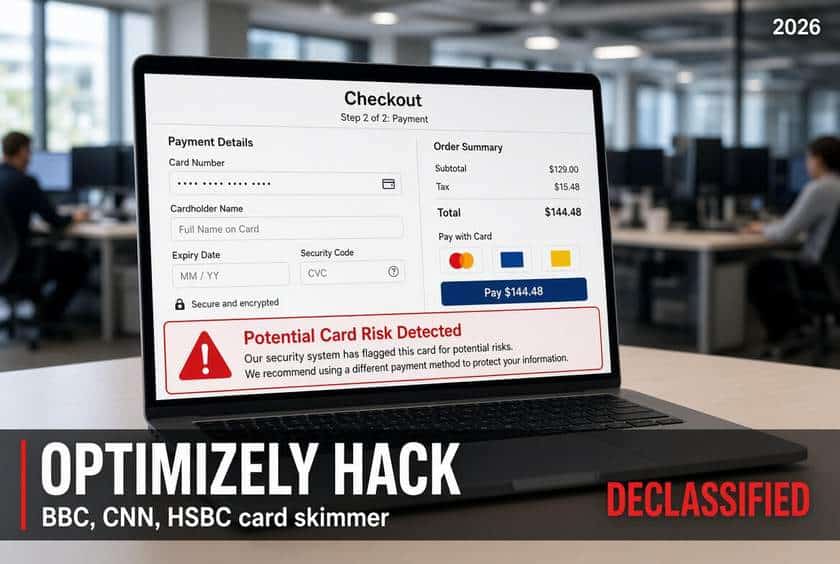
Optimizely confirmed Monday evening, Nov. 16, that an unauthorized party “exploited a vulnerability in Experimentation” and used it to plant malicious JavaScript in some customer projects. For most of that day, the code had been running on the websites of 178 organizations, including the BBC, CNN, Zoom, Salesforce, HSBC, IKEA and Equifax, according to the web security firm Report URI, which found it. The company said in a status-page notice that it had fixed the flaw, removed the injected code and secured affected user accounts.
Visitors to those sites loaded a script that swapped cryptocurrency wallet addresses for the attacker’s, skimmed card numbers typed into checkout forms, and took cookies and screenshots. On iPhones and iPads it tried to load two known iOS hacking kits, Coruna and DarkSword. None of the affected sites had to be hacked for this to happen. The code arrived through Optimizely’s own servers, a source every one of them already trusted.
How an A/B testing tool carried the payload
Optimizely Web lets companies test versions of their pages on live visitors. To use it, a site loads a small JavaScript file, which Optimizely calls a snippet, from Optimizely’s content delivery network. Each snippet carries an optional field called Project JavaScript, custom code the customer writes in the Optimizely dashboard that runs on every page of the site.
The attacker wrote a loader into that field and left the rest of each snippet alone, Report URI founder Scott Helme wrote in his Nov. 16 analysis. The files kept coming from cdn.optimizely.com with Optimizely’s certificate, so browsers had no reason to treat them differently. Helme was explicit that Optimizely’s network served exactly what it was given and that this wasn’t cache poisoning. Optimizely’s own homepage and login page carried the code too.
Some sites tried to protect themselves by allowing only approved script sources. That didn’t help when the approved source was the one delivering the malware. Report URI checked the security policies on 256 of the affected organizations’ own web hosts and found 24 organizations whose settings fully blocked the payload. At HSBC, the policy stopped the main script and the data theft, but a backup copy of the code still ran because the site allowed a setting that Optimizely’s own documentation tells customers to enable.
About 16 hours on Nov. 16
Report URI and the security firm StepSecurity published matching timelines built from site scans, domain records and the snippets themselves. All times are UTC, five hours ahead of Eastern.
| Time (UTC) | What happened |
|---|---|
| Nov. 16, 04:21 | First injection seen, in the BBC’s snippet |
| 05:23 | Attacker registers the main payload domain, 1688360.cc |
| 08:10 | First build of the crypto-swapping script |
| 13:03 | Attacker moves stolen crypto to exchanges |
| 13:43 | Card skimmer added to the script |
| 15:06 | Report URI’s monitoring flags the code on a customer’s site |
| 17:13 to 17:57 | iPhone exploit page added for devices on iOS 18.6 or older |
| 19:24 to 19:59 | Report URI finds the code in 186 of 1,611 snippets it checked |
| About 20:40 to 21:10 | Mass cleanup of the infected snippets |
| 23:11 | Report URI sees every infected file clean |
| Nov. 17, 00:37 | Payload domain placed on registry hold, stops resolving |
| 01:02 | Optimizely posts its incident notice (8:02 p.m. Eastern on Nov. 16) |
Helme counted 26 versions of the payload during the day. The attacker kept adding features and wallets and never took any out. Report URI’s final count was 188 infected snippets belonging to 178 organizations, found mostly through its own crawl data. Helme wrote that the real number is likely higher because his team could check only the snippets it found in time.
About $7,000 in crypto, and no count of cards
The attacker’s wallets had taken in about $7,040 by 19:25 UTC on Monday, Report URI reported. Its update on Tuesday morning put the total near $7,150 across five wallets, and Help Net Security reported the same figure. The attacker emptied the wallets early Tuesday. One of the cash-out addresses had been used in earlier operations in March and on Nov. 3, Report URI said, and the attacker’s TRON wallet has been active since March.
Those are receipts on public blockchains, and they don’t show who sent the money. Hudson Rock, a security firm that investigated separately, says it hasn’t been able to link the transfers to visitors of the affected sites. Report URI says it has no way to see how many card numbers, cookies or screenshots reached the attacker’s server, or how many iPhones were infected.
The iPhone piece is the least settled part of the story. Report URI identified the kits by their code and says iOS 18.7.3 and later, and iOS 26.3 and later, are patched against them. Cynet, whose detection software flagged connections to the attacker’s server, said what it observed was “not a successful compromise of a physical iPhone or iPad.” An independent researcher documented later stages built to steal keychain data and crypto seed phrases, Help Net reported, but Hudson Rock said it hadn’t reproduced them or seen a real victim’s phone compromised.
Optimizely hasn’t said how one flaw opened 178 accounts
The status-page notice doesn’t explain how a single vulnerability gave the attacker write access to so many unrelated customer projects. Helme raised the possibilities of a compromised Optimizely system or a credential with access across customers. “That’s for Optimizely to explain,” he wrote. An Optimizely spokesperson told Gizmodo the flaw was in the account signup flow, according to StepSecurity. We couldn’t access the Gizmodo report to confirm the wording.
The access didn’t end at the first cleanup. Smartsheet’s snippet was cleaned once and then re-infected with a version that hid the payload address in encoded text, which Report URI said showed the attacker still had access at that point. Optimizely’s notice says it has added protections against unauthorized code being delivered. Its status page still listed the incident as “Monitoring” on Tuesday.
No group has been named. Report URI ties the injection tool to an actor first seen on Turkish websites on Sept. 17, and says an earlier wave from Nov. 13 to Nov. 16 went through three other web services: Kissmetrics, StorifyMe and Minute Media. Hudson Rock and an independent researcher traced the same three services but cautioned, per Help Net, that shared hosting and loader code don’t prove a single operator or a single way in.
Banks, newsrooms and airlines on the list
Report URI published all 178 organizations by sector. Banking and finance was the largest group at 32, with HSBC sites in 11 markets, Equifax, Paychex and ABN AMRO. Technology firms made up 23, including Zoom, GitLab, Salesforce and Tableau, and retail made up 20, including IKEA, ASOS, Mattel and Levi’s sites across Asia and the Pacific. The news and media group included CNN, the BBC, Fox News and NPR. Air France-KLM, Alaska Airlines, Peacock, Starbucks Canada, UNICEF USA and the crypto wallet maker Ledger were also on it.
Being on the list means a site served the malicious code. It doesn’t mean the company’s own systems were breached, Cynet noted. Cynet’s browser captures showed the code running on CNN and Zoom pages. Salesforce told Reuters it was investigating unauthorized changes to its Optimizely scripts and had disabled them as a precaution, Help Net reported. Report URI said it had reached out to Optimizely through several channels and had no response by the time it published.
Helme, in a follow-up post on Nov. 17, wrote that there was “nothing particularly special about their incident.” His argument is that most large sites load third-party scripts they never review, so any vendor that gets compromised can do the same thing.
If you used one of these sites on Nov. 16
Report URI’s advice for visitors:
- Update an iPhone or iPad to iOS 18.7.3 or later, or iOS 26.3 or later.
- Check any crypto transfer made that day. If the address you pasted doesn’t match the one you meant to pay, it may have been swapped.
- Watch card statements if you paid on an affected site. Cards entered in separately hosted payment boxes, such as Stripe or Adyen, were out of the skimmer’s reach. Cards typed into a site’s own form fields were not.
The incident remains open on Optimizely’s status page, and the company hasn’t said how many accounts were affected or how the signup flaw worked. The full list of organizations, the attacker’s domains and wallet addresses are in Report URI’s write-up, linked below.
Sources:
- Optimizely status page, “Web Experimentation Security Incident” (Nov. 17, 2026)
- Report URI, Scott Helme, “World’s Largest Brands Infected With Malware Via Optimizely” (Nov. 16, 2026, updated Nov. 17)
- Scott Helme, “Reflecting on the Optimizely Incident and Why We Keep Failing” (Nov. 17, 2026)
- StepSecurity, “OPTIMJACK: Optimizely-Hosted Scripts Loaded a Crypto Clipper and Card Skimmer on 178 Organizations” (Nov. 17, 2026)
- Cynet, “OPTIMJACK: Malicious web injection across CNN, Zoom, Salesforce, Fox and more” (Nov. 2026)
- Help Net Security, “Malware spread through Optimizely hits 178 organizations, including BBC, CNN and Zoom” (Nov. 17, 2026)
- The Hacker News, “Hijacked Optimizely Scripts Served Card Skimmer and iOS Exploit Kits to CNN, BBC and Zoom Visitors” (Nov. 17, 2026)