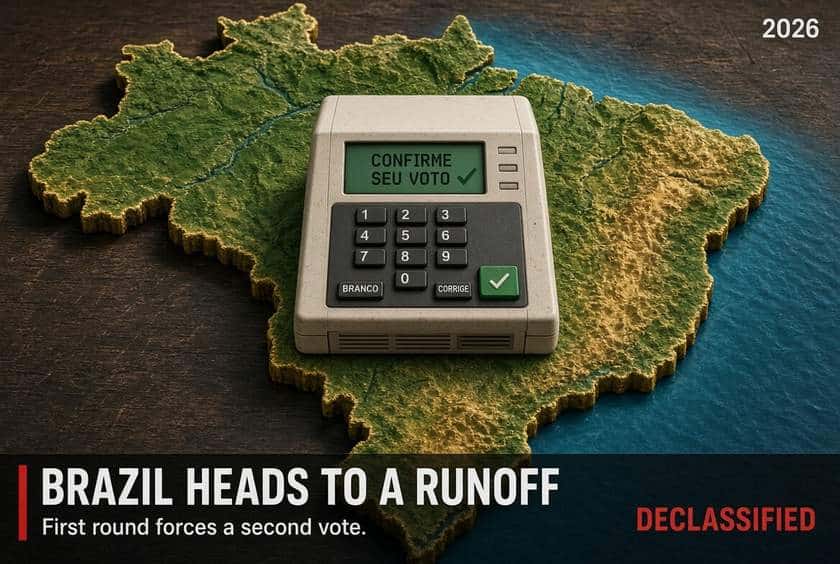
Senator Flávio Bolsonaro finished first in Brazil’s presidential election on Sunday, ahead of President Luiz Inácio Lula da Silva, but short of the majority needed to win outright. With 99.96% of polling stations counted, Bolsonaro had 47.04% of valid votes and Lula 45.15%, a gap of 2,252,566 votes, according to the electoral court’s count as reported by The Rio Times. The two will meet again in a runoff on Oct. 25.
The result upended the final polls, which had Lula narrowly ahead as late as Saturday, CNN reported. It also sets up a rematch in all but name. Lula beat Bolsonaro’s father, former President Jair Bolsonaro, in 2022. The father is now serving a 27-year sentence for plotting a coup to overturn that result.
A lead that shrank all night
Bolsonaro led throughout the count, but by less as the hours went on. With 64.81% of stations counted, he was ahead by 7.3 points. By the end of the night the margin was 1.89 points, as late-reporting states in the northeast went heavily for Lula, The Rio Times reported. Bolsonaro led in 15 states and Lula in 12.
Four other candidates trailed far behind: Augusto Cury with 2.89%, Renan Santos with 2.24%, Ronaldo Caiado with 2.18% and Romeu Zema with 0.27%. The third-, fourth- and fifth-place finishers are all on the right, NPR noted, which could give Bolsonaro a pool of voters to draw on. Early results also showed the right gaining ground in Congress, particularly in the Senate.
Both candidates spoke within hours. “Brazil wants change, that’s the reading of what happened today,” Bolsonaro told supporters and journalists outside his home in Brasília, calling the result “the end of the Workers’ Party era,” NPR reported. Lula told supporters in São Paulo he had been convinced he would win in the first round. “Tomorrow we start a new campaign,” he said, and described his opponent as carrying “a biography of a dark past,” according to NPR and CNN.
The father’s sentence and the son’s pledge
Jair Bolsonaro was convicted in 2025 and sentenced to 27 years and three months in prison for plotting to overturn the 2022 election, a plot that police said included a plan to assassinate Lula, NPR and France 24 reported. He is serving the sentence under house arrest on health grounds, according to CNN.
He is barred from running.
Flávio Bolsonaro has pledged to pardon him if elected, NPR and France 24 reported. The pledge has made the former president’s legal fate a campaign issue, NPR noted.
The family’s legal troubles extend further. In June, Brazil’s courts convicted another son, Eduardo Bolsonaro, of coercion and sentenced him to four years and two months, CNN reported. He had lobbied the Trump administration to pressure Brazil over his father’s case, and he remains in the United States.
Washington in the campaign
In July 2025, President Trump called the case against Jair Bolsonaro a “witch hunt” and announced 50% tariffs on Brazilian imports. Those tariffs were rolled back in November, and new ones on some Brazilian goods were imposed this summer, CNN reported. Lula has accused the United States of trying to meddle in the election, which the State Department has denied, according to NPR. At the United Nations in September, he said “Brazil is nobody’s backyard.”
The divide showed on the streets. Bolsonaro rallies have featured American flags and a giant inflatable of Trump holding a jailed Lula, NPR reported, and on election day in Rio voters could be seen wearing both Trump T-shirts and “out with Trump” stickers.
Washington’s role in Brazilian politics has a documented history. Declassified U.S. records published by the National Security Archive show that before the 1964 military coup that overthrew President João Goulart, Ambassador Lincoln Gordon recommended a clandestine delivery of arms to coup supporters, and that President Lyndon Johnson told aides to take “every step that we can.” Brazil remained under military rule until 1985.
A tired electorate, three more weeks
For all the stakes, the first round was quieter than the last two elections. Rallies were smaller, and analysts described an “apathetic polarization,” with voters loyal to their side but without much enthusiasm, CNN reported. “I think the campaign feels more muted because people are tired of fighting,” Raysa Tavares, a 38-year-old nutritionist, told NPR after voting in the Rio favela of Vidigal.
The 2022 runoff was not quiet. It saw a sharp rise in political violence, with dozens of people physically attacking one another for political reasons, the Brazilian news site Pública reported, according to NPR.
The second round of this election is on Sunday, Oct. 25.
Flávio Bolsonaro Edges Lula, Forcing Brazil Into a Runoff
Sources
- The Rio Times: Flávio and Lula Head to Brazil Runoff, 99.9% Counted (Oct. 4, 2026). Used for: the electoral court’s figures, vote gap, the narrowing lead, minor candidates, states won.
- NPR: Lula and Flávio Bolsonaro face off in Brazil run-off (Oct. 4, 2026). Used for: both candidates’ remarks, Congress results, voter quotes, U.S. meddling accusation, 2022 runoff violence.
- CNN: Brazil election heads to runoff after campaign dominated by crime, corruption and Trump (Oct. 4, 2026). Used for: final polls, house arrest, tariffs, Lula’s U.N. remark, “apathetic polarization.”
- CNN: Flávio Bolsonaro seeks presidency in his father’s shadow (Oct. 2, 2026). Used for: Eduardo Bolsonaro’s conviction; Trump’s “witch hunt” remark.
- NPR: Brazil’s big political rematch (Oct. 2, 2026). Used for: the pardon pledge, the assassination plan alleged by police, the end of military rule.
- France 24: Flavio Bolsonaro, in the name of the father (Oct. 3, 2026). Used for: the 27-year, three-month sentence; the pardon pledge.
- National Security Archive: Brazil Marks 40th Anniversary of Military Coup, Electronic Briefing Book No. 118. Used for: declassified Gordon cables and the Johnson tape on the 1964 coup.