OPINION
Canadians want out from under Washington’s thumb, and the country is already moving. The economic plumbing is why it feels so hard.
On September 29, the United States banned the import of nearly US$1 billion worth of Canadian goods, from alcoholic beverages to motorcycles to whey. It was retaliation for Canadian counter-tariffs that took effect three weeks earlier. Those were themselves a response to the 50 per cent U.S. tariffs imposed on a broad range of Canadian products on August 22, according to a timeline kept by the law firm Blakes.
Every round of this escalation renews the same question: why doesn’t Canada simply break free? The usual answers fall into a tired binary. Either the relationship is a cozy, inevitable partnership, or the push to leave it is sentimental anti-Americanism. Neither explains what is actually happening. Canada is already breaking away, in how it travels, where it sells and how it defends itself. What makes the break feel so hard, and leaves many Canadians reluctant, is an architecture of inertia built over a century.
The appetite is real
Whatever is slowing Canada down, it is not public indifference. Canadians have changed how they spend, where they shop and where they go on holiday, often at personal cost.
Travel is the clearest measure. By March 2026, Canadian return trips from the U.S. had fallen year over year for 15 straight months, and were 28 per cent below March 2024 levels, Statistics Canada data shows. The agency called the 2025 streak the deepest and most sustained on record outside the pandemic. Airlines followed the demand. Air Transat dropped its remaining U.S. routes for summer 2026, while Air Canada added 18 per cent more seats to Mexico.
The “Buy Canadian” movement has spread from grocery aisles to federal procurement policy. And the shift is showing up in harder numbers than holiday plans.
The break has already started
In a single year, the U.S. share of Canadian merchandise exports fell more than four points, to 71.7 per cent, while exports to everyone else rose 5.8 per cent to a record, according to the Business Data Lab. Trans Mountain shows what one pipeline can do. About three-quarters of its crude was going to Asia-Pacific buyers last year, The Hub reports. And Ottawa has set itself a goal of doubling non-U.S. exports within a decade.
None of this is finished. But the direction is set, and what remains is the hard part: the parts of the economy that were poured in concrete.
The plumbing points south
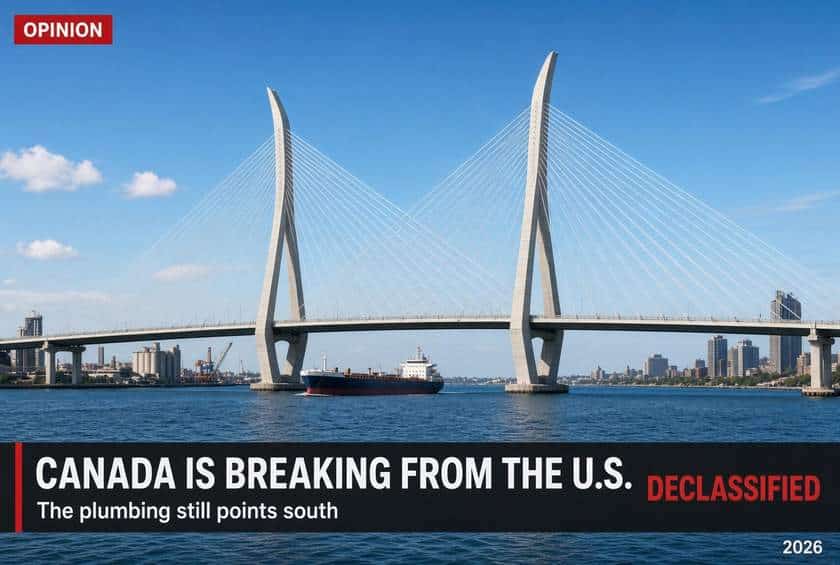
Economists call it structural dependency: a smaller economy whose infrastructure, supply chains and markets have been built around one larger partner. In Canada’s case this is not a state of mind. It is steel and concrete.
The base the break starts from is enormous. Even after last year’s drop, the U.S. still took nearly three-quarters of Canadian merchandise exports. And some of the shift flatters the picture. RBC Economics found that much of the non-U.S. growth came from higher gold prices, which say more about the metals market than about new customers.
Oil shows the problem most starkly. As recently as 2023, about 97 per cent of Canada’s crude exports went to the U.S., according to the Canada Energy Regulator. The Trans Mountain expansion has since opened a door to Asia, but roughly 85 per cent still flows south, The Hub reports. That is partly because many U.S. refineries are configured to process heavy Canadian crude.
The dependency grew out of decades of choices that made economic sense for both countries. That is exactly what makes it so hard to undo. Re-routing a pipeline network, or the supply chains of an integrated auto sector, is an engineering project measured in decades.
Why the familiar feels safer
Behavioural economics has a name for the pull of the familiar, borrowed from individual psychology. Status quo bias describes our tendency to treat the current situation as the baseline and any departure from it as a loss. It is reinforced by loss aversion. Research going back to Daniel Kahneman and Amos Tversky suggests that losses tend to weigh roughly twice as heavily as equivalent gains, though estimates vary from study to study.
Countries are not people, so the analogy has limits. But the same logic shows up in how businesses and governments weigh their options. The costs of decoupling are immediate, concentrated and easy to picture: a plant that closes, a contract that disappears. The benefits are distant, diffuse and uncertain.
The business response to the trade war reflects that calculation. A Canadian Manufacturers & Exporters survey found that 49 per cent of manufacturers are pursuing new export markets. But 44 per cent have cancelled investments, and 16 per cent have shifted some production south of the border. Faced with uncertainty, many firms are not leaving the U.S. market. They are moving closer to it.
The case for staying close
The strongest argument against breaking away is that the integration works. For most of the past 30 years, the continental relationship has been a major source of Canadian prosperity. The Hub points out that there are clear economic reasons to keep selling oil south: the supply chains are already integrated, and many U.S. refineries are configured for heavy Canadian crude. Selling to the biggest, closest, best-connected market is often simply the best price on offer. On this view, the reluctance many Canadians feel is plain arithmetic: walking away faster would mean paying more to earn less.
Institutional muscle memory
The deepest form of inertia may be institutional. Sociologists use the term institutionalization to describe how long dependence on a system erodes the habits needed to operate outside it. Applied loosely to a country, it captures something real about Canada’s security posture.
For more than six decades, continental defence has run through NORAD and close alignment with Washington. Canada built its military on the assumption that the U.S. would cover what Ottawa didn’t. As recently as 2024, defence spending sat at just 1.47 per cent of GDP, according to NATO data reported by BNN Bloomberg.
That is now changing. In March, Prime Minister Mark Carney announced that Canada had reached NATO’s 2 per cent target for the first time since the Cold War, and committed to the alliance’s new goal of 5 per cent by 2035. Ottawa has also been reviewing its 88-jet F-35 order since March 2025, with Swedish-built Gripen fighters among the alternatives. As of September, there was still no decision.
But money is the easy part. Procurement systems, supply relationships, interoperable equipment and strategic habits were all built for a junior partner. Rebuilding the capacity to act independently takes longer than writing a bigger cheque.
Naming the problem correctly
The ground under the status quo has already shifted. On July 1, at the agreement’s first six-year joint review, Washington declined to renew CUSMA for another 16-year term. The agreement remains in force until 2036, but it now faces a review every year. The predictable environment that made dependence feel safe is gone, whether Canada decouples or not.
That changes the debate. Continental integration brought Canada real prosperity, and it is not something to be ashamed of. But it has also become a structural trap, one that makes independence look far more frightening than it may be. Meeting Carney’s export goal will depend less on patriotic sentiment, which Canadians have shown they have in abundance, than on pipelines, ports, procurement and patience.
Canadians have already shown they are willing to change. The harder task is rebuilding the plumbing so the country can follow through.
Related: Canada’s Branch-Plant Economy Was a Choice. It Can Choose Again.
Canada Is Breaking From the U.S. : Why It Feels So Hard
Sources
- Blake, Cassels & Graydon LLP, U.S.–Canada Tariffs: Timeline of Key Dates and Documents, updated September 29, 2026. Supports: US import ban, Canadian counter-tariffs, 50% US tariffs, CUSMA joint review outcome.
- CTV News, Are Canadians still shunning U.S. travel? New StatCan data shows insights, May 21, 2026. Supports: 15 straight months of decline, 28% below March 2024.
- TravelPulse, Record Drop in Canadian Visitors Costs US Tourism Billions. Supports: Statistics Canada’s “deepest and most sustained on record” finding (quoting the agency’s report).
- AltexSoft, Canadian Trips to the US Kept Falling in February. Supports: Air Transat ending U.S. service; Air Canada’s 18% seat increase to Mexico.
- Business Data Lab, Diversification Gains Traction as Exports Close the Year Stronger. Supports: 71.7% export share in 2025, 75.9% in 2024; non-U.S. exports up 5.8% to a record.
- RBC Wealth Management, Borders, business and bargains, citing RBC Economics. Supports: gold prices driving non-U.S. export growth.
- Canada Energy Regulator, Almost all Canadian crude oil exports went to the United States in 2023. Supports: ~97% of crude exports to the U.S. in 2023; U.S. refineries built for heavy crude.
- The Hub, 85% of Canada’s crude oil still flows to the U.S., June 5, 2026. Supports: 85% crude share; U.S. refineries configured for heavy crude; about three-quarters of Trans Mountain crude to Asia-Pacific; Carney’s goal of doubling non-U.S. exports within a decade.
- The Hub, Fewer Canadian companies exported to U.S. in 2025, April 29, 2026. Supports: CME survey figures (49%, 44%, 16%).
- BNN Bloomberg, Canada officially hits NATO defence spending target, March 26, 2026. Supports: 1.47% of GDP in 2024; first time at 2% since the Cold War.
- Prime Minister of Canada, Prime Minister Carney announces Canada has achieved the NATO 2% defence spending target, March 26, 2026. Supports: 2% reached; 5% by 2035 commitment.
- AeroTime, Canada’s F-35 review drags on with no decision timeline, April 28, 2026. Supports: F-35 review ordered March 2025; Gripen option.
- 19FortyFive, Almost 18 months into a review, Ottawa is committed to only 16 F-35s, September 2026. Supports: no F-35 decision as of September 2026; mixed fleet with Gripen under study.
- Kahneman, D. and Tversky, A., “Prospect Theory: An Analysis of Decision under Risk,” Econometrica, 1979. Background for loss aversion (not linked).