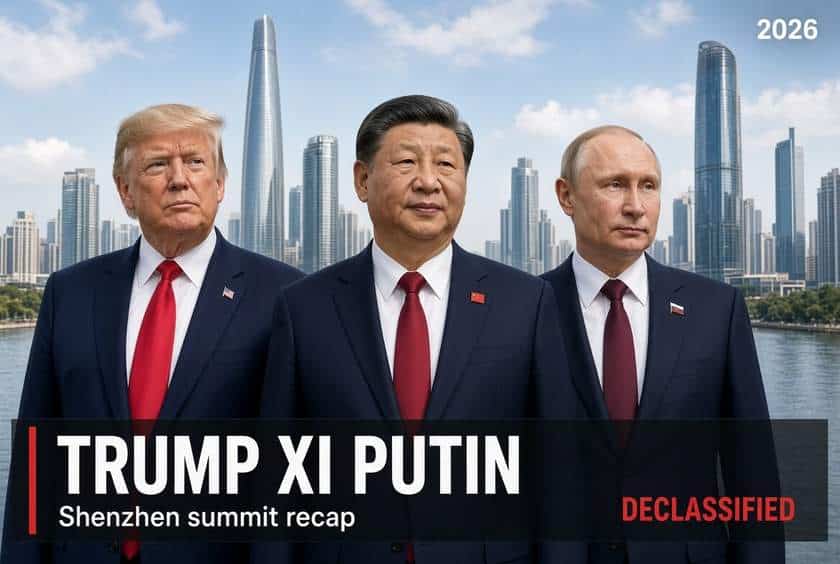
Two days of meetings in Shenzhen ended on Thursday, Nov. 19, with President Donald Trump, Chinese President Xi Jinping and Russian President Vladimir Putin signing a four-point “Declaration toward Peace” and reaching no agreement on the wars in Ukraine or Iran, on trade, or on Taiwan. It was the first three-way meeting ever held among the leaders of the three countries. The AP’s assessment was that the readouts carried more symbolism than substance.
The summit sat on the sidelines of the Asia-Pacific Economic Cooperation meetings. Over two days there were five meetings, and four of them were one-on-one.
Wednesday, Nov. 18: arrival and two dinners
Xi greeted Trump at Shenzhen’s airport, which CNN called a precedent-breaking welcome. Rana Mitter, a China historian at the Harvard Kennedy School, wrote in The Conversation that the hug that followed was unprecedented. Trump and Xi then talked on Wednesday evening. Trump said afterward that they spoke for two hours, with trade and tariffs the main subjects, CBS reported. He raised AI chips and Chinese spying only briefly, CNN reported, saying he didn’t want to insult his host.
Putin met Xi separately the same day and addressed him as a dear friend, according to the AP. Chinese state media described the China-Russia relationship as “steadfast as a rock through wind and rain,” CNN reported. Neither government released details of what the two discussed.
Thursday, Nov. 19: two bilaterals, then the table
Before the three-way session, Trump met Putin for about 40 minutes, the Kyiv Independent reported. Kremlin aide Yuri Ushakov said the war in Ukraine was the main topic, according to the same report. Trump called Putin his friend and told him that a lot of good could come out of the talks, or at least start, the AP reported. Trump also met Xi that afternoon, with Wang Yi, He Lifeng and other senior Chinese officials in the room, according to China’s Foreign Ministry. Its readout says the two agreed to draw up an action plan for what Beijing calls a “constructive relationship of strategic stability.” Xi urged the U.S. to avoid major setbacks over Taiwan, and the readout has Trump saying the United States does not support Taiwan independence. It also has Trump naming farm products, energy and what it calls super intelligence as areas for cooperation, and Xi calling for joint work to keep AI under human control. The White House has not released its own account of the meeting.
The trilateral took place at the Kylin Villa state guesthouse, with reporters dismissed before it started. Mitter noted that Xi sat in the middle. In opening remarks, Xi said that “when great powers clash, the world is in chaos,” Gulf News reported. Trump called the meeting historic, according to the Kyiv Independent. Putin said the three nations share responsibility for international peace as victors in World War II, the AP reported.
The declaration came out afterward. Xinhua and the Kremlin published it, and the White House distributed the same text to reporters under the title U.S.-Russia-China Heads of State Declaration toward Peace. Xinhua’s version lists China first. Its four points commit the three governments to reforming the United Nations, increasing the production and supply of refined petroleum products, defending state consent and the immunity of state officials, and holding a dialogue on reducing nuclear risks and preventing proliferation. It says the International Criminal Court and similar bodies “must not abuse their jurisdiction.” The ICC has had a warrant out for Putin since 2023, and the U.S. opposes the court’s warrant for Israeli Prime Minister Benjamin Netanyahu, the AP noted. The text repeats the 1985 Reagan-Gorbachev line that a nuclear war cannot be won and must never be fought, and it sets no timeline or mechanism for any of its points.
Kremlin video showed Xi walking Putin to his car. “I don’t think anyone even expected things to go so well,” Putin told him, according to the AP.
What stayed off the page
| Issue | In the declaration? | What was said |
|---|---|---|
| Ukraine | No | Putin said afterward that Russia “will not negotiate” after Ukraine’s strikes on the Crimean Bridge (CBS). Kremlin spokesman Dmitry Peskov said Ukraine wasn’t the main topic of the trilateral (AP). |
| Iran and Hormuz | No | Trump said he and Xi agree Iran must fully reopen the Strait of Hormuz and cannot get a nuclear weapon. The AP found no sign he secured help from Xi or Putin. |
| Nuclear arms limits | Dialogue only | Trump wants a new nonproliferation pact. CNN reported Xi was uninterested, and Gulf News, citing The New York Times, said Xi avoided binding limits on China’s arsenal. |
| Trade | No | No truce extension was announced, so the U.S.-China tariff truce still expires Jan. 10, 2027 (CBS). China’s readout of the Trump-Xi meeting says only that the two sides should step up communication on trade. |
| Taiwan | No | Not addressed in the declaration (AP). In the bilateral, Beijing’s readout has Trump saying the U.S. does not support Taiwan independence. The White House hasn’t confirmed that wording. |
What each leader took home
Xi hosted the first summit of its kind and sat at the center of it, a seating choice Mitter read as China presenting itself as the “Middle Kingdom.” He signed on to dialogue but avoided binding limits on China’s nuclear arsenal, Gulf News reported. So far, his government’s readout of the bilateral is the only account of Trump’s words on Taiwan independence, and it adds an agreed action plan for U.S.-China relations.
Putin sat as an equal with the U.S. and Chinese leaders while the war in Ukraine went on, and he gave no ground on it, saying afterward that Russia would not negotiate. The declaration’s language on the immunity of state officials and on limiting the International Criminal Court bears directly on him, since the court has a warrant out for his arrest, the AP noted. Ukraine’s name doesn’t appear in the text.
Trump got a seat at the first summit of its kind, which the Kremlin had proposed, and a three-way commitment to talks on nuclear risk, though with no date or format. On the issues he raised, the record is thinner. The AP found no sign Xi or Putin agreed to help end the Iran war, no truce extension was announced, and the nonproliferation pact he wants wasn’t taken up. He arrived two weeks after Democrats won control of Congress. “We are really making history,” he said as the talks began.
The war continued during the meeting. Russian drones struck Kyiv while the leaders talked, killing one person, and the Dutch embassy and a cathedral were reported damaged, Gulf News reported, citing AFP. Ukraine’s foreign minister, Andrii Sybiha, had warned in October that a three-way summit would “encourage” Putin to keep fighting, the Kyiv Independent reported.
Xi framed the day as a start, saying there is hope for peace as long as dialogue continues, according to Xinhua as cited by the AP. Trump is due to brief reporters on Friday, CNN reported.
The only signed trade deal from Shenzhen this week was Canada’s. Our side-by-side, Carney, Trump and Xi in Shenzhen: Canada vs. U.S. on China, covers it, and our preview of the trilateral covers the arms control treaties that have lapsed.
Sources
- White House press pool, “U.S.-Russia-China Heads of State Declaration toward Peace” (distributed Nov. 19, 2026)
- Ministry of Foreign Affairs of the People’s Republic of China, “President Xi Jinping Meets with U.S. President Donald J. Trump” (Nov. 19, 2026)
- Xinhua, “Full text: China-Russia-U.S. Heads of State Declaration toward Peace” (Nov. 19, 2026)
- AP via WRAL, “Takeaways from the historic summit between Trump, Xi and Putin” (Nov. 19, 2026)
- CBS News, “Trump, Xi and Putin sit down for a rare 3-way meeting in China, but appear to achieve little” (Nov. 19, 2026)
- Kyiv Independent, “Trump joins Putin, Xi in signing ‘declaration of peace’ as summit largely sidesteps Ukraine” (Nov. 19, 2026)
- CNN via ABC17, “Strongmen ‘friends,’ AI’s potential and other takeaways from Trump’s China trip and sit-down with Putin and Xi” (Nov. 19, 2026)
- Gulf News, “Trump, Xi, and Putin’s Historic Summit: A Step Toward Peace or Global Power Play?” (Nov. 19, 2026)
- The Conversation, Rana Mitter, “Xi-Putin-Trump summit was heavy on symbolism, light on substance” (Nov. 19, 2026)
- CNN, live updates on Trump’s China visit (Nov. 19, 2026)
- Kyiv Independent, “US-Russia-China summit would only encourage Putin to continue this war, Ukraine says” (Oct. 19, 2026)