Correction, Nov. 16: Starship Flight 15 flew on Nov. 13. SpaceX caught the ship with its launch tower on Nov. 14, a first, but lost the Super Heavy booster after it called off its own catch. ULA’s Vulcan return flight slipped to Nov. 15 and failed about 10 minutes after liftoff, losing all 40 Amazon Leo satellites. We have updated the opening, the Vulcan paragraph and the final section.
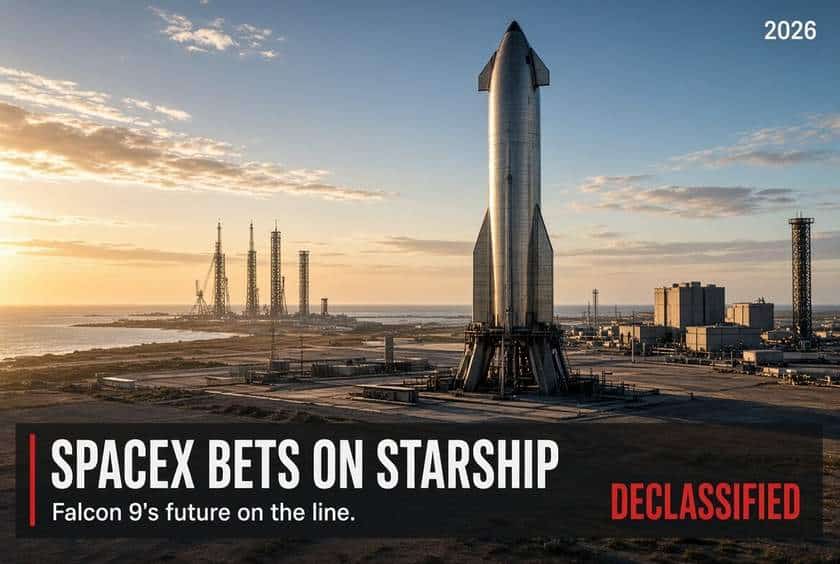
SpaceX caught a Starship upper stage with its launch tower for the first time on Saturday, Nov. 14, about 22.5 hours after Flight 15 lifted off from Starbase, Texas, Space.com and SpaceQ reported. The ship reached orbit and deployed 26 Starlink V3 satellites before coming home. The Super Heavy booster didn’t make it. It called off its own catch attempt and was destroyed just before it hit the water, SpaceQ reported. A lot rides on Starship beyond the test. SpaceX has said it will stop flying the Falcon 9, the rocket that carried 85% of U.S. launches in 2025, once Starship can take over, Scientific American reported. Satellite companies, the Space Force and NASA are now working out what that means for them.
The plan comes from Elon Musk. Once Starship is flying reliably several times a week, it makes sense to move SpaceX’s engineers and production to it, “which means winding down Falcon,” he wrote on X in August, according to NPR and Jalopnik. SpaceX hasn’t set a date. It did not respond to requests for comment from NPR or Scientific American.
No Falcon 9 bookings past 2028
The order book is already closing. SpaceX is no longer taking Falcon 9 reservations for launches after 2028, Jalopnik reported in September, citing industry and government sources. Ars Technica reported that SpaceX had closed its commercial order book for the rocket beyond 2028, according to an explainer by Shattered.
SpaceX has made no announcement saying so.
Martin Halliwell sees it from the customer’s side. As chief technology officer of the satellite operator SES, he booked the first flight on a reused Falcon 9 booster, which flew in 2017. In a Fortune op-ed published Nov. 13, he wrote that most remaining Falcon 9 slots up to around 2030 are already booked, based on his conversations with people at SpaceX, and that operators of small satellites may be especially exposed after that. Halliwell is now a partner at the investment firm NewSpace Capital, which holds stakes in two satellite companies he mentions.
Gwynne Shotwell, SpaceX’s president, has made the case for moving on. “A Falcon 9 with a Dragon capsule on top is like a minivan,” she said at the All In summit in September, according to NPR. The money points the same way. SpaceX earned about $2.1 billion from launches through September, against about $12.8 billion from its Starlink internet service, NPR reported, citing the company’s third-quarter results.
The Space Force gives two end dates
The military relies on Falcon 9 for many national security launches, and it has given different answers on how long it can count on the rocket. The Space Force told NPR it had secured Falcon 9 launches through 2028 and was “confident” other companies could pick up the slack. Its spokesperson Rose Riley told Scientific American that Falcon 9 and Falcon Heavy launches are planned through fiscal year 2032.
Neither statement says which missions are covered.
The Space Force recently tried to book three more missions, two of them for the Space Development Agency, and SpaceX declined, Politico reported in October, according to Scientific American and Shattered. Politico’s sources said no other launch company offered to take them.
The analysis firm Quilty Space estimates the commercial market could be about 150 launches short of demand between now and 2030, NPR and Shattered reported. Shattered noted that the figure leaves out extra military demand and is a model estimate, not a count of orders. Harvard Business School’s Matthew Weinzierl suggested to Scientific American that the government could license the Falcon 9’s technology so it isn’t lost.
NASA’s only ride for astronauts
Falcon 9 also launches Dragon, which is currently the only American spacecraft that can carry NASA astronauts. Starship can’t yet carry people. NASA added three more SpaceX crew flights in September, which at one flight every six months would keep Dragon flying only through 2028 unless more are ordered, NPR calculated. The International Space Station is set to retire in 2030.
The backup is Boeing’s Starliner. NASA plans another uncrewed Starliner test as early as December, with crewed flights in 2028, a NASA spokesperson, Joshua Finch, told Scientific American. Shotwell suggested in September that SpaceX would leave some of the business to Boeing, saying “they should fly their capsule,” NPR reported.
Who else can fly
The rockets meant to share the load have spent much of 2026 on the ground. Blue Origin’s New Glenn exploded on its Cape Canaveral launch pad during a test on May 28 and remains grounded, Scientific American reported. United Launch Alliance’s Vulcan was grounded for nine months after solid rocket booster problems on a February launch. Its return flight slipped from Nov. 13 to Nov. 15 and failed. ULA said the rocket suffered an anomaly about 10 minutes into flight and did not deliver its 40 Amazon Leo internet satellites to orbit, Space.com and Engadget reported. It was ULA’s first mission failure since the company formed in 2006, and ULA hasn’t named a cause. Rocket Lab’s Neutron and Relativity Space’s Terran R haven’t flown yet. Halliwell estimates they may not fly regularly until 2033 or 2034.
That leaves the timeline resting on Starship. Many of its earlier test flights ended in explosions, and it still lacks a payload fairing door for releasing most satellites, Scientific American reported, citing Ars Technica. On Sept. 28 it completed its first full orbit and deployed 26 Starlink satellites before SpaceX cut the flight short over an engine problem, which we covered here. Flight 15 brought the ship home. The booster is still the problem. All four of the newest V3 boosters flown so far have been lost, SpaceQ reported, and Musk wrote that slight engine underperformance left this one low on fuel. Every flight from here moves the date the Falcon 9 stops flying.
Sources
- Space.com, Mike Wall, “ULA’s Vulcan Centaur rocket fails during return-to-flight launch, 40 Amazon satellites lost” (Nov. 15, 2026). Used for: the Vulcan failure, ULA’s statement, the nine-month stand-down.
- Engadget, “ULA Vulcan rocket failure destroys 40 Amazon Leo satellites” (Nov. 16, 2026). Used for: the slip from Nov. 13, ULA’s first failure since 2006.
- SpaceQ, Marc Boucher, “Starship Flight 15: SpaceX catches its ship, loses the booster” (Nov. 2026). Used for: the ship catch, the booster loss, V3 booster record, Musk’s fuel explanation.
- Space.com, “SpaceX launches Starship on ambitious 22-hour Flight 15 test, but aborts booster ‘chopsticks’ catch” (Nov. 13, 2026). Used for: launch, orbit and Starlink deployment.
- NPR via KPBS, Geoff Brumfiel, “SpaceX’s giant rocket may leave NASA in the dust” (Nov. 13, 2026). Used for: the Flight 15 plan, Musk’s post, Shotwell, SpaceX’s revenue, the Space Force’s 2028 statement, Quilty Space, Dragon and the ISS.
- Scientific American, Ramin Skibba, “As SpaceX sunsets Falcon 9, a launch crunch is looming” (Nov. 4, 2026). Used for: the 85% share, Riley’s FY2032 statement, Politico’s report, Weinzierl, Starliner, New Glenn, Vulcan, Starship’s fairing door.
- Fortune, Martin Halliwell, “I booked the first used Falcon 9 booster. Where will satellite operators go when SpaceX retires it?” (opinion, Nov. 13, 2026). Used for: the booked slots, small satellite operators, Neutron and Terran R timing.
- Jalopnik, Nicholas Werner, “SpaceX Is So Confident In Its New Starship Rocket That It’s No Longer Taking Reservations For The Dependable Falcon 9” (Sept. 22, 2026). Used for: the post-2028 booking freeze, Musk’s post.
- Shattered, “Launch Supply Crunch: 150-Launch Gap by 2030” (Nov. 10, 2026). Used for: Ars Technica’s order-book report, the three Space Force missions, Quilty’s method.
- Shattered, “Vulcan Returns After 9 Months With 40 Amazon Leo Satellites” (Nov. 13, 2026). Used for: Vulcan’s scheduled return to flight.
- Space.com, “Watch SpaceX attempt a historic Starship launch and double-catch landing today (Nov. 13)” (Nov. 13, 2026). Used for: the double-catch attempt.
- DeClassified Now, “SpaceX’s Giant Starship Makes Its First Full Orbit” (Sept. 30, 2026)