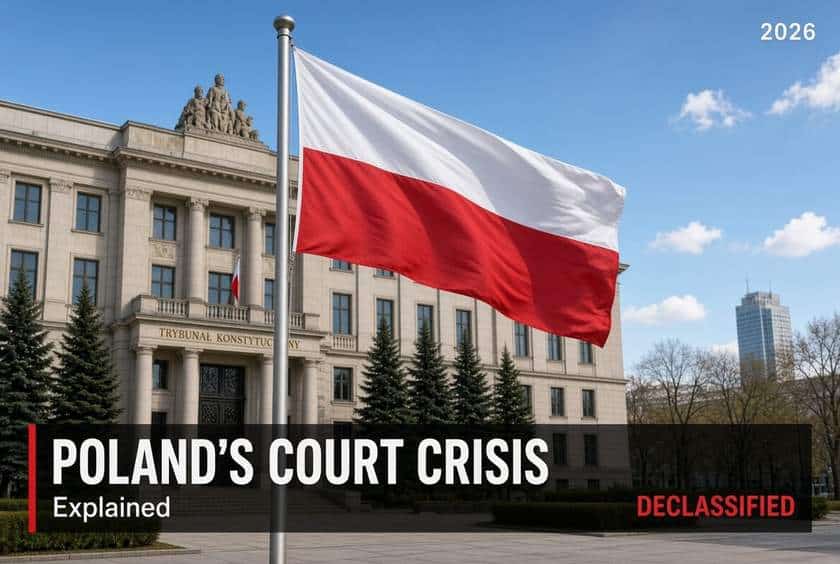
Updated Nov. 1, 2026: Święczkowski was turned away from the court again on Sunday, his side says it will boycott Tuesday’s judges’ assembly, and lawyers are disputing whether the assembly can reach a quorum.
What just happened
Bogdan Święczkowski, the suspended head of Poland’s Constitutional Tribunal, returned to the court’s gate on Sunday, November 1, demanded that police let him in and was refused. He says he will come back every day. The next test is Tuesday, when the judge who suspended him has called an assembly of the court’s judges, which his side says it will not attend.
On the evening of Friday, October 30, 2026, a judge chosen by Poland’s current parliament declared that she had suspended the head of the country’s Constitutional Tribunal and his deputy for one month, and took charge of the court herself. Police secured the grounds. The suspended chief justice, his supporters and opposition politicians called it an illegal seizure of power. President Karol Nawrocki turned his plane around mid-flight to Senegal and came back to Warsaw.
The government of Prime Minister Donald Tusk says it is ending years of obstruction and restoring a lawful court. The right-wing opposition, led by the Law and Justice party (PiS), says the government has taken over a constitutional body by force. Both sides accuse the other of breaking the constitution, and each has legal arguments and institutions on its side.
This explainer sets out how Poland got here, what each side argues, and what to watch next. It is current as of November 1, 2026; the situation is changing quickly.
What the Constitutional Tribunal is
The Constitutional Tribunal (in Polish, Trybunał Konstytucyjny, or TK) is Poland’s top court for constitutional questions. It decides whether laws comply with the constitution, and its rulings can strike laws down. It has 15 judges, each serving a single nine-year term.
The process for choosing judges is at the heart of the dispute:
- The Sejm, the lower house of parliament, elects each judge by majority vote.
- Under the law on the tribunal’s judges, a newly elected judge must then take an oath “before the president” before taking up the seat.
- The tribunal’s own president (its chief justice) is chosen by the President of Poland from candidates put forward by the judges, and runs the court day to day, including assigning judges to cases.
Because the court can block legislation, whoever shapes its membership has real power over what a government can do. That is why both political camps have fought over it for a decade.
How it started: 2015
The dispute began with a contested handover of power in autumn 2015. Both sides made moves that critics regard as improper.
- The outgoing majority acted early. Before the October 2015 election, the Sejm controlled by Civic Platform (PO), Tusk’s party, elected five tribunal judges. Two of those seats were not due to fall vacant until after the new parliament would be seated.
- The new president refused the oaths. President Andrzej Duda, an ally of PiS, declined to swear in any of the five.
- The new majority elected its own five. After PiS won the election, its Sejm chose five judges of its own. The tribunal later held that three of PO’s choices had been validly elected and two had not. PiS’s appointees nonetheless took the three seats PO had validly filled.
Those three PiS appointees became known as “doubler” judges, because their seats were already taken. In 2021, the European Court of Human Rights ruled that a tribunal panel including one of them was not a “tribunal established by law”. The tribunal rejected that ruling.
The 2015 episode matters today for two reasons. It is the root of the government’s claim that the current court is tainted. And it is a precedent: a president refusing to swear in judges chosen by parliament is exactly what is happening again in 2026, with a PiS-allied president again refusing judges chosen by a majority led by Tusk’s party.
The PiS years and Europe’s response (2015–2023)
Under PiS, the tribunal gained a majority of judges chosen by that party, and its rulings increasingly lined up with the government. PiS argued this was a correction.
The tribunal was one part of wider changes to Poland’s courts, including the body that nominates judges and a new disciplinary system for the Supreme Court. Critics at home and abroad said the tribunal no longer met the standard of an independent court. Several of its rulings became flashpoints:
- 2020: a near-total ban on abortion, which set off some of the largest protests in decades.
- 2021: rulings that parts of the EU treaties, and part of the European Convention on Human Rights, clash with the Polish constitution.
The European Union responded by opening a formal rule-of-law procedure against Poland in 2017 and later holding back billions of euros in EU funds over judicial independence. In December 2025, the EU Court of Justice ruled against Poland over tribunal decisions that challenged core principles of EU law.
PiS and its allies have consistently framed this pressure as Brussels overriding Polish sovereignty, an argument that still resonates with their voters.
Tusk’s government and a blocked path (2023–2025)
Donald Tusk returned as prime minister in December 2023, leading a coalition that runs from the left to the centre-right. It had campaigned on restoring the rule of law, and it soon declared that it did not recognise the tribunal as legitimate. In practice, the government has declined to treat the tribunal’s rulings as binding.
The obvious fix, a new law reorganising the court, has been out of reach. Poland’s president can veto legislation, and Tusk’s coalition lacks the votes to override a veto. President Duda, a PiS ally, held office until August 2025. His successor, Karol Nawrocki, was elected in 2025 with PiS support and has used the veto in the same way.
In December 2024, Bogdan Święczkowski became the tribunal’s president. He had been a judge on the court since 2022 and previously served as a deputy justice minister and national prosecutor under PiS.
The result was a standoff: a government that rejects the court, a court that rejects the government’s authority over it, and a president who blocks legislative change.
2026: eight new judges and the oath dispute
This year, as PiS-era judges’ terms expired, the Tusk-aligned Sejm filled eight seats. That would have given judges chosen by the current majority a strong position on the 15-member court. The fight shifted to the oath.
- March: the Sejm elected six judges: Krystian Markiewicz, Anna Korwin-Piotrowska, Maciej Taborowski, Magdalena Bentkowska, Marcin Dziurda and Dariusz Szostek. It later added Sławomir Patyra and, in September, Maciej Berek, whom Tusk has called his right-hand man.
- The president chose whom to swear in. Nawrocki received the oaths of three: Szostek and Bentkowska in April and Patyra in July. He refused the other five, citing doubts about how they were elected or their qualifications.
- The other five swore their oaths in parliament at ceremonies the president was invited to but did not attend, four in April and Berek in October.
- The tribunal sided with the president. On May 12 it ruled (case K 3/26) that the president does not have to accept every appointment and must be present for the oath. Chief Justice Święczkowski kept the five judges from hearing cases.
- European bodies sided with parliament. On May 5, the European Court of Human Rights ordered Polish authorities not to obstruct the judges elected in March. On October 13, the Venice Commission, the Council of Europe’s panel of constitutional experts, said appointing judges is the Sejm’s power and the president cannot block the oaths.
- Prosecutors stepped in. In September, prosecutors charged tribunal officials with preventing the new judges from taking up their posts.
By late October, five judges whom the government considers lawfully elected were locked out of a court whose leadership said they were not judges at all.
October 30 to November 1: the takeover, or the restoration
Friday evening, October 30. Seven of the judges elected by the current parliament entered the tribunal building. Anna Korwin-Piotrowska announced that, acting on four legal cases, she had suspended Chief Justice Święczkowski and his deputy, Bartłomiej Sochański, for one month. She accused them of blocking judges from their posts and of irregularities in assigning cases. She said that as the most senior judge she was now acting head of the court.
Her claim to seniority is itself contested: it rests on her judicial career since 1995, not on time served on the tribunal, where she has never been allowed to sit.
The night. Police secured the grounds, saying Korwin-Piotrowska had warned of threats to judges and staff and to public order. The tribunal’s account on X, still controlled by Święczkowski’s side, said an unlawful takeover was under way, that he remained chief justice, and that Korwin-Piotrowska was not a judge. Some of his supporters cut through the fence with a power tool; police kept him out. President Nawrocki, who had been flying to Senegal for a state visit, ordered his plane back to Warsaw (PiS leader Kaczyński had publicly urged him to return) and arrived at the court during the night, where there were scuffles at the entrance. In a statement read by the head of his cabinet, Paweł Szefernaker, he called it a violation of the constitutional order and a forceful takeover of a constitutional body. Justice Minister and Prosecutor General Waldemar Żurek moved to lift the immunity from prosecution of Święczkowski and Sochański.
Saturday, October 31. Euronews reported that Święczkowski and Sochański were denied entry to the building. PiS supporters gathered outside again, after hundreds protested on Friday night. In a televised address, Tusk defended the suspension, vowed to restore the conditions for independent justice and said that “in certain matters there can be no compromise.”
Sunday, November 1. Święczkowski arrived at the gate after 8:30 a.m. and told the crowd that “nobody dismissed me,” Polish outlets reported. He said Korwin-Piotrowska had deactivated his pass, called her a usurper and warned officers that standing by could itself be a crime. Interior Minister Marcin Kierwiński said police had acted professionally, and the national police chief, Marek Boroń, told officers in a letter that the operation met legal and ethical norms. The head of one police union wrote that officers had raised legal doubts about it. Presidential aide Marcin Przydacz blamed the government for the crisis and said there was no room for talks with Civic Coalition.
Four former tribunal presidents, Marek Safjan, Jerzy Stępień, Bohdan Zdziennicki and Andrzej Zoll, backed the new judges in a joint statement, saying there is no other way to end the crisis. Legal doubts remain on that side too: Korwin-Piotrowska relied partly on a provision of the law on ordinary courts, and Prawo.pl reports that the Helsinki Foundation for Human Rights is among those questioning her legal grounds.
The two sides’ arguments
Each camp says it is defending the constitution. Here is the strongest version of each case.
The government’s case
- Parliament elects judges; the oath is a duty, not a veto. The constitution gives the Sejm the power to choose tribunal judges. A president who picks which of them may take office is, in this view, inventing a power he does not have.
- Outside experts agree. The Venice Commission, the European Court of Human Rights and the European Commission have all said the Sejm’s appointments stand and should not be obstructed.
- The court’s leadership was itself the obstruction. Święczkowski kept five judges out for months, and prosecutors had already charged tribunal officials over it. The suspension, the government argues, ended an unlawful blockade rather than starting one.
- The tribunal has been compromised since 2015, so its May ruling backing the president carries no weight. As Foreign Minister Radosław Sikorski put it, the opposition is refusing to accept that it has lost control of the court.
The opposition’s case
- The law says what it says. Judges must take their oath before the president. Five did not, so by the letter of the law they are not judges, and the tribunal confirmed this in its May ruling. Poland’s human rights commissioner, Marcin Wiącek, also said in April that the law requires the president to swear in tribunal judges.
- A judge who was never seated cannot suspend the chief justice. Marcin Matczak, a constitutional scholar and critic of PiS’s judicial reforms, called the legal basis for the suspension “nonexistent,” and her seniority claim rests on her career outside the tribunal.
- Police were used to change control of a court. To PiS and the president, that is a coup, made worse by the justice minister moving to prosecute the suspended judges, which critics call political pressure.
- The government has ignored the court since 2023 rather than winning a legal change, and European institutions should not look away because of political alliances.
Where the facts are not in dispute
Some core facts are accepted by both camps: the Sejm elected eight judges this year; the president refused to receive five of their oaths; and the tribunal’s chief justice kept those five from working. What is disputed is what those facts mean in law. Whether any rule lets one judge suspend the tribunal’s president is also an open question.
What happens next
Neither side has backed down, and several moves are already scheduled or under way.
- Crisis talks. On October 31, President Nawrocki held urgent consultations with parties at the presidential palace, citing a threat to Poland’s internal security. Civic Coalition and The Left stayed away, and no breakthrough was reported. Proposals ranged from a negotiated “reset” of the tribunal, backed by PSL and Poland 2050, to Confederation’s call to end the terms of all 15 judges and elect replacements.
- A judges’ assembly on Tuesday, November 3. Korwin-Piotrowska has called a meeting of tribunal judges to pass the court’s 2027 budget, saying it is the last moment to do so. Święczkowski says he and the judges he recognises will not take part. That raises a question of numbers. Assembly resolutions need two-thirds of the tribunal’s judges, widely counted as 10 of 15, and the current parliament has elected eight. Michał Romanowski, a law professor, argues that only serving judges count, which could bring the figure down to eight. The tribunal’s president is formally appointed by the President of Poland from the judges’ candidates, so any new leadership would need Nawrocki’s cooperation or face the same legitimacy fight.
- Prosecution of the suspended judges. Żurek has filed five motions to lift immunity, four against Święczkowski and one against Sochański. Under the constitution the tribunal itself must consent, through a resolution of the same assembly, and Żurek’s remarks suggest Tuesday’s meeting may take them up. The outcome, and whether charges follow, will shape how much further this escalates.
- Europe. The European Commission has said the eight appointments fall within the Sejm’s powers and has pointed to the Strasbourg court’s interim order. The European Conservatives and Reformists group condemned the government’s actions and said European institutions “must not avert their eyes.”
- Two rival courts? If both sides keep claiming control, Poland could face rulings issued by one group of judges and rejected by the other, leaving citizens and courts unsure which decisions count. Żurek says the first hearings are a matter of weeks away. Święczkowski says he is on panels for three hearings set for the second half of November, and his side says its judges would keep ruling if allowed into the building.
- The 2027 election. A parliamentary election is due in about a year. Both camps are likely to campaign on this crisis, and the result may decide whether a lasting legal settlement is possible.
Who’s who
| Person | Role | Side |
|---|---|---|
| Donald Tusk | Prime minister since December 2023; leader of Civic Platform | Government |
| Karol Nawrocki | President since August 2025, elected with PiS support | Opposition-aligned |
| Jarosław Kaczyński | Leader of Law and Justice (PiS), the main opposition party | Opposition |
| Bogdan Święczkowski | Tribunal president since December 2024; suspended October 30 | Opposition-aligned |
| Bartłomiej Sochański | Tribunal vice-president; suspended October 30 | Opposition-aligned |
| Anna Korwin-Piotrowska | Judge elected by the Sejm in March 2026; claims to be acting head of the tribunal | Government-backed |
| Waldemar Żurek | Justice minister and prosecutor general | Government |
| Radosław Sikorski | Foreign minister | Government |
| Marcin Wiącek | Poland’s human rights commissioner | Independent office |
Key dates
| Date | Event |
|---|---|
| Nov 3, 2026 | Assembly of tribunal judges called by Korwin-Piotrowska |
| Nov 1, 2026 | Święczkowski is refused entry at the gate again and says he will return daily |
| Oct 31, 2026 | Nawrocki holds crisis talks; European Commission says the appointments are within the Sejm’s powers; protests outside the court; Tusk rules out compromise on “certain matters” |
| Oct 30, 2026 | Korwin-Piotrowska suspends Święczkowski and Sochański; police secure the grounds; Nawrocki returns to Warsaw |
| Oct 14, 2026 | Berek, the fifth judge refused by the president, takes his oath in parliament |
| Oct 13, 2026 | Venice Commission says the president cannot block the oaths |
| Sep 2026 | Prosecutors charge tribunal officials with keeping out new judges |
| Jul 2026 | Nawrocki swears in Patyra |
| May 12, 2026 | Tribunal rules (K 3/26) that the president need not accept every judge |
| May 5, 2026 | European Court of Human Rights orders Poland not to obstruct the March judges |
| Apr 2026 | Nawrocki swears in two of six judges; four take oaths in parliament |
| Mar 2026 | Sejm elects six new tribunal judges |
| Dec 2025 | EU Court of Justice rules against Poland over tribunal decisions |
| Aug 2025 | Nawrocki takes office as president |
| Dec 2024 | Święczkowski becomes tribunal president |
| Dec 2023 | Tusk’s coalition takes power |
| 2021 | European Court of Human Rights rules a panel with a “doubler” judge is not a lawful tribunal |
| 2017 | EU opens rule-of-law procedure against Poland |
| Oct–Dec 2015 | Rival appointments by outgoing and incoming parliaments; president refuses PO’s judges |
Sources
- Notes from Poland: Chaos at Poland’s constitutional court (Oct 30)
- Notes from Poland: Polish president in physical confrontation with judges (Oct 31)
- Notes from Poland: New judge takes oath in defiance of president (Oct 14)
- Notes from Poland: Officials charged with preventing entry of new judges (Sep 24)
- Notes from Poland: President to swear in new judge (Jul 23)
- Notes from Poland: Parliament hosts swearing-in in defiance of president (Apr 9)
- Notes from Poland: President swears in first new judges for four years (Apr 1)
- Euronews: Constitutional Tribunal crisis explained
- Euronews: EU Commission says parliament has right to appoint judges
- Al Jazeera: What’s the crisis about?
- Al Jazeera: Polish president holds crisis talks
- Reuters via US News: Tusk vows support for tribunal
- Kyiv Independent: EU Commission backs Poland government
- Euronews: Tusk vows ‘no compromise’
- Euronews: Constitutional court in chaos
- Kyiv Post: Tusk and Nawrocki double down
- Poland Watch: Constitutional war gives the centre an opening
- Hungarian Conservative: Tusk rules out compromise (reports Confederation’s proposal)
- Polsat News: Święczkowski at the gate (Nov 1, in Polish)
- Zero.pl: Święczkowski tries again to enter (Nov 1, in Polish)
- Super Express: live coverage (Nov 1, in Polish)
- Prawo.pl: Eight or 10 judges for the assembly? (Nov 1, in Polish)
- Prawo.pl: Former tribunal presidents’ statement (Nov 1, in Polish)
- Prawo.pl: Święczkowski on the assembly boycott (Oct 31, in Polish)
- Prawo.pl: Assembly, quorum and immunity rules (Oct 30, in Polish)
- Interia: Former presidents’ statement (in Polish)
- Wikipedia: Bogdan Święczkowski
- Wikipedia: Suspension of Bogdan Święczkowski
- Wikipedia: Polish Constitutional Tribunal crisis (2015–ongoing)