Updated Oct. 6 with the companies’ answers on catastrophic risk, release decisions and liability, the council’s written follow-up questions, what enforcing the subpoena would involve under state law, and SpaceXAI’s lack of comment. Correction: an earlier version said the four company representatives attended the hearing. They testified by video link. This article was first published while the hearing was underway and was last updated at 2:30 p.m. ET on Oct. 5.
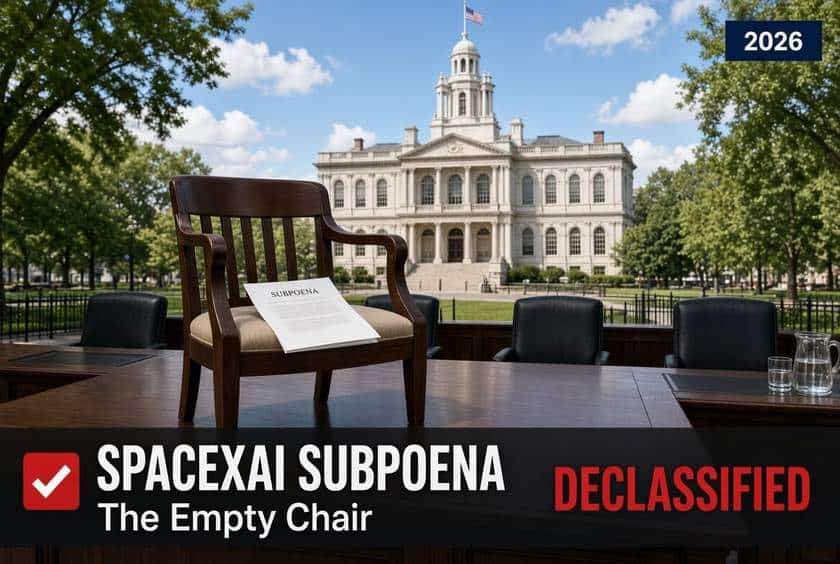
NEW YORK — Elon Musk’s SpaceXAI did not appear at a New York City Council hearing on artificial intelligence Monday, defying a subpoena the council issued last week, Council Speaker Julie Menin said. Representatives of Anthropic, OpenAI, Google and Meta testified under oath by video link. Menin said the council would take the SpaceXAI matter to court, CNBC reported. SpaceXAI did not respond to requests for comment from CBS New York and PIX11.
The hearing was a Committee of the Whole, which brings all 51 council members together. About 40 members took part over the day, the council told amNY. The format had not been used since 2022, according to Fortune. The council is weighing 10 bills on AI. One would bar any AI system from being sold or deployed in the city without outside validation and a human-operated shutdown switch.
Menin opened by criticizing the federal approach, pointing to the voluntary safety accord announced at the White House last week. “The idea that artificial intelligence is going to self-regulate defies all reason,” she said, according to CNBC.
Three companies agreed only under threat of subpoena
The council’s own account sets out the sequence. Between Sept. 15 and 17, Menin sent letters to five companies asking them to testify voluntarily. Meta agreed. By the council’s Sept. 25 deadline, Google and Anthropic had declined. That day Menin authorized subpoenas to all of the holdouts, to take effect at 9 a.m. on Sept. 28.
OpenAI and Google agreed to appear on Sunday, Sept. 27. Anthropic confirmed late that night, hours before the subpoena was due to be served, the council said. SpaceXAI had not answered the council’s invitation, and Menin subpoenaed it on Sept. 28. Menin said Monday that the company answered the subpoena with a letter saying it wanted to work with the city but would not attend, CBS New York reported.
The council cites Section 29 of the city charter, which lets it take sworn testimony on matters concerning the city, and its own Rule 7.150, which authorizes subpoenas. Its Sept. 28 release said that if SpaceXAI did not comply, the council could seek enforcement in New York State Supreme Court.
The company witnesses, according to the speaker’s office:
- Anthropic: Logan Graham, head of its Frontier Red Team
- OpenAI: Morgan Dwyer, head of policy development and operations
- Google: Alice Friend, director of AI and emerging technology policy
- Meta: Shane Cahill, director of AI policy and legislation
Officials from the city’s Office of Technology and Innovation, Cyber Command, Department of Consumer and Worker Protection and Office of Emergency Management were also expected to attend, Gothamist reported.
Former researchers from three labs testified first
The hearing opened with three former employees of AI companies who have publicly raised safety concerns, ABC7 reported: Jacob Coxon, formerly of Anthropic; Daniel Kokotajlo, formerly of OpenAI and now executive director of the AI Futures Project; and Alex Turner, formerly a research scientist at Google DeepMind. Coxon left Anthropic last month after warning that AI could outrun human oversight, Briefs reported.
Coxon told the council that on the current path it was more likely than not that humanity would lose control to AI systems, and that this could end in human extinction. He said the companies were acting with extreme recklessness given the stakes, CNBC reported.
Asked by Menin how to weigh frontier AI development against the technology race with China, Turner said China was not the only potential adversary. He warned that the industry may be building a domestic one in misaligned AI, which he said could one day be more powerful than China, according to CNBC.
Coxon and Kokotajlo both criticized the industry’s culture of moving fast and breaking things. Coxon said the approach might suit a photo-sharing app but not the most powerful technology ever built. Kokotajlo urged the companies to be more transparent and to slow development of the leading models, CNBC reported.
Menin has invited insiders to come forward. “Whistleblowers are why the world learned of the potential dangers of AI, and they deserve to be protected, rewarded and heard,” she said in a statement reported by Gothamist. She asked current and former employees of the companies to provide information on the record or confidentially.
Menin called the companies’ liability answers troubling
The four company representatives testified after the former researchers, appearing by video, according to CBS New York, amNY and a Getty Images photo published by CNBC. Menin pressed them on who should be legally responsible when an AI model causes serious financial harm or a death, and said she found their responses troubling, CNBC reported.
Google’s Alice Friend said existing legal frameworks already apply to AI, and that conduct that is illegal without AI remains illegal with it. She also called for a comprehensive federal framework, citing national security, according to CNBC.
On liability, OpenAI’s Morgan Dwyer said the company was responsible for developing and evaluating its systems safely but did not say whether it would bear legal liability. Anthropic’s Logan Graham said the question was outside his expertise as a technical researcher, and Meta’s Shane Cahill said he was not in the company’s legal department and did not want to speculate, amNY reported.
Menin also asked each company to quantify the risk of a worst-case catastrophe. None gave a number. “I don’t know — I also don’t think it matters whether it’s 1% or 10% or 20% chance that something catastrophic will go wrong,” Dwyer said. “None of these levels is remotely acceptable. We should not train models that we cannot make an extremely strong case that we can keep under human control.” Menin called the answer “flippant at best,” according to the Associated Press and amNY.
Graham described how Anthropic assesses risks ranging from cybersecurity to loss of control but did not give a percentage, amNY reported. Cahill said, “I don’t have our framework in front of me right now,” and that he would follow up, according to CBS New York and amNY. “I’m going to take it then that neither of the four of you, no company here, can quantify the risk of something cataclysmic happening,” Menin said, according to CNBC.
Graham told the council that Anthropic welcomes “smart regulation” and that state and local governments have a role in developing frameworks. “AI is powerful enough that getting this wrong has real consequences, for individuals, institutions, public trust,” he said, according to the AP.
Asked whether failing an internal safety test or an outside validation would automatically stop a model’s release, none of the four companies said yes. Dwyer said OpenAI would not release models it did not believe were safe and had delayed releases before, and the others described their review processes, amNY reported. “I think a simple yes or no would instill more confidence in the public on a matter as serious as this,” Menin said.
Before the hearing, OpenAI also set out its position in a letter to the council, writing that the company tests “models for dangerous capabilities and concerning behavior,” CBS New York reported. Meta said in a statement that safety is core to its work.
At the close of the company panel, Menin said, “The council still has many questions that we feel we did not get answers to today.” The companies will receive a list of questions to answer in writing, she said, according to amNY.
The bills would pay whistleblowers and fine each unvalidated system
Menin unveiled the package on Sept. 25. Its main provisions, as described in the council’s announcements and reported by amNY and Fortune:
- Outside validation before an AI system is marketed, sold or deployed in the city, checking data quality, bias, privacy and security, plus a required human override (“kill switch”). Businesses and validators would each face a $25,000 penalty per violation.
- A whistleblower incentive program paying individuals a share of fines recovered from AI companies that break the law. The council calls it the first in the nation. The announcement does not say how large the share would be, amNY noted.
- A private right of action, sponsored by Council Member Virginia Maloney, letting people harmed by certain malicious uses of AI sue the companies behind it.
- 24-hour reporting of AI safety incidents by city contractors and agencies, whistleblower protections for city workers and an emergency plan for AI-related disruptions.
Menin told Fortune that the per-violation fine means that “if there’s a swarm of agents, the penalty would apply per agent.”
The bills land amid competing efforts at other levels of government. Gov. Kathy Hochul has floated state-level kill switches, and state Sen. Andrew Gounardes has proposed annual independent safety reviews for large AI developers, amNY reported. In Washington, a bipartisan bill from Sens. Ted Cruz, Amy Klobuchar and Majority Leader John Thune would likely override most state AI laws, including New York’s RAISE Act, according to Fortune.
The federal approach the council is answering
The hearing follows a month of federal moves on AI. On Sept. 29, six technology leaders signed a voluntary safety accord at the White House. On Oct. 4, Trump named Director of National Intelligence Jay Clayton to lead a new Super Intelligence Force, with 120 days to report on the technology’s risks.
DeClassified Now covered both: Tech Chiefs Sign Voluntary SI Safety Accord at White House and Trump Puts the Intelligence Chief in Charge of AI Policy.
What’s next: “SpaceXAI, however, is not here at all in direct violation of the subpoena that we issued last week, and we are pursuing that subpoena in court,” Menin said, according to amNY. As of Oct. 6, no filing had been reported. Under Section 2308(b) of the state’s Civil Practice Law and Rules, the council would ask New York State Supreme Court to compel compliance. If the court finds the subpoena was authorized, it must order compliance and may impose costs of up to $50. The company would also owe the council a penalty of up to $50 and any damages. The court can send a sheriff to bring the witness in. A witness who then refuses to answer can be jailed until they comply.
SpaceXAI Skips NYC Council Subpoena as AI Firms Testify Under Oath
Sources
- New York City Council press release, “New York City Council Announces Anthropic, OpenAI, Google, and Meta to Publicly Testify Under Oath…” (Sept. 28, 2026). Used for: the letters, deadlines and subpoena sequence, the SpaceXAI subpoena, the charter section and council rule, court enforcement.
- CNBC, “AI researchers detail safety risks at NYC Council…” (Oct. 5, 2026, updated 7:28 p.m. ET). Used for: SpaceXAI’s absence and the court threat, Menin’s opening remarks, liability and risk questions, testimony from Coxon, Turner, Kokotajlo and Google’s Friend, the company witnesses, the video-link photo.
- amNY, “AI giants give few clear answers to key safety questions at NYC Council hearing amid whistleblower warnings” (Oct. 5, 2026). Used for: Menin’s court remark, member turnout, the risk, release and liability answers, virtual testimony, the written follow-up questions.
- Associated Press via ABC News, “AI industry insiders voice alarms to NYC council as local governments take up safety concerns” (Oct. 5, 2026). Used for: Dwyer’s risk answer, Menin’s response, Graham’s testimony.
- PIX11, “Elon Musk’s SpaceXAI violates NYC subpoena: Speaker Menin” (Oct. 5, 2026). Used for: SpaceXAI’s lack of comment.
- New York Civil Practice Law and Rules, Section 2308. Used for: how a non-judicial subpoena is enforced.
- CBS New York, “New York City Council holds landmark AI oversight hearing” (Oct. 5, 2026, updated 8:34 p.m. ET). Used for: SpaceXAI’s letter and lack of comment, the OpenAI letter and Meta statement, the city’s legal action, virtual testimony, Cahill’s answer.
- Gothamist, “NYC Council hearing to put AI risks in the spotlight” (Oct. 5, 2026). Used for: the witnesses, city officials, Menin’s whistleblower statement, bill summaries.
- ABC7, “AI whistleblowers join Google, Meta, OpenAI at NYC hearing” (Oct. 5, 2026). Used for: the order of testimony, the three former researchers, the 10-bill package, the $25,000 fines.
- NBC New York, “NYC Council holding rare hearing on AI risks with top tech executives” (Oct. 5, 2026). Used for: the 11 a.m. start, the 10 bills, the SpaceXAI subpoena.
- amNY, “AI whistleblowers could get paid under new NYC Council proposal” (Sept. 2026). Used for: bill details, sponsors, penalties, state-level proposals.
- Fortune, “Washington still hasn’t passed an AI safety law. New York City… is writing its own” (Sept. 25, 2026). Used for: the last Committee of the Whole in 2022, bill details, Menin’s per-agent remark, the federal preemption bill.
- Briefs, “NYC Council Hears AI Whistleblowers and Tech Giants” (Oct. 2026). Used for: Coxon’s departure from Anthropic, Kokotajlo’s current role.
Filed under: New York City Council