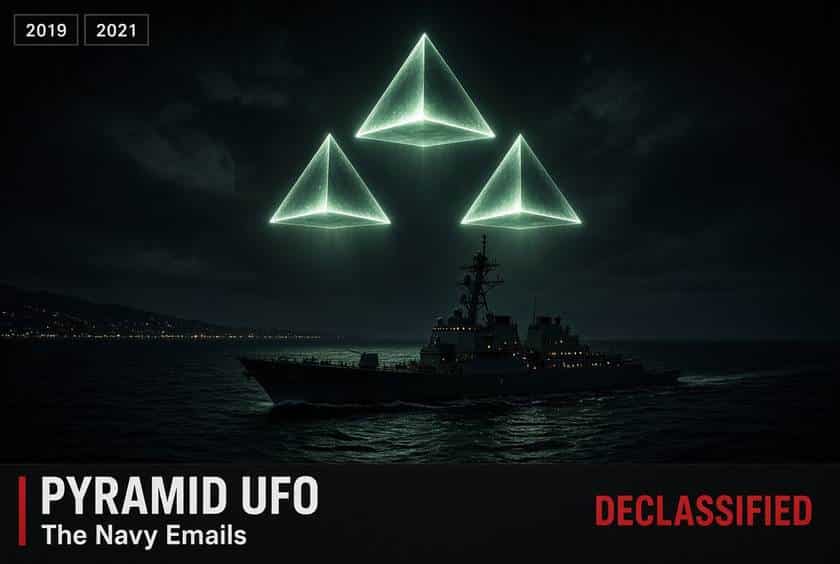
At 11:55 p.m. on April 8, 2021, on the day a night-vision clip of flashing “pyramids” over a Navy destroyer began circulating online, an official sent a two-line complaint to recipients including Matthew Cummings, a senior civilian in the Pentagon’s intelligence office. “I’m curious as to how an ‘investigative filmmaker’ can confirm authenticity…when we haven’t yet,” it read. “Plus, you know, it’d be nice if we could plug leaks about the UAPTF.”
By 6:26 the next morning the message was in the inbox of Scott Bray, then the Navy’s deputy director of naval intelligence, who oversaw the UAP Task Force. It came forwarded with a label, “From DOD PA….” and a verdict: “Not good.”
The exchange is on pages 865 to 869 of the Bray emails the Navy released Sept. 23 under the Freedom of Information Act, four years after The Black Vault’s John Greenewald asked for them. The Navy found 1,321 pages, released 1,019 with redactions and withheld 302. We read the thread around the pyramid video. It shows something the public story left out. Three days before the clip was presented to the world as evidence from the Task Force’s own files, an email sent on Bray’s behalf accepted, on a staffer’s word, that the incident behind it “isn’t a UAP TF issue.”
The video the internet called “flying pyramids”
The clip surfaced on April 8, 2021, through filmmaker Jeremy Corbell and reporter George Knapp’s Mystery Wire. It had been shot in July 2019 through night-vision goggles aboard the destroyer USS Russell, off Southern California. Corbell said it came from a classified Task Force briefing, and that the briefing had stressed the objects were not something “that we own” and not a foreign military’s. A Fox station in Cleveland had picked it up by that night. By the next day the Pentagon had confirmed to The Black Vault that the photos and videos “were taken by Navy personnel” and that the Task Force “has included these incidents in their ongoing examinations.”
For a lot of readers that settled the question. The Navy had filmed flying pyramids, the military’s own UFO investigators were studying them, and nobody could say what they were.
Three days earlier: “this isn’t a UAP TF issue”
The Russell was one of several destroyers whose deck logs, obtained and published by The War Zone that spring, described drones loitering around ships off California over several nights in July 2019. On April 5, 2021, a reporter asked the Chief of Naval Operations about those incidents at a press briefing. He said the Navy had not determined what the aircraft were, and that the sightings had gone to “a separate repository for analysis.” The War Zone’s Adam Kehoe followed up that afternoon, emailing a Pentagon press officer two questions. Was the Task Force examining the July 2019 incident, and was it the repository the admiral meant?
The internal answer, preserved in the release, is not what the public heard four days later. A staffer drafting the reply suggested saying that “Information on this event was shared with the TF, but the incident and the aircraft identified in the reports fall outside the purview of the TF.” “Would that be accurate?” the staffer asked. “Since it is not a TF issue,” the staffer added, it would fall outside the office’s standard “we don’t discuss individual sightings” line.
At 7:06 p.m., a reply went back “on behalf of Mr. Bray.” It opens with “Even though this isn’t a UAP TF issue,” with a parenthetical noting that this was per the staffer’s note, not Bray’s first-hand knowledge. Everything after that is withheld as deliberative.
That is the part worth reading slowly. The draft line was a proposal, and the release does not show what, if anything, was finally sent to The War Zone. But the working view in the April 5 thread, which the reply from Bray’s office repeated, was that the July 2019 drones had been shared with the Task Force and belonged to someone else. On April 8, footage from that same week was being described as a Task Force case. On April 9, the Pentagon’s public statement said the Task Force had included the incidents in its examinations.
The morning after the leak
The emails from April 8 and 9 show officials learning about the leaks the way everyone else did. At 7:29 a.m. on April 8, someone sent Bray a link to a Mystery Wire story with three iPhone photos. They noted they had heard about it from “our favorite FOIA machine,” The Black Vault, which was asking whether the Navy would comment.
After the video went up, the traffic moved fast. The 11:55 p.m. note questioning how a filmmaker could vouch for footage the government had not authenticated reached Bray at dawn. At 8:05 a.m. on April 9, someone wrote to Bray that the story had been passed to the National Intelligence Manager for Aviation and to two other offices at the Office of the Director of National Intelligence. The writer asked whether to expect “some high side comms,” the usual shorthand for classified traffic. At 9:24 a.m., another sender forwarded Bray a Fox affiliate’s version of the story with a one-line joke. “Are you out flying your drones again?”
Nobody in this thread treats the pyramids as a mystery of physics. It is about leaks, authentication and who answers the press.
What Bray said in public a year later
On May 17, 2022, Bray testified at the first open congressional hearing on UAP in half a century, before a House Intelligence subcommittee. He played a Navy night-vision video of flashing triangles recorded “several years ago off the coast of the United States,” which news coverage identified as the Russell footage. The ship, he said, had observed “a number of small, unmanned aerial systems in the area.” The video had been shot through night-vision goggles with a single-lens reflex camera, and it stayed unresolved for years.
Then he showed a second image, taken later off another coast, again through goggles and an SLR during a swarm of drones that other Navy assets also saw. “We are now reasonably confident that these triangles correlate to unmanned aerial systems in the area,” Bray said. The triangular shape, he said, came from light passing through the goggles and being recorded by the camera. Asked by Rep. Adam Schiff whether anyone had reproduced the effect by filming a drone the same way, Bray said the Task Force was aware of studies that had done that.
That testimony explained the shape. The 2021 emails add something the hearing didn’t. Before the leak, the thread in Bray’s inbox already placed the July 2019 drone encounters outside the Task Force. Afterward, its first concern was who had leaked the footage, not what it showed.
What the release doesn’t show
The Navy withheld 302 pages in full, and much of what it released carries redactions. The deliberative text after “Even though this isn’t a UAP TF issue” is gone, and so is whatever Bray’s office proposed saying in public. The sender of the 11:55 p.m. email is redacted. So are the names of the people who wrote to Bray the next morning. Nothing in these pages says who leaked the footage, or who owned the drones over the destroyers in July 2019. Bray’s own explanation in 2022 left that open too.
Read the thread yourself. It starts on page 861 of the release.
Primary source: Department of the Navy, FOIA case DON-NAVY-2022-008648, Scott W. Bray email release, pp. 861–869 (PDF, 1,324 pages). Full context: House Intelligence subcommittee hearing transcript, “Unidentified Aerial Phenomena,” May 17, 2022.
Sources
- Department of the Navy, FOIA release DON-NAVY-2022-008648 (Scott W. Bray emails), Sept. 23, 2026
- House Permanent Select Committee on Intelligence, Subcommittee on Counterterrorism, Counterintelligence, and Counterproliferation, hearing transcript, May 17, 2022
- The Black Vault, “Pentagon Confirms Recent UAP / UFO Leaks as Genuine,” Apr. 9, 2021
- The War Zone, “Multiple Destroyers Were Swarmed by Mysterious Drones off California over Numerous Nights”
- The Black Vault, “Navy Releases Massive Cache of Scott Bray UAP Emails After Four Years,” Sept. 24, 2026