Page 331 of the CIA’s history of its Mexico City station gets to the night of Oct. 2, 1968, in two sentences. Students and the Mexican army met in the Plaza of Three Cultures, the author writes, and it “developed into a shooting contest and the students lost.” The page then notes that a station asset, LIEMBRACE-4, was caught in the army’s sweep while reporting on the rally “at station instructions,” and was held for several days before talking his way out.
Then the page goes blank. Below that paragraph sits a withheld block. The next nine pages, 332 through 340, are withheld entirely, and the top of page 341 is too. We counted them in the copy declassified in 2025 and posted by the National Archives this year, after an executive order that directed the release of the remaining JFK assassination records in full.
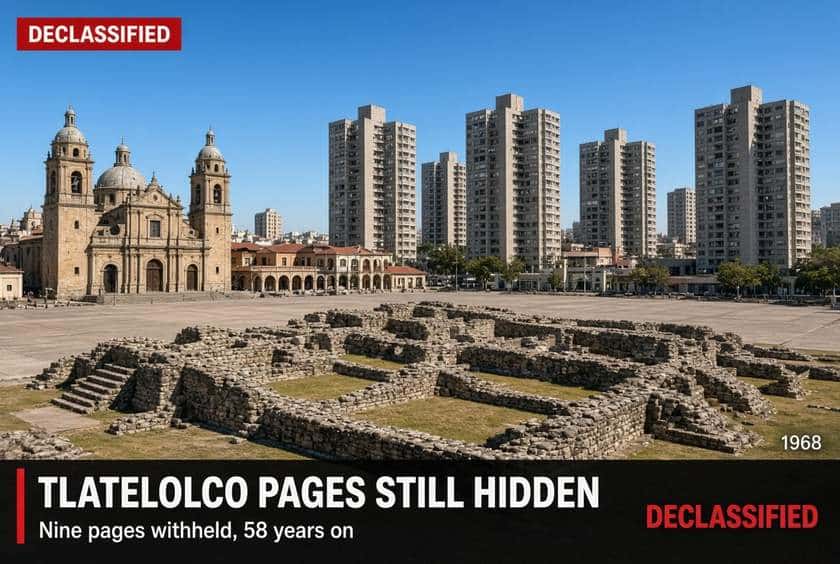
The massacre at Tlatelolco happened 58 years ago this week. Army and police units surrounded the plaza and fired on thousands of demonstrators, ten days before the 1968 Olympics opened in Mexico City. The section of the CIA’s own history that covers it is still classified.
A JFK file that isn’t about Kennedy
The station history ended up in the JFK collection by way of a congressional investigation. In 1978, as part of its inquiry into the Kennedy assassination, the House Select Committee on Assassinations asked the CIA for the station’s full history. That history ran to three volumes and 539 pages, covering 1947 to mid-1969. The CIA handed over 227 pages, according to the National Security Archive, and those extracts became part of the JFK Assassination Records Collection.
When President Trump signed Executive Order 14176 in January 2025, it directed the release of the remaining JFK records in full. For most of the collection, that happened. This document is the exception, and the National Archives says why on its own release page. All assassination-related information in the station history is “fully available to the public,” the page states, but the White House Counsel’s office told the Archives the CIA “may continue withholding portions” that don’t relate to Kennedy’s death, under the exemptions for classified information and information protected by statute.
That carve-out is what keeps pages 332 through 340 dark. Kennedy had been dead for almost five years by October 1968. Nothing in the student section is about his assassination, so nothing in it has to come out.
What the visible pages say about students
The pages just before the gap are open, and they show the station was not a bystander to university politics. Page 329 describes the right wing’s ouster of the National University’s rector in 1952 and adds, flatly, that “in this operation the station had a hand through the LILISP-C group.”
The CIA’s project files, released separately in the JFK collection, fill in more. Project renewals for an operation called LIHUFF show the station funding MURO, a far-right student movement, through an anti-communist think tank called the Instituto de Investigaciones Sociales y Económicas. One renewal credits MURO’s “200 shock troops” with campaigning against communist and pro-Castro groups at the National University and at the universities of Puebla and Guadalajara, and says MURO took major credit for ousting the “Communist” rectors of four universities. The station paid MURO $500 a month.
Headquarters cut that subsidy in June 1965. A renewal request gives two reasons. The think tank could now pay for MURO on its own, and MURO “became more and more controversial and extremely militant on the far right.”
The files show the relationship didn’t end there. A renewal covering mid-1968 says the station had used LIHUFF’s ties to MURO that spring, during the Soviet poet Yevgeny Yevtushenko’s visit to Mexico, though it added that “the use of MURO is being de-emphasized.” A 1969 internal review goes further. It records that the station paid an asset code-named LITEMPO-4 $4,000 “to organize and rally as many students as possible,” in addition to a MURO demonstration at the Soviet Embassy protesting the invasion of Czechoslovakia. That invasion came in August 1968, about six weeks before Tlatelolco.
The CIA has never officially identified LITEMPO-4. Researchers, following the historian Jefferson Morley, identify him as Fernando Gutiérrez Barrios, head of Mexico’s Federal Security Directorate. The National Security Archive notes that Gutiérrez Barrios was the official who recruited Miguel Nazar Haro, later the directorate’s chief, as a CIA asset.
What the gap probably covers, and what it doesn’t prove
The notes at the end of the history were declassified even where the text was not. According to the National Security Archive, the endnotes for the withheld student pages cite four CIA projects by cryptonym: LICOAX, LIMIX, LIAGOG and LINOODLE. Other JFK-collection records describe LICOAX as an effort to gain control of student leadership at Mexican universities, and LIMIX as a project to infiltrate the ruling party and the official technical students’ federation.
The Archive, which published the records on Oct. 1, reads the pattern this way. At best, it says, the CIA helped polarize student politics in the years before the massacre. At worst, given its ties to Mexico’s security chiefs, it played a more direct role in the violence. That second reading is the Archive’s inference. None of the declassified pages we read shows the CIA planning or directing the events of Oct. 2. The pages that might settle it either way are the ones still withheld.
What the visible record does show is how the station described the night afterward. Two sentences, one “shooting contest,” and an asset it had sent to watch.
Who decides what comes out
The history has gone through five declassification reviews since 2017, the National Security Archive counts: two in 2017, then 2022, 2023 and 2025. The Archive first drew attention to the document in 2006. Its researchers say that when they asked to see the newest version at the National Archives in College Park, they were turned away and told that “an agency” was reviewing it. The Archive has filed a Freedom of Information Act request for the full history and is calling on the CIA to release it.
Under the White House Counsel’s guidance, the withheld pages are treated like any other classified CIA record. Whether they come out is now the CIA’s call, made through the ordinary FOIA process.
The CIA’s own history of its Mexico City station describes the 1968 Tlatelolco massacre in two sentences. The next nine pages are still withheld in full.
Primary source: CIA, Mexico City Station History [Extracts], JFK Assassination Records, RIF 104-10414-10124 (2025 release, PDF). Full context: National Security Archive, “The CIA Station in Mexico: The Last JFK Assassination Records Secrets,” Briefing Book #931, Oct. 1, 2026.
Sources
- CIA, Mexico City Station History [Extracts], RIF 104-10414-10124, 2025 release (pages 329-341 cited)
- CIA, Project LIHUFF renewal requests, 1963-1971, RIF 104-10218-10044 (via National Security Archive)
- National Archives, JFK Assassination Records 2025 release page and release notes
- National Security Archive, Briefing Book #931, Oct. 1, 2026
- Executive Order 14176, Declassification of Records Concerning the Assassinations of President John F. Kennedy, Senator Robert F. Kennedy, and the Reverend Dr. Martin Luther King, Jr., Jan. 23, 2025
- National Security Archive, “LITEMPO: The CIA’s Eyes on Tlatelolco,” 2006