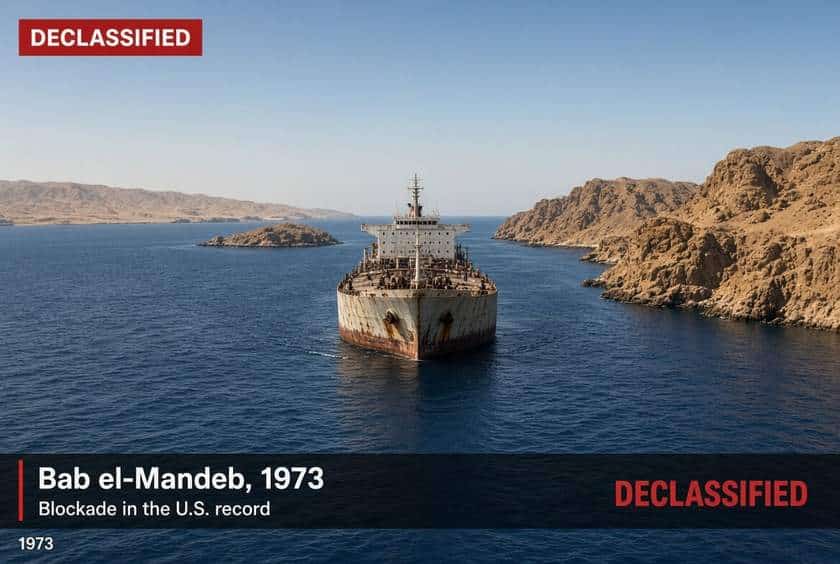
During the October 1973 Arab-Israeli war, Egyptian naval units at the Bab el-Mandeb strait, the southern entrance to the Red Sea, restricted shipping bound to and from Israel. The episode lasted about six weeks.
It is documented in Foreign Relations of the United States, 1969–1976, Volume XXV, Arab-Israeli Crisis and War, 1973, published by the State Department’s Office of the Historian in 2011. The volume’s index lists 16 documents that discuss the straits, drawn from National Security Council files and State Department central files at the National Archives. Most were classified Secret or Top Secret when written.
This entry follows those documents in order. Citations refer to document numbers in Volume XXV.
The war and the October 22 ceasefire
The war began on October 6, 1973, with Egyptian and Syrian attacks on Israeli positions. A United Nations ceasefire took effect on October 22. Israeli forces west of the Suez Canal had by then surrounded Egypt’s Third Army, and the ceasefire lines, the Third Army’s supply and the exchange of prisoners became the subjects of negotiation over the following weeks. The Bab el-Mandeb restrictions became one item in that negotiation (docs. 300, 305, 319).
October 22: the blockade is raised with Kissinger
The first reference in the volume is a memorandum of conversation from Secretary of State Henry Kissinger’s meeting with Israeli Prime Minister Golda Meir near Tel Aviv on October 22 (doc. 230; Top Secret, Sensitive, Exclusively Eyes Only). Meir told Kissinger that when the war began, a blockade of the straits had been established, with Egyptian destroyers under what she described as a Yemeni command.
Kissinger replied that he had not known and would raise it with the Soviets. He advised that Israel could state it publicly as a demand, and that it was important he not appear to be Israel’s spokesman.
October 30–November 2: the Egyptian position
Acting Egyptian Foreign Minister Ismail Fahmi met Kissinger in Washington on October 30 (doc. 300; Secret, Nodis). According to the memorandum, Fahmi said Egypt had military units in the area but that others were involved, noting Soviet relations with South Yemen.
He offered to ask President Anwar Sadat to instruct Egyptian units “to behave” as long as they were not provoked. Kissinger said the ceasefire could not apply on land and not at sea, and that both the prisoner exchange and the blockade should be part of any proposal.
An Egyptian paper recorded on October 31 set out a sequence in which free passage for Red Sea shipping would follow the movement of Israeli forces eastward to a disengagement zone. A bracketed gloss in the original reads: “In other words, the blockade of Bab al-Mandab will be lifted” (doc. 303).
In meetings with Meir on November 1 and 2, Kissinger said he had told the Egyptian foreign minister repeatedly that the blockade had to be lifted, and he advised Israel to tie non-military resupply of the Third Army to a prisoner exchange and an end to the blockade (docs. 305, 312). In a further meeting with Fahmi on November 1, he described the blockade as incompatible with the first Security Council ceasefire resolution (doc. 307).
A National Security Council staff memorandum of November 3 compared the two governments’ written positions. Israel conditioned resupply arrangements on the return of all prisoners and the lifting of the blockade. Egypt placed the lifting of the blockade after an Israeli withdrawal to a disengagement line (doc. 319).
November 6: “not a blockade in the international sense”
The Washington Special Actions Group, the senior interagency crisis committee, discussed the straits on November 6 (doc. 322; Top Secret, Nodis, Codeword). Vice Adm. John P. Weinel, assistant to the chairman of the Joint Chiefs of Staff, gave his personal view that the blockade was “an Israeli invention” and “not a blockade in the international sense,” noting that Egypt had not announced one and had no ships in a line.
Director of Central Intelligence William Colby reported that 13 Israeli ships were tied up in Eilat. Technically there was no blockade, he said, but a ship’s master would not sail. Deputy Secretary of State Kenneth Rush said it was not legally a blockade.
The group agreed that a U.S. cargo ship bound for Jidda should continue through the Red Sea without its destroyer escort. The escort had already been ordered to break off to avoid an incident while Kissinger was in the region.
November 7–9: an oral understanding
Kissinger met Sadat in Cairo on November 7. The volume’s editors note that no record of the discussion has been found (doc. 324). A memorandum from Maj. Gen. Brent Scowcroft, deputy assistant to the president for national security affairs, to President Nixon the same day, quoted in the same editorial note, listed six agreed points on the ceasefire, the town of Suez, Third Army resupply and prisoners. It added that there was also an oral understanding that Egypt undertook “to ease the blockade at Bab El-Mandab.”
The Israeli government accepted the six points with clarifications set out in a U.S.-Israeli memorandum of understanding dated November 8. Its first point stated that the ceasefire on the ground, in the air and on the sea ruled out a blockade of the straits (doc. 327; Secret, Flash, Cherokee, Nodis).
The wording then became a dispute of its own. On November 9, Fahmi complained that Israel had leaked the understanding and said Egypt would be forced to deny that it had agreed to lift the blockade, while standing by its undertaking to ease it (doc. 329). Meir wrote to Kissinger the same day that she would state publicly that both sides would observe the ceasefire on land, air and sea, which would indicate the blockade had been lifted de facto without an announcement (doc. 335).
At a Special Actions Group meeting that afternoon, Scowcroft described the compromise: “They couldn’t lift the blockade because they didn’t have one, so they changed ‘ease’ to ‘relax'” (doc. 336).
November 16–18: shipping resumes
On November 16, Kissinger cabled the U.S. Interests Section in Cairo with a message for Fahmi, reporting that some shipping to and from Israel through the straits would resume on Sunday, November 18 (doc. 344; Secret, Immediate, Nodis, Cherokee). The same telegram instructed the State Department to remind the Israeli embassy to avoid public attention to the matter, and in particular any public reference to Egypt “lifting the blockade.”
An editor’s footnote records a November 17 telegram from Hermann F. Eilts, ambassador-designate and principal officer at the U.S. Interests Section in Cairo: Egyptian naval commanders had been told to allow the first two ships through, while Fahmi maintained that Egypt had agreed to ease, not lift, the blockade.
December 20: a U.S. assurance
The last reference in the volume is a U.S.-Israeli memorandum of understanding of December 20, 1973, setting out the two governments’ approach to the Geneva peace conference. Its sixth point committed the United States to “do its utmost” to ensure that the existing arrangement for uninterrupted passage of ships through Bab el-Mandeb to and from Israel would remain in force, and that Egypt would not apply any blockade measures (doc. 410).
Later events
The strait returned to prominence in September 2026, when Houthi forces in Yemen took the Red Sea coast overlooking it and threatened Saudi shipping, as reported by Reuters and CNN.
Related coverage: U.S. Stays Out of Yemen’s Offensive, but Supplies the Targets.
The 1973 Bab el-Mandeb Blockade in the Declassified U.S. Record
Sources
- Foreign Relations of the United States, 1969–1976, Volume XXV, Arab-Israeli Crisis and War, 1973, ed. Nina Howland and Craig Daigle (Washington: Government Printing Office, 2011). Index entry: Bab Al Mandeb Straits.
- Doc. 230: Memorandum of Conversation, Tel Aviv, October 22, 1973 (Meir, Kissinger).
- Doc. 300: Memorandum of Conversation, Washington, October 30, 1973 (Fahmi, Kissinger).
- Doc. 303: Memorandum of Conversation, Washington, October 31, 1973 (Egyptian position paper).
- Doc. 305: Memorandum of Conversation, Washington, November 1, 1973 (Meir, Kissinger).
- Doc. 307: Memorandum of Conversation, Washington, November 1, 1973 (Fahmi, Kissinger).
- Doc. 312: Memorandum of Conversation, Washington, November 2, 1973 (Meir, Kissinger).
- Doc. 319: Memorandum From Saunders and Quandt to Kissinger, November 3, 1973.
- Doc. 322: Minutes of Washington Special Actions Group Meeting, November 6, 1973.
- Doc. 324: Editorial Note on the Kissinger–Sadat meeting, November 7, 1973.
- Doc. 327: Telegram From the Embassy in Israel, November 8, 1973 (U.S.-Israeli Memorandum of Understanding).
- Doc. 329: Message From Scowcroft to Shalev, November 9, 1973.
- Doc. 335: Backchannel Message From Scowcroft to Kissinger, November 9, 1973 (Meir’s message).
- Doc. 336: Minutes of Washington Special Actions Group Meeting, November 9, 1973.
- Doc. 344: Telegram From Kissinger to the U.S. Interests Section in Cairo, November 16, 1973.
- Doc. 410: U.S.–Israeli Memorandum of Understanding, December 20, 1973.
- The Globe and Mail, from Reuters, October 4, 2026, and CNN, October 4, 2026. Used for: the 2026 Houthi seizure of the coast and threat to Saudi shipping.