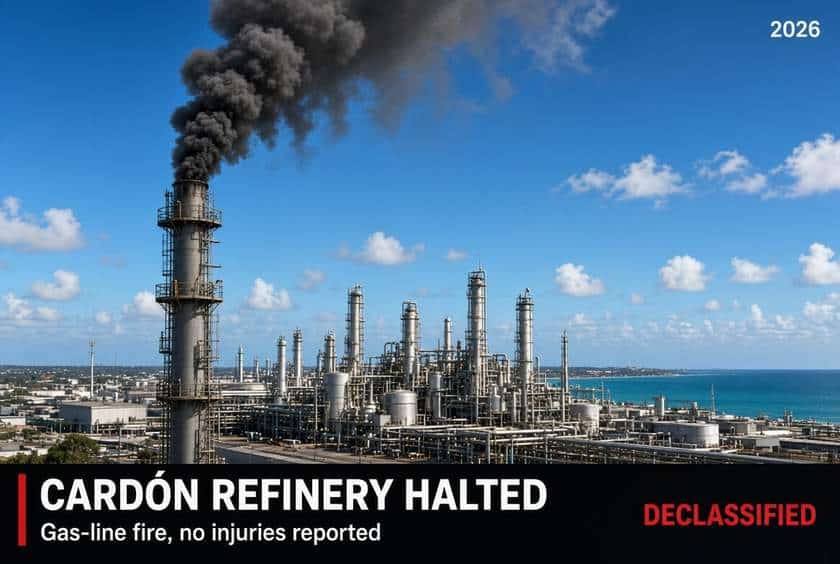
At about 3:25 p.m. on Tuesday, Oct. 6, a natural gas line ruptured at the Cardón refinery on Venezuela’s Paraguaná Peninsula, and the fire that followed shut down the country’s second-largest refinery. State oil company PDVSA said its emergency crews brought the fire under control quickly, that no workers were hurt and that there was no major damage. It ordered an emergency shutdown of the refinery’s plants, saying they will stay down while it assesses the conditions for a safe restart.
PDVSA also said it had formed an investigation committee to determine the cause, and that the national refining system holds enough fuel inventory to keep supplying the country. It has not given a restart date or a damage assessment, and its statement did not include inventory figures.
Cardón is rated at 310,000 barrels a day. With the neighboring Amuay refinery it makes up the Paraguaná Refining Center, rated at 955,000 barrels a day and the largest refining complex in Venezuela. PDVSA’s refineries typically work at a fraction of capacity, Reuters has reported. When the fire broke out, one of Cardón’s crude units and its gasoline-making cracker had been halted since late September for lack of feedstock.
Three versions of where the fire started
The accounts agree on the time, the shutdown and the absence of injuries. They do not agree on where the fire began.
PDVSA’s statement, posted on X Tuesday evening, says the ruptured line fed the refinery’s boilers. Two of the eight sources Reuters spoke to said the fire started at a gas line connected to the diesel hydrotreater, the unit that strips sulfur from diesel, and that it forced the whole facility to shut down, boilers included. The Venezuelan outlet TalCual, citing local reports, placed it in the refinery’s lubricants area. None of the three versions has been confirmed by an inspection report.
Reuters’ sources and neighbors said the blaze was out in less than an hour, after several explosions and the evacuation of personnel. El Pitazo’s sources said they heard three explosions before the flames, and that the fire was controlled at around 4 p.m. PDVSA’s statement does not mention explosions or an evacuation.
A refinery that spent 2026 restarting
The fire landed on a plant that had been stopping and starting all year, according to workers and sources who spoke to Reuters at each step.
| When | What happened at Cardón | Reported by |
|---|---|---|
| Early 2026 | Power cuts hit the Paraguaná refineries. In April, a blackout left all of Cardón without power. | Reuters |
| April 20–21 | PDVSA begins restarting the fluid catalytic cracker, the unit that turns heavy oil into gasoline. | Reuters, via OE Digital and La República |
| Late April | A large fire breaks out at the cracker during the restart. One worker put Cardón’s crude runs at about 76,000 barrels a day before it. | Reuters, citing eight workers |
| Sept. 11 | The cracker restarts. Paraguaná processes about 287,000 barrels a day, roughly 30% of capacity. | Reuters, citing three sources |
| Week of Sept. 21 | A crude unit and the cracker stop for lack of feedstock. Paraguaná falls to about 257,000 barrels a day, roughly 27%. | Reuters, citing workers |
| Oct. 6 | Gas line fire. The whole refinery shuts down. | PDVSA; Reuters |
The cracker matters most here. It is the unit that turns heavy feedstock into gasoline, and gasoline is the fuel Venezuela has struggled for years to make enough of at home.
The insurer’s count from 2012
The most detailed public look inside this complex came from an insurer’s study, not from PDVSA. In March 2012, the engineering firm RJG Risk Engineering prepared a study of the Paraguaná Refining Center for the insurer QBE. After the Amuay explosion that August, the newspapers El Universal and El Nacional published it.
The study counted 222 incidents at the complex in 2011, about 100 of them fires, according to Associated Press and other agency accounts of the document. Of the 222, it said, only nine had been fully investigated with recommendations carried out. Another 173 were still sitting with a committee. The AP said it tried to reach the report’s author to confirm the document was authentic and got no reply.
The Amuay blast that brought the study to light came from a gas leak on Aug. 25, 2012. Official counts at the time put the dead at 41 to 42, and Al Jazeera, citing news agencies, said at least 20 of them were National Guard troops posted to protect the plant. El Pitazo, in its report on Tuesday’s fire, gives the toll as 55, along with 156 injured.
No sabotage claim this time
El Pitazo also pointed out something missing from PDVSA’s statement. Unlike in earlier years, the company named no culprit in advance, and officials did not accuse the opposition of sabotage.
That had been the pattern. After a distillation unit at Amuay exploded in October 2020, Nicolás Maduro, who was president at the time, called it a U.S.-financed terrorist attack using a “powerful long-range weapon,” Argus reported, while a union official at the site suggested a water leak had set off a vapor blast. In June 2022, oil minister Tareck El Aissami said authorities had foiled a sabotage plot against the El Palito refinery and blamed Colombia, AFP reported.
Tuesday’s statement says only that a committee will determine the cause. PDVSA has not said when, or whether, it will publish the findings. Its record on that is recent. In May, a fire after an explosion at the Lamargas compression plant on Lake Maracaibo killed one worker and injured five. PDVSA announced an investigation then too, and as of this week it had not made the findings public, the Spanish news agency EFE reported.
PDVSA’s statement is on El Pitazo’s report, which embeds the company’s post on X.
For how refining capacity, not crude, has been setting fuel prices this year, see our earlier piece, Diesel’s Record Run: Why Refining, Not Crude, Sets The Price.
Fire Shuts Venezuela’s Cardón Refinery
Sources
- El Pitazo, “Pdvsa confirma incendio en refinería Cardón y paralización hasta lograr ‘su arranque seguro'” (Oct. 7, 2026), with PDVSA’s statement on X (Oct. 6). Used for: the boiler gas line, no injuries, the emergency shutdown, the investigation committee, the three explosions and 4 p.m. control, the absence of a sabotage claim, the 55 toll.
- El Heraldo, citing EFE, “PDVSA informó que logró controlar un incendio en la Refinería Cardón” (Oct. 7, 2026). Used for: the 3:25 p.m. time, no major damage, fuel inventories, the May Lamargas fire and its unpublished findings.
- Reuters, “Venezuela’s Cardon refinery halted after fire, sources say” (Oct. 6, 2026), as published by Devdiscourse. Used for: the eight sources, the hydrotreater gas line, the full shutdown, the explosions, evacuation and time to extinguish, the September halt.
- UNN, citing Reuters (Oct. 7, 2026). Used for: the two accounts of the gas line side by side.
- TalCual, “Incendio obligó a paralizar operaciones en refinería Cardón” (Oct. 6, 2026). Used for: the lubricants-area reports.
- Hydrocarbon Processing, citing Reuters, “Venezuela’s PDVSA controlling fire at Cardon refinery’s cracker” (April 2026). Used for: the April blackout and cracker fire, the 76,000-barrel figure, PDVSA’s refineries working at a fraction of capacity.
- La República, “Planta de craqueo de refinería Cardón de Venezuela está reiniciando operaciones” (April 21, 2026) and OE Digital (April 20, 2026). Used for: the April restart.
- Reuters, “PDVSA reinicia unidad de craqueo catalítico fluido en refinería de Cardón” (Sept. 11, 2026), as published by GBM and OE Digital (Sept. 11, 2026). Used for: the September restart, early-year power cuts, 287,000 barrels and 30%.
- Reuters, “Se detiene la producción en la unidad de crudo y en la unidad de craqueo…” (Sept. 25, 2026), via Yahoo Noticias. Used for: the feedstock halt, 257,000 barrels and 27%.
- Cubanet, citing AP and other agencies, “Informe revela fallas en refinerías venezolanas” (Aug. 31, 2012). Used for: the RJG/QBE study, its figures, its publication by El Universal and El Nacional, the AP’s unanswered request, the official toll of 41.
- Al Jazeera, “Venezuela restarts refinery after fatal blast” (Sept. 1, 2012). Used for: the March 2012 study, 222 accidents and 100 fires, the gas leak, the toll of 42 and the National Guard deaths.
- Argus, “PdV investigating refinery unit blast: Update” (Oct. 28, 2020). Used for: Maduro’s 2020 claim and the union official’s account.
- Montevideo Portal, citing AFP, “Venezuela denuncia intento de ‘sabotaje’ contra refinería y responsabilizó a Colombia” (June 4, 2022). Used for: El Aissami’s 2022 claim.