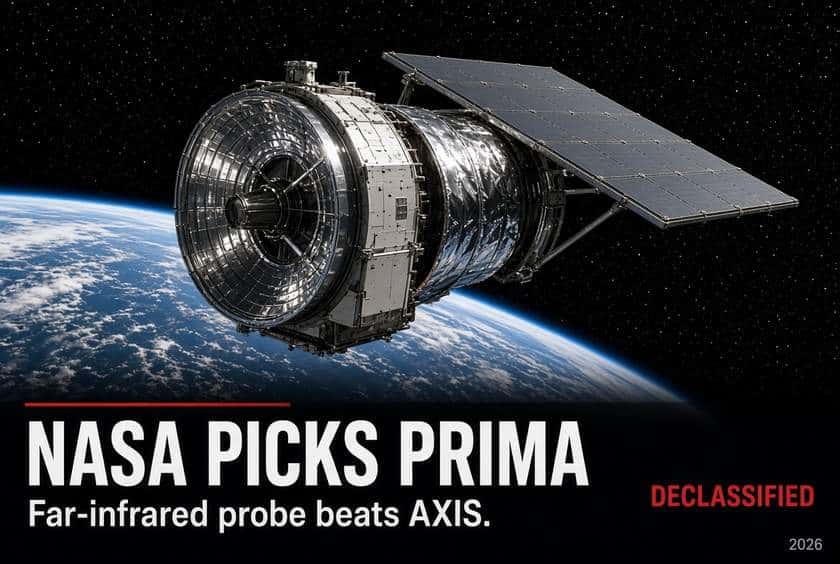
In 1999, Caltech physicist Jonas Zmuidzinas and JPL engineer Rick LeDuc worked out, at a Peet’s coffee shop near the Caltech campus, how a superconducting circuit could be made to detect faint far-infrared light. Twenty-seven years later their idea is the core of a $1.2 billion space telescope.
On Sept. 23, NASA picked PRIMA, the Probe far-Infrared Mission for Astrophysics, as the first mission in a new class it calls Probe Explorers. The telescope is meant to launch in 2033 and reopen a band of light that no observatory has watched since 2022. NASA science chief Nicky Fox called it “humanity’s next window into the deep universe.”
The coverage has mostly stopped there. Less told is how PRIMA won. Its only rival, an X-ray telescope called AXIS, was ruled out in March before NASA ever reviewed its full study. The scientist who led AXIS says the cause was a year of staff losses and a government shutdown at the NASA center building it.
The light that Webb can’t see
Far-infrared light sits between the infrared that the James Webb Space Telescope sees and the radio waves picked up by dish antennas. PRIMA will cover wavelengths from 24 to 235 micrometers, roughly the thickness of a third of a human hair up to two stacked sheets of paper, according to Caltech.
That band matters because it is where cold dust and gas glow. The earliest galaxies are wrapped in dust, and the expansion of the universe stretches their light into the far infrared by the time it reaches us, TU Delft explains. Astronomers want this light to trace how galaxies and their central black holes grew, how dust and heavy elements built up over cosmic history, and how planets and their atmospheres form. NASA’s release adds one more target, how water on Earth came to be.
Nothing is watching that band now.
Europe’s Herschel Space Observatory, the last space telescope built for it, ran out of liquid helium coolant on April 29, 2013. NASA’s Spitzer, which covered part of the infrared, shut down in 2020. SOFIA, a telescope flown aboard a Boeing 747SP by NASA and Germany’s DLR, made its last flight on Dec. 13, 2022, after the National Academies recommended ending it over its cost and scientific return. Paul Hertz, a senior adviser in NASA’s science directorate and former SOFIA program scientist, told Space.com that the decadal survey had recommended a space probe to take over much of the science only SOFIA could do.
A colder mirror and a 27-year-old idea
The trouble with far-infrared astronomy is heat. Warm objects glow at exactly these wavelengths, so a telescope at ordinary temperatures blinds its own camera. Herschel had a bigger mirror than PRIMA’s, 3.5 meters across against PRIMA’s 1.8 meters (5.9 feet). PRIMA’s mirror, however, will be actively cooled to 4.5 kelvin, about minus 451 degrees Fahrenheit. TU Delft says PRIMA will be the first space telescope with an actively cooled mirror.
A cold mirror only pays off if the detectors behind it are sensitive enough to use it. That is where the 1999 idea comes in. Kinetic inductance detectors, or KIDs, register light as a tiny change in a superconducting circuit. Caltech says the team first tested them in 2007 at the now-decommissioned Caltech Submillimeter Observatory on Maunakea in Hawaii. SRON, the Dutch space research institute, has worked on its own far-infrared KIDs for more than 20 years in partnership with JPL. With TU Delft, it says the detectors are now sensitive enough to pick up the faint background glow of the universe itself.
How big is the jump? The figures vary with who is counting and what is being measured. Zmuidzinas said in Caltech’s announcement that the far infrared offers “a chance to leap forward in sensitivity by about a factor of a thousand.” TU Delft puts it at one thousand to one hundred thousand times more sensitive than earlier telescopes. The University of Maryland, whose astronomers are on the team, says that at some wavelengths PRIMA can reach the same depth up to a million times faster than Herschel.
The observatory will carry two instruments, a camera called PRIMAger that maps large areas of sky and measures polarization, and a spectrometer called FIRESS. Caltech’s IPAC will run the science center. About 75 percent of observing time will go to outside astronomers through peer review, and Caltech says the team has already received nearly 200 ideas for using its data from more than 400 astronomers.
How the X-ray rival dropped out
NASA created the Probe class on the advice of the 2020 astronomy decadal survey, the National Academies’ 10-year plan for the field. The class sits between cheaper Explorer missions and multibillion-dollar flagships like Webb and the Roman Space Telescope. In October 2024 NASA gave $5 million each to two finalists for yearlong concept studies, PRIMA and AXIS, the Advanced X-ray Imaging Satellite. AXIS could have replaced NASA’s aging Chandra X-ray Observatory, Space.com noted, and its core study team was based at NASA’s Goddard Space Flight Center in Maryland.
On March 9, AXIS principal investigator Christopher Reynolds emailed his team that NASA headquarters had ruled the mission ineligible for selection, Space.com and astrophysicist Ethan Siegel reported. NASA told Space.com the concept did not comply with the competition’s rules. Its study had exceeded the budget and schedule limits, and one Goddard scientist told Space.com the cost overrun was about 10 percent.
In his email, Reynolds blamed events at Goddard. The project lost more than 20 Goddard staff with key expertise, both outlets reported, as people left through the federal deferred resignation program, retired or took other jobs. Among them were the AXIS project manager and Will Zhang, the Goddard scientist behind the mission’s silicon X-ray mirrors, according to Siegel. Work then stopped for almost seven weeks when the core study team, mostly civil servants, was furloughed during the shutdown that ran from Oct. 1 to Nov. 12, 2025. Reynolds wrote that NASA’s deadline extension did not make up for the lost time, and that the mission “fell victim to the programmatic chaos of 2025.”
Two Goddard scientists who spoke to Space.com without authorization said a 10 percent miss is normal for a first pass and blamed Goddard’s leadership, not the AXIS team. One of them also said AXIS had always been the riskier X-ray proposal. NASA told Space.com more opportunities for X-ray astronomy would follow.
Reynolds closed his message by wishing PRIMA a smooth path to flight. Jason Glenn, who was PRIMA’s principal investigator at Goddard when it became a finalist in 2024, has since left NASA for the University of Virginia, which announced his arrival in August. NASA’s Jet Propulsion Laboratory will manage the mission.
A slower, costlier timetable than first planned
The program has already drifted from its 2024 targets. NASA said then that it would pick a winner early in 2026, launch in 2032 and cap each probe at $1 billion, excluding the rocket. The selection came in late September. The launch target is now 2033, and the cap is $1.2 billion, still excluding launch.
| Date | What happened |
|---|---|
| 1999 | Zmuidzinas and LeDuc work out the KID detector concept |
| April 29, 2013 | Herschel runs out of coolant, ending its far-infrared observations |
| Dec. 13, 2022 | SOFIA’s final flight |
| Oct. 2024 | PRIMA and AXIS each get $5 million for concept studies; target launch 2032, cap $1 billion |
| Oct. 1 – Nov. 12, 2025 | Government shutdown furloughs the AXIS core team |
| March 9, 2026 | NASA rules AXIS ineligible |
| Sept. 23, 2026 | PRIMA advances to Phase B; target launch 2033, cap $1.2 billion |
Phase B is preliminary design, not final approval. PRIMA still has to pass a confirmation review on technical, schedule and cost grounds before NASA commits to building it. NASA hasn’t chosen a rocket yet.
Abroad, the agencies of France, Italy, Germany, Canada, South Korea, Japan and Britain are listed as contributors. The Netherlands isn’t on NASA’s list. Even so, SRON, TU Delft and the University of Groningen say they are the leading candidates to build the detectors, housing and insulation for the PRIMAger camera, with Dutch government money already paying for tests to prove the detector can survive launch and space.
PRIMA: NASA’s Next Telescope and the Rival That Never Got Judged
Sources
- NASA, “NASA Selects Far-Infrared Telescope as First in New Mission Class” (Sept. 23, 2026; updated Sept. 24). Used for: the selection, Phase B and confirmation review, the $1.2 billion cap, the 2033 launch target, science goals, Fox’s quote, the decadal survey, JPL management, international partners.
- Caltech, “NASA Selects PRIMA Mission; Key Roles for Caltech, JPL, and IPAC” (Sept. 23, 2026). Used for: the 1999 coffee-shop origin of KIDs, the 2007 Maunakea test, Zmuidzinas’s quote, the wavelength range, instruments, IPAC, observing time and proposals, Spitzer’s years.
- NASA Science, “NASA Selects AXIS and PRIMA for Studies” (Oct. 2024). Used for: the $5 million studies, the 2026 selection and 2032 launch targets, the $1 billion cap, Glenn as PI at Goddard.
- Space.com, “NASA project leader blames next-generation X-ray telescope cancellation on agency mismanagement” (March 12, 2026). Used for: Reynolds’s email and quote, NASA’s statement, the 10 percent overrun, staff losses, the work stoppage, the Goddard scientists’ comments.
- Ethan Siegel, Big Think / Starts With a Bang, “NASA’s next X-ray mission, AXIS, has been killed” (March 12, 2026). Used for: the ineligibility ruling, 20-plus staff departures and named losses, the deferred resignation program, the shutdown dates.
- TU Delft, “NASA selects infrared space telescope PRIMA featuring Dutch technology” (Sept. 2026). Used for: the 4.5 K actively cooled mirror, the sensitivity range, Dutch contributions.
- SRON, “Far-infrared detectors for PRIMA supported by NSO Instrument Programme”. Used for: SRON’s 20-year detector work with JPL, Dutch government support for flight tests.
- Bits&Chips, “Dutch detectors to help NASA telescope see faint infrared sources” (Sept. 2026). Used for: how KIDs work, the cooled mirror, why early galaxies glow in the far infrared.
- University of Maryland Astronomy, on PRIMA’s selection (Sept. 2026). Used for: Herschel’s 2009–2013 run and the “six orders of magnitude faster” comparison.
- ESA, “Herschel closes its eyes on the Universe” (April 2013). Used for: Herschel’s end date and its 3.5-meter mirror.
- Space.com, “SOFIA: NASA’s prematurely canceled airborne telescope that left a gap behind”. Used for: SOFIA’s aircraft, end, the National Academies recommendation, Hertz on a probe mission, the final flight date.
- Space.com, “NASA’s new PRIMA ‘Probe Explorer’ mission is truly the 1st of its kind” (Oct. 2, 2026) and Spaceflight Now (Sept. 24, 2026). Used for: the mirror size in feet, the five-year mission, the launch provider not yet chosen.
- University of Virginia, “Meet Jason Glenn” (Aug. 31, 2026). Used for: Glenn’s move from NASA to UVA.