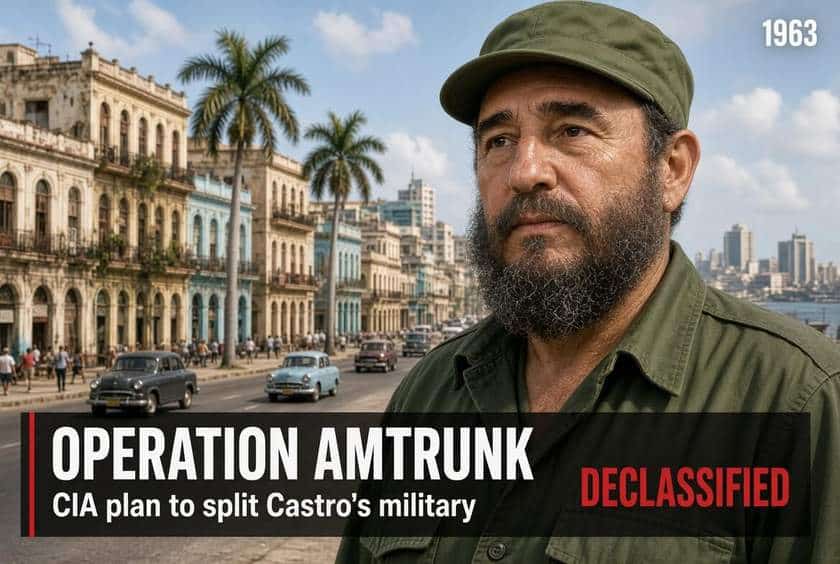
Operation AMTRUNK was a CIA covert program, run from February 1963 to October 1966, to recruit dissident officers inside Fidel Castro’s armed forces and organize a coup against the Cuban government. Its records were released over three decades, through the CIA Historical Review Program in 1998, the Gerald Ford Presidential Library and the John F. Kennedy Assassination Records Act, with one CIA postmortem carrying a 2025 release stamp. The National Security Archive published 10 of them together on Nov. 17, 2026, as Briefing Book No. 935, edited by Peter Kornbluh and Arturo Jimenez-Bacardi. This entry follows the program through those documents in order.
A reporter’s plan reaches the CIA, February 1963
The Cuban Missile Crisis ended in October 1962 with a U.S. pledge not to invade Cuba, which closed off the premise of Operation Mongoose: an uprising that would justify U.S. military intervention. The concept that replaced it came from outside the agency. In early February 1963, Tad Szulc, the New York Times correspondent on Cuba, with U.S. Information Agency officer George Volsky and Cuban exile Nestor Moreno, wrote a six-page “plan of action” called Operation Leonardo. It proposed contacting anti-communist elements in the Cuban government, Rebel Army and militia and pressing them “to act now” (Document 2).
Szulc took the plan to Robert Hurwitch, the State Department’s Cuba coordinator, on Feb. 5, 1963. A CIA-detailed Army officer, Lt. Col. Albert Davies, met Szulc at his Washington home the next evening. Davies’s memo of the conversation gives Szulc the cryptonym AMCAPE-1 and records his view that the plan was “the one sure way of splitting the regime” (Document 3). A 1977 CIA review of the file lists who attended the follow-up meeting at a Washington safe house on Feb. 9: Hurwitch, Szulc, Volsky, Moreno, Davies and CIA officers David Morales and Alfonso Rodriguez. Two days later Rodriguez recommended that the Miami station, JMWAVE, have the Cuban participants ready for infiltration by mid-March (Document 10).
Fitzgerald’s “pincers strategy,” March 1963
Desmond Fitzgerald, chief of the CIA’s Special Activities Staff for Cuba, set out the program’s logic in a March 1963 memo to Director of Central Intelligence John McCone. With an overt invasion excluded and a popular uprising judged unlikely, he wrote, the only potentially effective course was “a pincers strategy of economic strangulation” combined with an effort to identify and contact disaffected officers in the regime’s power centers. The main effort, the memo says, would go against key officers in the armed forces (Document 1). The proposal was approved and took the cryptonym AMTRUNK.
The operational review that JMWAVE station chief Theodore Shackley sent to headquarters states the mission plainly: to overthrow the government through “a conspiracy among high level military and civilian leaders” ending in a coup that would remove both Castro and the Communists (Document 4). The dispatch, numbered UFGA-8381, is dated April 5, 1963, in the Archive’s listing and April 8 in the CIA’s 1977 reviews (Documents 4, 9 and 10).
The station chief recommends termination, April 1963
Shackley’s dispatch recommended that AMTRUNK be ended “at the earliest possible moment.” He described a “very high ‘flap potential'” if any agent were captured, since exposure would tie the operation to the State Department, the USIA, which employed Volsky, and Szulc’s newspaper. He added that the three originators admitted being “anti-KUBARK,” the CIA’s cryptonym for itself (Document 4, as transcribed by the Archive). His review also notes that one planned infiltration area lay within five miles of a cruise missile site.
Headquarters agreed. A cable on April 10, 1963, concurred that the operation should be terminated, in part because the CIA “could not at that time be certain that hostile elements were unaware of the plan.” The 1977 reviewer then records what happened next: “for some reason, CIA continued to support the operation” (Document 10).
AMLASH and the Paris meetings, 1963
Fitzgerald’s plan leaned on Maj. Rolando Cubela Sacades, cryptonym AMLASH, the highest-ranking Cuban officer then in contact with the agency. A Paris station cable of Oct. 7, 1963, reports case officer Nestor Sanchez’s meeting with Cubela, who left restating his wish to return to Cuba for “the big job” (Document 6). On Oct. 29, Fitzgerald met Cubela in Paris himself, under the alias “James Clark,” posing as a White House official close to Attorney General Robert Kennedy. Sanchez’s memo of that meeting records Fitzgerald’s assurance that the United States would assist any anti-communist group that succeeded in “neutralizing the present Cuban leadership” (Document 7).
A CIA summary prepared for the Church Committee in June 1976 covers what followed. Between Nov. 19 and Nov. 22, 1963, a ballpoint pen was rigged as a hypodermic syringe for administering poison. The case officer met Cubela in Paris on Nov. 22, the day of President Kennedy’s assassination. According to the summary, Cubela “was shown the ballpoint pen device but did not accept it” (Document 5). The Archive’s narrative describes the pen as provided to him. The summary’s own account is that he declined it.
Infiltrations, arrests and the end of the program, 1963–1966
The two principals working inside the operation, Moreno (AMICE-27) and Miguel A. Diaz Isalgue (AMICE-14), claimed contacts with senior Cuban officials. They completed four infiltration missions to Cuba and were terminated in March 1964 (Document 10). Over the program’s life the CIA planned more than 20 infiltrations, according to the Archive. Early missions recruited three on-island agents designated AMTRUNK-9, -10 and -11. One was exfiltrated in March 1964 after “reportedly running scared” and later went back to Cuba. Another was arrested in December 1965 and sentenced to 30 years for alleged CIA activities (Document 10).
Headquarters’ doubts grew in 1965. The CIA’s 1977 chronology records a Sept. 7, 1965, headquarters cable instructing that the whole Cubela and AMTRUNK-10 network be assumed “DSE controlled or DSE monitored,” a reference to Cuba’s intelligence service. The same chronology shows the operation renamed STEAMER, with STEAMER-1 mounted on April 29, 1965, and aborted (Document 8). Cuban authorities arrested Cubela and AMTRUNK-10, Ramon Tomas Guin Diaz, separately in February 1966. JMWAVE reported in March 1966 that four more former AMTRUNK assets had been arrested and that all of the network’s 1963-64 principals had been “rolled up” (Document 10). The CIA cancelled the last planned infiltration on Oct. 30, 1966, citing security problems, according to the Archive.
The CIA’s 1977 postmortems
During the House Select Committee on Assassinations inquiry, the CIA’s JFK Task Force wrote two working drafts on AMTRUNK. The first, dated Feb. 10, 1977, opens by stating that the agency had been pressured by “Higher Authority,” as far back as early 1962, to produce a plan against the Castro government (Document 9). It also assesses Cubela as a possible double agent sent to test whether the U.S. government would back an assassination.
The second, dated Feb. 14, 1977, goes further. It suggests AMTRUNK “might have been a political action operation run against the U.S.G./CIA,” in which the Cuban side obtained CIA money and equipment, identified anti-Castro forces on the island and tied up agency time and manpower “for an operation of their own creation.” Among its listed reasons are the originators’ independence from CIA control and Szulc’s access to the White House. It notes that Cubela received a relatively light sentence and was reported to be practicing medicine in Havana in 1977 (Document 10). The reviewers present these as possibilities. Neither draft states a finding that the operation was controlled from Havana.
DeClassified Now’s entry on Operation Mongoose covers the program AMTRUNK replaced.
Sources:
- National Security Archive, “The CIA’s Covert Playbook in Cuba: An ‘AMTRUNK’ Precedent,” Briefing Book No. 935, ed. Peter Kornbluh and Arturo Jimenez-Bacardi (Nov. 17, 2026)
- Document 1: CIA, memorandum to Director McCone, “Outline of Program to Exacerbate and Stimulate Disaffection in the Cuban Armed Forces,” Secret, March 1963 (JFK Records Act)
- Document 2: “Operation Leonardo” proposal, Secret, Feb. 3, 1963 (JFK Records Act)
- Document 3: CIA, “Meeting with AMCAPE-1, 6 February 1963,” Secret, Feb. 7, 1963 (JFK Records Act)
- Document 4: CIA, JMWAVE dispatch UFGA-8381 to SAS with “Project AMTRUNK Operational Review,” Secret, April 1963 (JFK Records Act)
- Document 5: CIA, “AMLASH Operation,” Top Secret, June 10, 1976 (Gerald Ford Presidential Library)
- Document 6: CIA, Paris station cable to the DCI on the Sanchez-Cubela meeting, Secret, Oct. 7, 1963 (JFK Records Act; copy stamped CIA Historical Review Program release, 1998)
- Document 7: CIA, memorandum for the record, “AMLASH/1/Dainold,” Secret, Nov. 13, 1963 (JFK Records Act)
- Document 8: CIA, “Chronology of Significant Documents in AMTRUNK File,” April 1977 (JFK Records Act; copy stamped CIA Historical Review Program release in full, 1998)
- Document 9: CIA, “Operations to Split the Castro Regime – Interim Working Draft,” Secret, Feb. 10, 1977 (JFK Records Act)
- Document 10: CIA, “AMTRUNK Operation – Interim Working Draft,” Feb. 14, 1977 (JFK Records Act, 2025 release)