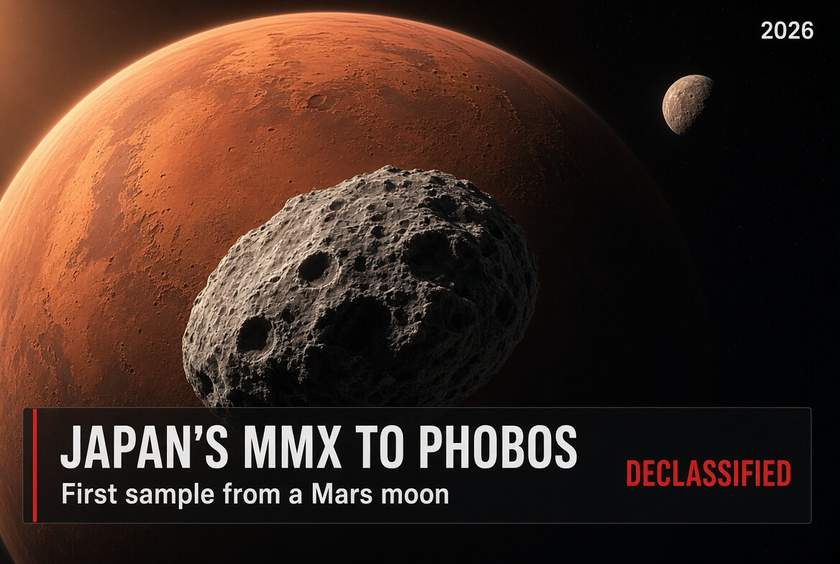
At 3:41 p.m. Eastern time on Monday, which is 4:41 a.m. Tuesday at the Tanegashima Space Center in southern Japan, an H3 rocket is scheduled to lift off with a 4,200-kilogram spacecraft bound for a moon about 22 kilometers across. If the mission works, a capsule will parachute into the Australian outback in 2031 carrying at least 10 grams of Phobos, the larger of Mars’s two moons. Nothing from the Mars system has ever been brought back to Earth.
The mission is Martian Moons eXploration, or MMX, led by the Japan Aerospace Exploration Agency (JAXA) with NASA, France’s CNES, Germany’s DLR and the European Space Agency. If it succeeds, ESA says, MMX will be the first spacecraft to orbit Phobos, the first to collect a sample from a moon other than our own, and the first to come back to Earth after visiting the Mars system.
Every mission built to study Phobos up close has failed. There have been three, all Soviet or Russian.
Two clues that point in opposite directions
Scientists still can’t say where Mars’s moons came from. Phobos and Deimos are small and irregularly shaped, and their spectra resemble primitive D-type asteroids, bodies thought to preserve material from the solar system’s first days. That points to two asteroids that wandered too close to Mars and were captured.
Their orbits argue the other way. Both moons travel in nearly circular paths above Mars’s equator, and a captured asteroid would more likely end up on a stretched, tilted orbit that reflects the direction it came in from. Circular, equatorial orbits fit a different story, in which a giant impact blasted debris off young Mars and the moons formed from the ring of rubble, much as Earth’s moon is thought to have formed.
“It’s two totally different lines of evidence that point in two different directions,” Tom Statler, MMX program executive and scientist in NASA’s Planetary Science Division, said at a NASA briefing on Oct. 15, as reported by Space.com. Hybrid versions that combine the two scenarios have also been proposed, he said.
The two answers predict different chemistry. A captured asteroid should carry volatile elements such as hydrogen, chlorine, sodium and potassium in relatively high amounts. A moon made from impact debris should be a mix of Martian rock and impactor, baked and depleted by the heat of the collision. NASA’s contribution to the spacecraft, a gamma-ray and neutron spectrometer called MEGANE built by the Johns Hopkins Applied Physics Laboratory, is designed to measure those elements to depths of tens of centimeters below the surface. “At this point, we know nothing about the composition of Phobos,” David Lawrence, MEGANE’s principal investigator, said at the same briefing. Earlier missions mapped its minerals, he said, but not its elements.
The rest of the payload works on the same question from other angles. Japanese cameras and a laser altimeter will map the surface and pick landing sites. A French infrared spectrometer, MIRS, built at the Paris Observatory’s LESIA laboratory with CNES, will classify minerals and look for organic compounds. ESA and JAXA give different instrument counts. ESA says 11 science instruments, seven on the main spacecraft and four on the rover, while JAXA’s mission site says 13.
A rover that weighs 15 grams
Phobos is too small to orbit in the usual way. Its gravity is so weak that MMX will fly in what mission planners call a quasi-satellite orbit, circling Mars in step with the moon so that, seen from Phobos, the spacecraft appears to loop around it. The 25-kilogram rover MMX carries, built by CNES and DLR and named Idefix after the dog in the French comic Asterix, will weigh the equivalent of about 15 grams on the surface, ESA says. Space.com reports it will be released from about 40 meters up, free-fall to the ground, bounce and right itself.
The main spacecraft will then come down on four landing legs. It carries two samplers, a corer that shoots into the ground to pull material from about 2 centimeters down, and a pneumatic sampler near a footpad that uses a puff of pressurized gas to blow surface grains into a container. MMX will attempt two collection landings, returning to orbit after each one, according to Space.com. Sampling could begin as early as December 2028, Lindsay Hays, acting director of NASA’s Planetary Science Division, told the briefing. ESA’s own timeline puts the landing in 2030.
| When | Planned step | Source |
|---|---|---|
| Oct. 19, 2026 (Oct. 20 in Japan) | Launch on an H3 rocket from Tanegashima | JAXA, ESA |
| Aug. 2027 | Arrives in Mars orbit and drops its propulsion module | ESA, Space.com |
| Sept. 2027 | Begins orbiting with Phobos and mapping it | ESA |
| Late 2028 or early 2029 | Releases the Idefix rover during a landing rehearsal | Space.com; ESA says early 2029 |
| Dec. 2028 at the earliest | First sample landing | NASA via Space.com; ESA says 2030 |
| 2030 | Deimos flybys, then leaves Mars near the end of the year | Space.com |
| 2031 | Capsule lands in the Woomera area of South Australia | ESA, Space.com |
The capsule, about 60 centimeters wide, will be flown from Australia to JAXA’s Institute of Space and Astronautical Science in Sagamihara, near Tokyo, where the samples will be catalogued and shared with partner agencies. “Bringing samples to our most sophisticated labs here on Earth is a multiplier for discoveries,” said Elliot Sefton-Nash, ESA’s MMX project scientist.
The moon that was once called hollow
Phobos has drawn stranger theories than most moons. In the 1940s, the U.S. Naval Observatory astronomer Bevan Sharpless calculated from decades of observations that Phobos’s orbit was speeding up, which meant it was slowly falling toward Mars. In 1959 the Soviet astrophysicist Iosif Shklovsky looked for a cause. If the decay came from drag in Mars’s thin upper atmosphere, he reasoned, Phobos would have to be extraordinarily light for its size, and he suggested it might be hollow and possibly artificial, a metal shell perhaps 6 centimeters thick.
The idea traveled. Carl Sagan, who later wrote a book with Shklovsky, and the physicist Fred Singer both took it seriously at the time. Shklovsky himself later told the British astronomer Patrick Moore that the paper had been a joke, though accounts differ on how seriously he meant it.
The decay turned out to be real but much slower than Sharpless’s numbers suggested, because his calculation was skewed by errors in the old observations. Tidal forces, not air drag, explain it. NASA now puts the rate at about 1.8 meters every hundred years, and says that in roughly 50 million years Phobos will either hit Mars or be pulled apart into a ring. Both Sharpless and Shklovsky now have craters on Phobos named after them.
Three tries, no landing
The Soviet Union launched twin probes, Phobos 1 and Phobos 2, a few days apart in July 1988. Each was meant to fly within about 50 meters of the moon’s surface and drop landers, including a hopper designed to bounce across the ground on spring-loaded legs.
Phobos 1 never reached Mars. On Aug. 28, 1988, controllers sent an upload containing a one-character error, and it triggered a test routine left in the probe’s permanent memory that switched off its attitude thrusters. The probe lost its lock on the Sun, its solar arrays drifted out of position and its batteries ran down.
Phobos 2 made it into Mars orbit in January 1989 and returned 37 images covering most of Phobos, along with the first mineral maps of the moon from an infrared spectrometer built in part by Paris Observatory scientists with CNES. By then two of its three onboard computers were failing. Contact was lost in late March 1989, shortly before the close approach, and the landers were never released.
Russia tried again in November 2011 with Fobos-Grunt, a sample-return mission that also carried China’s first Mars orbiter, Yinghuo-1. The rocket worked. The spacecraft’s own engines never fired to send it toward Mars, and it fell back into the Pacific Ocean west of Chile in January 2012.
The rocket has failed twice
MMX was first meant to launch in 2024. The H3, Japan’s new flagship rocket, failed on its first flight in March 2023 when its second-stage engine didn’t ignite, In December 2023 Japan’s government formally moved MMX from fiscal 2024 to fiscal 2026, the next Mars launch window, after JAXA decided the new rocket had to prove itself before carrying an interplanetary mission, Space.com reported. Earth and Mars line up for those launches about once every 26 months.
The H3 flew successfully in February 2024 and several times after that. Then on Dec. 22, 2025, it failed again with the Michibiki 5 navigation satellite on board. JAXA has said it suspects a part that holds the payload failed shortly after the nose fairing separated, damaging the second stage. The rocket returned to flight on June 12, 2026, in a new configuration without solid boosters, and placed its test payload and several small satellites in orbit. JAXA’s mission site lists MMX as riding H3 Launch Vehicle No. 10.
ESA has said it will issue an image release confirming a successful launch on Oct. 20.
Sources:
- ESA, “Mars moon lander set to launch on 19 October” (Oct. 2026). Used for: launch time, partners, the mission’s firsts, instrument count, rover weight, timeline and Sefton-Nash’s quote.
- ESA, “MMX factsheet”. Used for: spacecraft mass, the samplers, the capsule and its handling, and MIRS.
- JAXA, Martian Moons eXploration project site. Used for: JAXA’s instrument count, the 10-gram goal and the H3 vehicle number.
- Space.com, “Returning the first samples from a Martian moon: Inside the science of Japan’s bold MMX mission to Mars” (Oct. 2026). Used for: the Oct. 15 NASA briefing, Statler’s, Lawrence’s and Hays’ remarks, MEGANE, the origin hypotheses, the rover release and the timeline.
- NASA, “Phobos”. Used for: the moon’s current orbital decay and fate.
- Wikipedia, “Bevan Sharpless” and “Iosif Shklovsky”. Used for: the 1940s decay measurement, Shklovsky’s hollow-moon suggestion and its reception.
- Bulletin of the American Astronomical Society, abstract on Shklovsky’s Phobos calculation (2025). Used for: the later correction of the decay rate and the tidal explanation.
- NASA Space Science Data Coordinated Archive, “Phobos Project Information”. Used for: the 1988 launch dates of Phobos 1 and 2.
- Wikipedia, “Phobos 1” and “Phobos 2”. Used for: how each probe was lost, the planned landers and Phobos 2’s images and spectra.
- Wikipedia, “Fobos-Grunt”. Used for: the 2011 launch, Yinghuo-1 and the January 2012 re-entry.
- Space.com, “Japan delays MMX Mars moon sample-return mission to 2026” (Jan. 2024) and Spaceflight Now, “Japanese space science missions facing delays after H3 rocket failure” (April 11, 2023). Used for: the H3’s first-flight failure, the two-year delay and the launch-window interval.
- Wikipedia, “H3 (rocket)”. Used for: the H3’s flight record, the December 2025 failure and the June 2026 return to flight.