OPINION
You ever notice that the guest who says “don’t go to any trouble” is usually the one who shows up with a casserole the size of a canoe? Brazil has been getting a version of that from Washington all year. Nobody in the U.S. government has said, officially, who it wants to win. It just keeps bringing casseroles.
The question is whether the United States is interfering in Brazil’s presidential election. The runoff between President Luiz Inácio Lula da Silva and Senator Flávio Bolsonaro is this Sunday, October 25.
Start with the scoreboard. In the first round on October 4, Bolsonaro took 47.03 percent of valid votes and Lula took 45.16 percent, according to Brazil’s Superior Electoral Court. Datafolha’s poll the day before had Lula ahead by three points. So the polls missed, which is a thing polls do now, the way toast lands butter-side down.
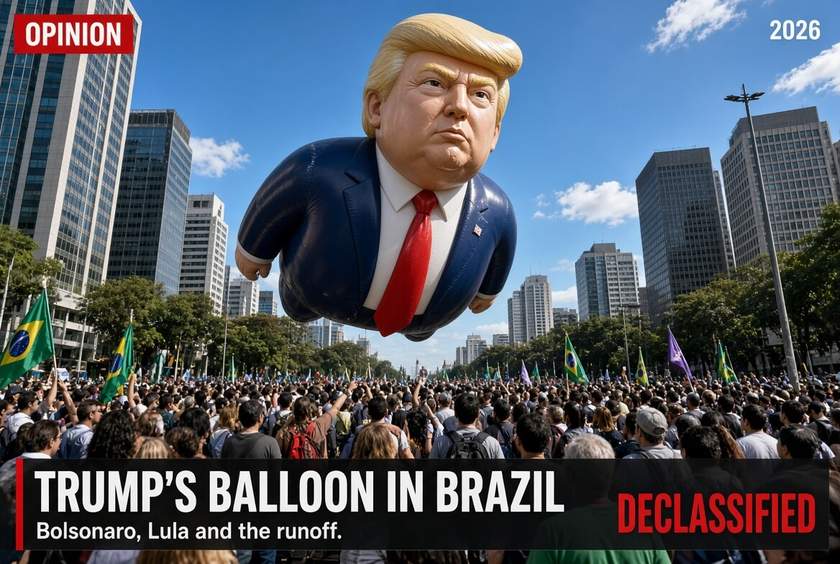
Then the endorsement. There hasn’t been one. Trump said he was “following it very closely” but did not formally endorse Bolsonaro. That’s notable, because he did endorse in recent races in Honduras, Colombia, Chile, Argentina and Costa Rica. Bolsonaro’s supporters, meanwhile, brought a giant inflatable Trump to a São Paulo rally on September 7, according to CNN and Foreign Policy. So the balloon came to the rally and the endorsement stayed home. In most families that’s the other way around.
By October 18, a week before the runoff, the props had escalated. Supporters on São Paulo’s Avenida Paulista hoisted an inflatable missile with “Trump Nuke Brazil” written on it, according to Agência Brasil and Congresso em Foco. Organizers asked the crowd to put away the American and Israeli flags for the day. Asking a foreign president to bomb your own country is a sign you’d usually expect to find at the other side’s rally.
Now the casseroles. In 2025, the U.S. put 50 percent tariffs on Brazil in response to Jair Bolsonaro’s coup trial, and most of them were later rolled back. Trump had called that trial a “witch hunt.” Then in July of this year came round two: two new sets of tariffs, 25 percent on some Brazilian goods and 12.5 percent on others, with Washington pointing to unfair trade practices and forced labor.
The official reason changed, but the Bolsonaro family’s story got harder to tell. Flávio Bolsonaro’s brother Eduardo had claimed credit the year before for pushing the White House to raise tariffs. Flávio himself says he expressly asked Trump not to tariff Brazil. It’s like asking a neighbor not to egg your house the year after your brother told everyone he’d ordered the eggs.
Add the rest of the year. Brazil’s intelligence agency raised its assessment of U.S. interference risk to “critical” in August. The U.S. revoked the visa of Brazil’s ambassador in Washington. Consular services shut down two days before the first round. Thirty-one Democratic members of Congress wrote to Secretary of State Rubio about what they called a “sustained, multifaceted campaign of interference and destabilization.” None of that is a smoking gun. It is a lot of warm stovetops.
The newest fight isn’t with Washington at all. It’s with Meta. Lula’s campaign says his posts showed up without share buttons, lost reach, and had stories that blocked reactions, played without sound, or ran at accelerated speed, which is how most of us would prefer to hear campaign speeches anyway. Meta’s Brazil office called the charges “simply false.” Then Folha de S.Paulo got hold of internal messages in which Meta employees acknowledged that Lula’s Instagram accounts were negatively affected by restrictions during the election, and that the platform had recommended Bolsonaro’s profile and his WhatsApp channel.
An electoral court justice has since ordered Meta not to unjustifiably limit the reach of political content about either candidate through the runoff, and told Meta AI not to favor either one. That’s a court telling a chatbot to stay neutral. We’ve arrived somewhere.
Here’s the strongest case on the other side, and it’s a real one. If this was a plot to elect Flávio Bolsonaro, it was a terrible one. After the 2025 tariffs, Lula’s approval went up as Brazilians rejected foreign interference in their courts. After this summer’s round, polls suggested Brazilians blamed the Bolsonaro family more than Lula, and the nickname “TariFlávio” went viral.
The State Department rejected the characterization of a planned visit by its officials as election interference. The intelligence report was preventive and didn’t claim any interference had happened, even if agency officials later told European diplomats, according to Reuters, that they’d seen some from both Washington and Moscow. And no court has tied Meta’s algorithm to anyone in Washington. A U.S. administration can pursue trade disputes and defend an ally it considers wrongly prosecuted without that being a scheme to pick Brazil’s president. And Bolsonaro won the first round on his own votes, counted by Brazil’s own court. Brazilians may simply want a change, and it isn’t fair to them to assume they couldn’t have gotten there without help.
So, interference? The honest answer is that Washington has done a great many things that affect Brazil’s election, and it has not done the one thing that would settle the question. It never said who it was rooting for.
It didn’t have to. It’s just floating a balloon.
Sources:
- TASS, first-round results at 100% counted, citing Brazil’s Superior Electoral Court (Oct. 2026)
- O Povo, “Datafolha: Lula tem 45% e Flávio, 42% dos votos válidos” (Oct. 2026)
- MercoPress, “Trump declines to back Lula or Flávio Bolsonaro as Brazil votes” (Oct. 4, 2026). Used for: Trump’s comments, past endorsements, the intelligence report and Reuters’ account of agency officials
- CNN, “Brazil election heads to runoff between Bolsonaro and Lula, in campaign dominated by crime, corruption and Trump” (Oct. 4, 2026)
- Foreign Policy, “Lula, Flávio Bolsonaro Vie for Swing Votes in Final Days” (Oct. 2, 2026)
- Agência Brasil, “Campanha de Flávio Bolsonaro realiza manifestação na Paulista” (Oct. 18, 2026)
- Congresso em Foco, “Apoiadores levam réplica de míssil com recado a Trump em ato de Flávio” (Oct. 18, 2026)
- News Central TV, “Brazil, US Resume Talks on Trump Tariffs” (Sept. 1, 2026)
- Reuters, on the July tariffs and the Bolsonaro family (July 16, 2026)
- Kuwait Times/AFP, “Brazil and US to hold trade talks after leaders’ call” (Aug. 22, 2026)
- Sábado, “Trump elogia adversário de Lula em meio a novas tarifas dos EUA” (July 2026)
- Americas Quarterly, “Trump Pushes the Bolsonaros to the Brink” (July 2026)
- The Rio Times, on the ABIN report rating U.S. interference risk “critical” (Sept. 2026)
- MercoPress, “US revokes Brazilian ambassador’s visa over delay in accepting its envoy” (Aug. 4, 2026)
- Reuters via The Star, “US halts consular services in Brazil over security concerns before election” (Oct. 3, 2026)
- Brasil de Fato, “Bernie Sanders and US Democrats accuse Trump of trying to interfere in Brazil’s elections” (Sept. 25, 2026)
- The Express Tribune/AFP, “Brazil’s Lula accuses Meta of election interference” (Oct. 2026)
- Reuters via WSAU, on Meta’s internal messages reported by Folha de S.Paulo (Oct. 16, 2026)
- Straight Arrow News, “Brazil election heads to runoff between Lula, Flávio Bolsonaro as Trump looms” (Oct. 2026)