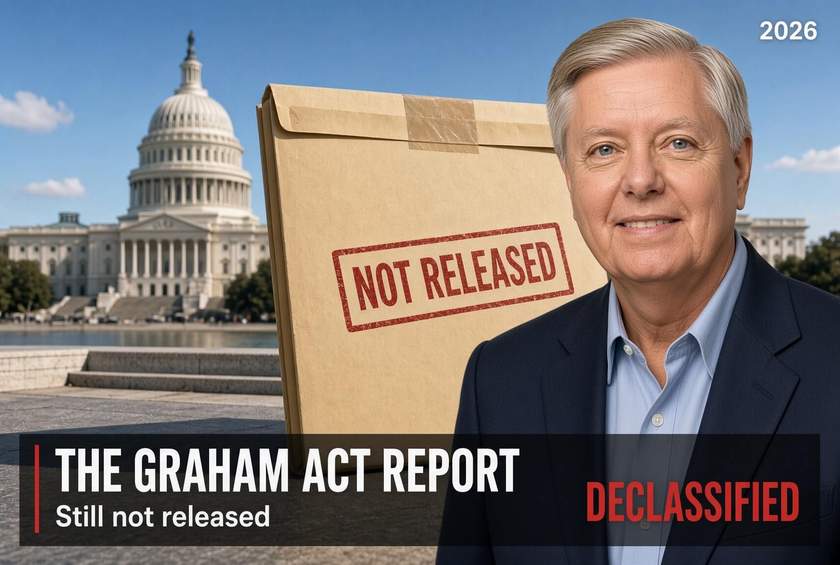
WASHINGTON — President Donald Trump told Congress in writing why he waived nearly every Russia provision of the Lindsey O. Graham Sanctioning Russia and Iran Act, according to his Oct. 16 executive order. The law requires that explanation to be submitted in unclassified form. Neither the White House nor Congress has released it.
Section 115 of the act, Public Law 119-111, lets the president waive any of its sanctions, restrictions or duties. Before he does, he must send Congress two documents: a written certification that the waiver is in the national interests of the United States, and “a report explaining the basis for the certification.” Section 115(b)(3) says each report “shall be submitted in unclassified form but may include a classified annex.”
The law does not require the report to be published.
Trump’s order says he submitted both “consistent with section 115(b) of the Graham Act.” The order itself gives no reasoning beyond the national-interest finding, ABC News and Law Commentary reported. RFE/RL reported that the White House had not publicly detailed its justification.
The order sets the tariffs, then waives them
The order’s Section 2 raises the duty on Russian goods by 500% ad valorem. It sets a 100% duty on goods from the five largest importers of Russian crude oil and natural gas that keep buying on or after Oct. 18, and a 100% duty on the top five facilitators of Russian oil sanctions evasion. Section 4 then waives all of those duties.
Section 4 also waives the act’s sanctions in sections 102(a), 102(d), 102(e) and 103 through 111. Those cover foreign banks that do significant business with Russian state-owned banks, purchases of Russian sovereign debt and new U.S. investment in Russia, ABC News reported. The order says it does not affect sanctions already in place under earlier executive orders on Russia.
The order also waives Section 117, which sets the conditions for ending any sanction under the act, including Russia signing a peace agreement accepted by Ukraine, ABC News reported. It gives Congress at least 30 days’ notice to block a termination by joint resolution, according to an analysis by the law firm Davis Polk. ABC News reported that the waiver of the provision that kept existing sanctions in place clears the way for Trump to act on those sanctions on his own.
The waivers have no end date. They stay in effect until the president or the secretary of state decides “further action is appropriate,” the order says.
Passed 86-11, waived four weeks later
The Senate passed the act 86-11 and the House 262-159, Time reported. Trump signed it on Sept. 18. Its sanctions were due to take effect Oct. 18. The act is named for Sen. Lindsey Graham, R-S.C., who pushed it for more than a year and died July 11.
The waiver follows the Oct. 9 diesel deal with Russia. The Treasury Department’s Office of Foreign Assets Control issued a general license authorizing imports of Russian diesel into the United States, ABC News reported. Without the waiver, the act would have required tariffs on Russian petroleum products and sanctions on ships carrying them, according to ABC.
White House spokesperson Taylor Rogers said enforcing the sanctions now “would impede ongoing U.S. efforts” to negotiate a peace agreement between Ukraine and Russia, ABC News and Time reported. On Saturday, Secretary of State Marco Rubio said Trump would take up to 60 days to assess what the sanctions and tariffs would mean for the global and U.S. economies, Reuters reported. Rubio pointed to India, which still relies heavily on Russian oil. Trump told reporters at Mar-a-Lago that he had not announced a final decision.
Lawmakers from both parties object
Sen. Thom Tillis, R-N.C., called the waiver “beyond irresponsible.” Sen. John Cornyn, R-Texas, said Graham “would be appalled,” ABC News reported. Senate Democratic Leader Chuck Schumer said Trump’s “deal with the devil keeps getting dirtier.” Sen. Darline Graham, R-S.C., Lindsey Graham’s sister, told reporters she disagreed with the decision and would raise it with Trump, Reuters reported.
Rep. Thomas Massie, R-Ky., one of seven House Republicans who voted against the act, welcomed the waiver, ABC News reported. Kirill Dmitriev, Russian President Vladimir Putin’s economic envoy, called the suspension “truly historic,” CNBC reported. Ukrainian President Volodymyr Zelensky said the decision “seems wrong to me” and predicted more sanctions relief would follow.
Section 113 of the act carries a separate reporting duty. Before imposing or changing a duty, the president or the U.S. trade representative must give Congress a written justification. Sources told RFE/RL the administration missed an Oct. 8 deadline tied to that requirement.
What’s next: Rubio said the review would take up to 60 days. The order sets no expiration for the waivers.
Sources
- Public Law 119-111, Lindsey O. Graham Sanctioning Russia and Iran Act of 2026 (Sept. 18, 2026), via GovInfo. Section 115 waiver and report requirements.
- The White House, “Implementing the Lindsey O. Graham Sanctioning Russia and Iran Act of 2026” (Oct. 16, 2026). The duties, waivers, carve-out and duration.
- ABC News, “Trump signs order waiving Graham Act sanctions on Russia, drawing backlash from some lawmakers and Zelenskyy” (Oct. 17, 2026). Scope of the waiver, the diesel license, Rogers, Tillis, Cornyn, Schumer, Massie and Zelensky.
- RFE/RL, “Trump Waives Graham Act Sanctions On Russia Before They Take Effect” (Oct. 17, 2026). The unpublished justification and the missed Oct. 8 deadline.
- Time, “What Trump’s Waiver of New Russia Sanctions Means for Ukraine” (Oct. 17, 2026). Vote totals and the White House statement.
- Reuters via the Irish Times, “Trump will take up to 60 days to weigh Russia sanctions, Rubio says” (Oct. 18, 2026). Rubio, Trump and Darline Graham.
- CNBC, “Trump waives Russia-linked sanctions, citing national interest” (Oct. 17, 2026). Dmitriev’s statement.
- Davis Polk, “New Russia sanctions law enacted – what you need to know” (Oct. 2, 2026). Section 117 review procedure and Section 113 justification requirement.
- Law Commentary, “Trump Halts Sweeping Russia Sanctions Just Weeks After Signing Them Into Law” (Oct. 16, 2026). The order’s lack of a detailed justification.
Filed under: The White House, Congress