As of 27 September 2026
Disclaimer:
This report is for general information purposes only and is not legal, investment, financial or other professional advice. It draws on third-party sources as of 27 September 2026, and figures may change rapidly and without notice. Seek professional independent advice before making legal, financial and investment decisions.
Starting point
This report sets out where the US economy stands going into the fourth quarter, using data through the close on Friday 25 September. October’s releases will show whether this picture holds (see What October will tell us).
Executive summary
The US economy enters the fourth quarter running hot while households feel squeezed, and the Fed is still tightening into a strained bond market.
- Activity is accelerating. The September flash composite PMI hit 58.4, the strongest since July 2021. S&P reads it as roughly 5% annualized growth, and about 4% for Q3.
- Inflation pressure is building again. August CPI was 3.4%, with energy up 16.3% on a year earlier. Brent is trading around $105, and the Fed now projects PCE inflation of 3.7% at the end of 2026.
- Rates are heading higher. The Fed hiked to 3.75–4.00% on 16 September, and 16 of 18 officials expect another hike this year. The 10-year Treasury closed at 5.17% on 25 September, its highest since 2007.
- Households are not sharing the gains. Labour’s share of output fell to 52.8%, a record low. Consumer sentiment dropped to 47.8 in early September, and year-ahead inflation expectations rose to 4.6%.
The main risk is an energy-driven chain: higher oil, more tightening, higher long yields and an equity correction. S&P treats this as a downside scenario, not its base case.
What’s shifted since the source reports
Both reports got the direction right, but two of their calls are already stale. The WEF survey was collected when crude averaged about $84, before September’s jump to around $105.
| Call | Source | Status | As of 27 Sept |
|---|---|---|---|
| Fed is “one and done” after the September hike | S&P, 16 Sept | Stale | 16 of 18 Fed officials expect at least one more hike this year; markets price about 66–70% odds of a hike at the next meeting |
| Global inflation expectations moderating (50% expect a rise, down from 94% in May) | WEF survey, Aug | Stale | Taken before the September oil spike; US consumers’ year-ahead expectations have since risen to 4.6% |
| US growth moderate (two-thirds of economists) | WEF survey, Aug | Understated | September PMI points to about 5% annualized growth |
| Bank of Japan hikes in September | S&P, 16 Sept | Confirmed | Raised to 1.25% on 18 Sept, in a split vote with two dissents |
| Upward pressure on long-term yields | S&P, 16 Sept | Confirmed | 10-year at 5.17%, 30-year near 5.49%, highest since 2007 and 2004 respectively |
| Geopolitics and asset-price correction are the top risks | WEF survey, Aug | Still valid | Houthi attacks on Saudi supply and US–Iran talks are driving oil day to day |
| Fiscal support will cushion less next time | WEF survey, Aug | Still valid | A weak 5-year auction this week added to pressure on yields |
Growth and activity
Output is accelerating: the September PMI signals about 4% annualized growth for Q3, well above Q2’s 1.5%.
- Q2 GDP grew 1.5% annualized, down from 2.1% in Q1. Underlying demand was stronger: real final sales to private domestic purchasers rose 4.2%.
- September flash PMI. Composite 58.4 (August 56.0), services 58.7, manufacturing 57.0. New orders grew at the fastest rate in nearly four and a half years, and payroll growth was the highest in over four years.
- Demand is domestic. Goods exports continued to decline, and services exports rose only modestly.
- Projections. The IMF (July) and the Fed (September) both see 2.3% growth in 2026. The Fed raised its figure from 2.2% in June.
AI investment is a major driver. Google, Meta, Microsoft and Amazon are expected to spend more than $725 billion in 2026. AI companies absorbed close to two-thirds of US venture capital and about a quarter of investment-grade debt issuance over the past year. 78% of WEF economists expect data-centre investment to drive a significant share of global growth.
The build-out carries local costs. 79% of the economists expect significant community pushback, and a May Gallup poll found about three-quarters of Americans opposed data centres in their area.
Inflation and energy
Headline inflation is 3.4%, and September’s oil spike makes a near-term rise more likely than a fall.
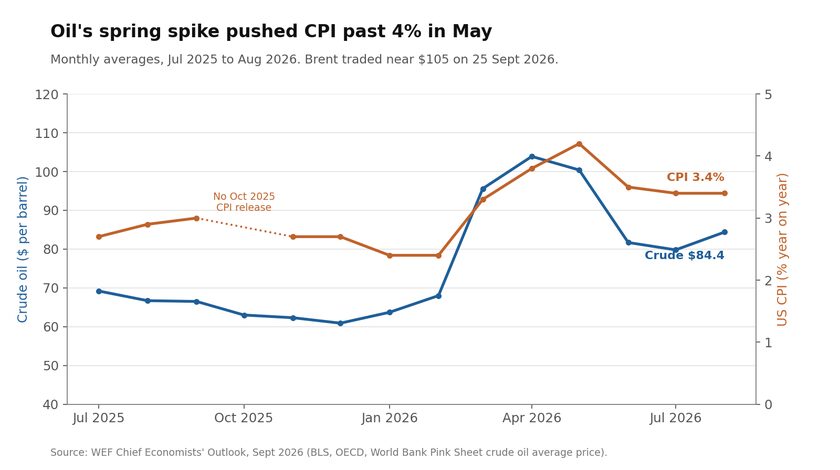
- August CPI was 3.4% year on year. Core eased to 2.4%, while energy was 16.3% higher than a year earlier.
- Oil. Brent traded around $105 on 25 September, up about 20% over the month. Houthi attacks on Saudi Arabia supported prices, while talk of a US–Iran interim deal pulled them back late in the week.
- Refined products. US diesel rose above $6 a gallon for the first time, per S&P.
- Business costs. Input cost growth in the September PMI hit a near four-year high.
- Fed projection. Officials see PCE inflation at 3.7% at the end of 2026.
- Consumer expectations. Year-ahead inflation expectations rose to 4.6% in early September, and long-run expectations to 3.4%.
S&P notes that pass-through to core inflation has been modest so far. The longer the energy shock lasts, the bigger that pass-through is likely to be.
Monetary policy and rates
The Fed has started hiking and signals more, while long-term yields have jumped to their highest levels in nearly two decades.
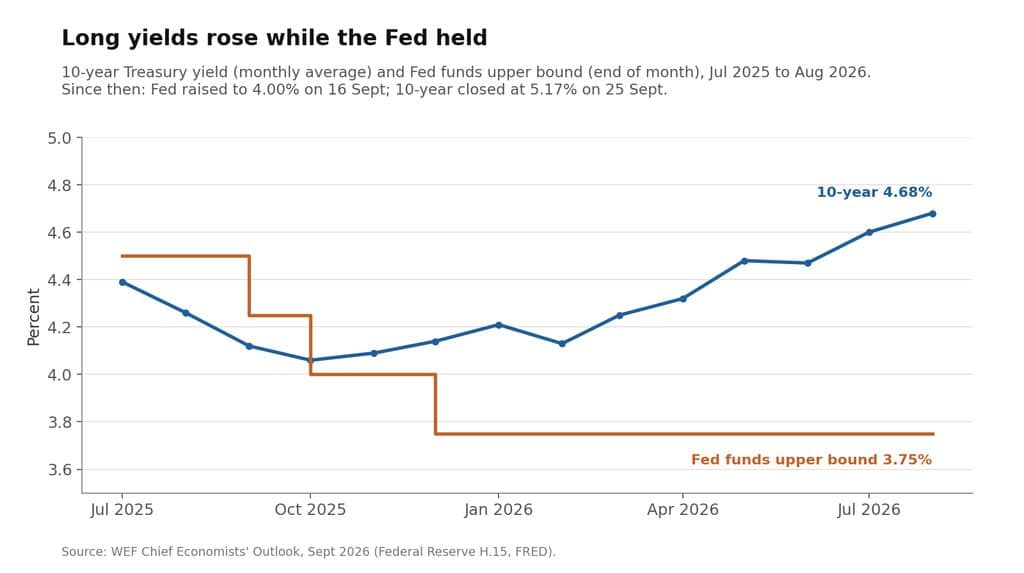
- Fed decision. A 25bp hike to 3.75–4.00% on 16 September, by a 12–0 vote. It was the first move since the December 2025 cut.
- Fed projections. The median end-2026 rate rose to 4.1% (June: 3.8%), implying one more hike. The 2027 median rose to 4.1% (June: 3.6%). 16 of 18 officials see at least one more hike this year, four of them two.
- Market pricing. About 66–70% odds of another hike at the late-October meeting, with swaps pricing three more quarter-point hikes over the next year.
- Treasury yields (25 Sept close). 2-year 4.81%, 10-year 5.17% (highest since 2007), 30-year about 5.49% (highest since 2004).
- What moved yields this week. The hot PMI, a weak 5-year auction, hawkish Fed commentary, and a global selloff in Japanese, UK and German bonds.
- Abroad. The ECB raised its deposit rate to 2.50% and the Bank of Japan to 1.25% in September.
Borrowing costs are feeding through: the 30-year mortgage rate was 6.65% in August, before the latest move in yields.
Fiscal position
Fiscal space is the binding constraint: record debt and rising yields leave less room to cushion the next shock.
- Debt. US public debt reached a record $40 trillion.
- Market pressure. S&P notes the Treasury’s enlarged buybacks did little to stem rising yields. It argues governments may need more market pressure before they address stretched public finances.
- Resilience is shifting away from fiscal support. 69% of WEF economists credit fiscal support as the main source of resilience since 2020, but only 28% expect it to play that role over the next 12 months.
- US fiscal expectations have cooled. 43% expect looser policy, 40% no change and 17% tighter. In May, 62% expected easing.
- Likely responses to living costs (global survey). Tax cuts on essentials (60%), consumption subsidies (54%) and price caps (50%) rank highest. Targeted cash transfers rank last (26%).
Labour market and households
Jobs are holding up, but households are not sharing the gains: labour’s share of output has hit a record low.
- Payrolls. August added 162,000 jobs, after a revised 21,000 in July. Unemployment held at 4.1%.
- Hiring is picking up. The September PMI showed the strongest job creation in over four years.
- Output is outpacing pay. Productivity rose 1.4% annualized in Q2, while labour’s share of output fell to 52.8%, the lowest since records began in 1947.
- Real incomes. WEF economists are split on US households: 39% expect real incomes to rise, 36% no change and 24% a fall.
- Unemployment outlook. 53% expect no change over the next year, 35% a rise and 12% a fall.
- Sentiment. The Michigan index fell to 47.8 in early September, the weakest since May’s record low and 16% below February, before the Iran conflict began.
- Costs. Food, electricity and transport lead expected cost increases globally (88%, 83% and 77% of economists). 78% expect data centres to push up electricity prices for other consumers.
This gap between strong output and weak household sentiment is the report’s central tension. It matters more if the Fed keeps hiking into it.
Trade and investment
US trade policy is diverging by partner: escalation with Canada, a truce with China.
US–Canada, newest first
| Date | Event |
|---|---|
| 29 Sept (Tue) | US ban on imports of many Canadian dairy products, motorcycles and alcoholic beverages takes effect |
| 15 Sept | US changes to its 50% tariff list take effect, with some items added and others removed |
| 8 Sept | Canada’s counter-tariffs of 15–50% on over 700 US products take effect, matching US measures dollar for dollar; the US announces the import ban the same day |
| 22 Aug | Talks collapse; the US imposes a 50% tariff on Canadian goods (about $20 billion per AP; Ottawa cites $27.6 billion) |
- US–China. The two sides extended their trade truce as President Xi arrived for his first state visit to Washington in 11 years.
- Tariff outlook. 55% of WEF economists expect US tariffs to rise over the next year, and 77% expect global fragmentation to deepen.
- Exports. Expectations for US exports to countries other than China have improved: 39% now expect an increase, up from 9% in January. The PMI still shows goods exports declining.
- Investment. 56% expect FDI into the US to rise, against 23% for China. The US tops the ranking of business environments for multinationals, named in the top three by 77%.
Projection summary
The official projections point to one more Fed hike and growth above 2%, but spot oil is well above S&P’s forecast path.
| Indicator | Latest | Projection | Source | Data date |
|---|---|---|---|---|
| Real GDP | Q2: 1.5% annualized | 2.3% in 2026 | BEA; IMF (July); Fed | 26 Aug; 8 Jul; 16 Sept |
| Q3 growth signal | Composite PMI 58.4 | About 4% annualized for Q3 | S&P flash PMI | 23 Sept |
| Inflation | CPI 3.4% y/y, core 2.4% (Aug) | PCE 3.7% at end-2026 | BLS; Fed | 11 Sept; 16 Sept |
| Fed funds rate | 3.75–4.00% | 4.00–4.25% at end-2026 and end-2027 (median) | Fed | 16 Sept |
| 10-year Treasury | 5.17% | No major reversal near term without progress in the Middle East | Market close; S&P | 25 Sept; 16 Sept |
| Brent crude | About $105 | $89 at end-2026, $86 at end-2027 (base case, now well below spot) | Market; S&P Global Energy | 25 Sept; 16 Sept |
| Unemployment | 4.1% (Aug) | Q4 projection revised down from 4.3% | BLS; Fed | 4 Sept; 16 Sept |
| Global inflation | 4.1% in 2025 | 4.7% in 2026, 3.9% in 2027 | IMF (July), via WEF | 8 Jul |
The IMF figures date from July. Its October outlook will be the first major forecast to reflect September’s oil spike.
Risk scenarios
The base case is benign, but most of the named risks run through the same channel: energy prices feeding inflation and rates.
| Scenario | What sets it off | How it plays out | What to watch |
|---|---|---|---|
| Base case | Current trends hold | Strong growth, one more Fed hike this year, oil and yields stay elevated | PMIs, jobs, CPI |
| Energy spiral (S&P’s downside) | US–Iran escalation or more attacks on Gulf supply | Higher energy prices, more tightening, higher peaks in long yields, an equity correction | Brent, Strait of Hormuz traffic, Houthi attacks |
| Overheating and bond stress | Hot data keeps the Fed hiking | Weak auctions push long yields higher, raising mortgage and federal borrowing costs | Treasury auctions, 30-year yield, wage data |
| AI and asset-price correction | Doubts over returns on AI investment | Stretched valuations unwind; WEF economists are split on overinvestment (42% yes, 44% no) | Chip stocks, AI capex guidance, credit spreads |
| Trade escalation | Further US–Canada rounds or a break in the China truce | Higher import costs and disrupted supply chains | Tariff lists, the 29 Sept import ban |
| Upside: US–Iran deal | Return to an interim agreement | Oil falls, inflation pressure eases, fewer hikes needed | Negotiation headlines, Brent |
A late-July preview of the correction risk: a US hedge fund fell into distress after chip stocks declined. The 3 November midterms add policy uncertainty; WEF economists are split on their global impact (31% agree it will be significant, 39% disagree).
What October will tell us
October’s releases will test the Q4 picture on four fronts: hiring, inflation pass-through, the Fed and trade. Dates marked “expected” are not yet confirmed.
| Date | Release or event | The question it answers |
|---|---|---|
| 29 Sept | US import ban on Canadian dairy, motorcycles and alcohol takes effect | Does the Canada dispute escalate further, or settle? |
| Early Oct (expected 2 Oct) | September jobs report | Does hiring confirm the PMI’s strongest job creation in over four years? |
| Mid-Oct (expected) | September CPI | Is the energy spike starting to feed into core inflation? |
| Mid-Oct (expected) | IMF World Economic Outlook | How far does the oil spike move the official forecasts? |
| Late Oct (expected 27–28 Oct) | FOMC meeting | Does the Fed deliver the hike markets price at about 66–70%? |
| Late Oct (expected) | Q3 advance GDP estimate | Did growth come in near the PMI’s 4% signal? |
| 29–30 Oct | Bank of Japan meeting | Does Japan keep tightening despite two dissents in September? |
| 3 Nov | US midterm elections | Does the result shift fiscal or trade policy? |
Implications
Going into Q4, the picture points to higher borrowing costs, elevated energy costs and more trade friction than looked likely in the summer.
- Borrowing costs. With the Fed signalling at least one more hike and the 10-year above 5%, new borrowing and refinancing will cost more than earlier in the year. The 30-year mortgage rate was already 6.65% in August.
- Energy and input costs. Oil around $105 and diesel above $6 a gallon raise transport and production costs. Input cost growth in the PMI is at a near four-year high.
- Consumer demand. Strong output has not translated into household confidence. Spending is a risk if real incomes stall while prices keep rising.
- Trade exposure. Businesses trading across the US–Canada border face tariffs of up to 50% and new import bans. China-linked trade looks steadier in the near term under the extended truce.
- Market volatility. Rising yields and stretched valuations leave assets exposed to a correction, particularly those tied to AI.
Appendix
Change log
First published 27 September 2026.
Sources
| Source | Data as of | What it is |
|---|---|---|
| S&P Global Market Intelligence, Global Economic Outlook | 16 Sept | Model-based forecast update |
| WEF Chief Economists’ Outlook | Survey 4–20 Aug; data to 16 Sept | Sentiment survey of 36 chief economists, plus cited data |
| Market and economic data | 23–25 Sept | Flash PMI, Treasury yields, oil, Fed projections, BoJ, trade, consumer sentiment |
Source reports
- S&P Global Market Intelligence, Global Economic Outlook: September 2026 (16 Sept)
- World Economic Forum, Chief Economists’ Outlook: September 2026 (22 Sept; survey 4–20 Aug)
Market and economic data, 23–25 Sept
- S&P Global, US flash PMI, September 2026
- FXStreet, PMI growth read-through
- CNBC, Fed rate decision, 16 Sept
- TradingKey, Fed dot plot detail
- Forbes Advisor, Treasury rates, 25 Sept
- CNBC, Treasury yields, 25 Sept
- Trading Economics, US 10-year yield and rate pricing
- Washington Trust, week in review, 25 Sept
- OilPrice.com, Brent weekly move
- Trading Economics, Brent crude
- Bloomberg, Bank of Japan decision, 18 Sept
- Trading Economics, University of Michigan sentiment, September
- Government of Canada, counter-tariffs effective 8 Sept
- ABC7 / AP, US tariffs on Canada, 22 Aug
- Al Jazeera, Canada’s counter-tariffs take effect, 8 Sept
- CFIB, Canada–US trade war tracker
- SignatureFD, market brief, 25 Sept
Disclaimer
Disclaimer:
This report is for general information purpose only and is not legal, investment, financial or other professional advice. It draws on third-party sources as of 27 September 2026, and figures may change rapidly and without notice. Seek professional independent advice before making legal, financial and investment decisions.