Sep 26, 2026
At a glance
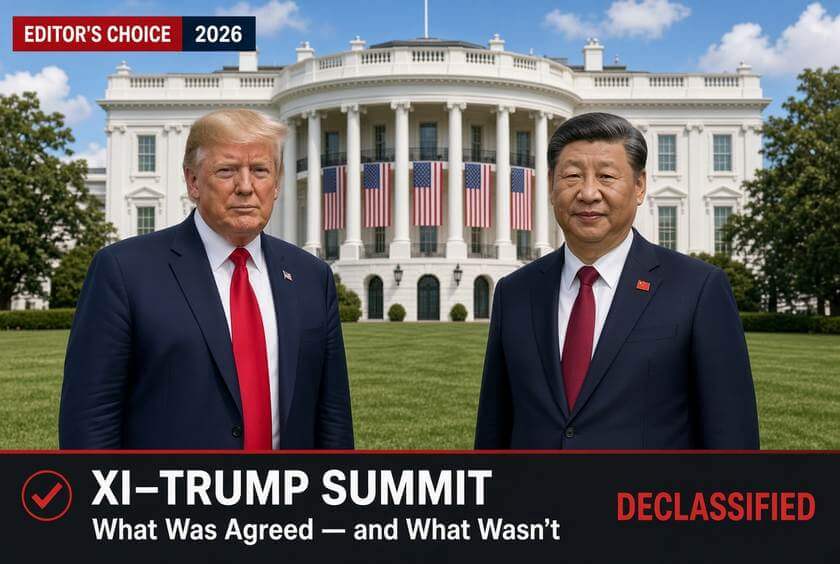
Xi Jinping’s state visit to Washington (Sept. 23–25, 2026) ended with an eight-point consensus: a $30 billion reciprocal tariff cut, a new AI dialogue, and a set of shared foreign-policy positions. It was the leaders’ third in-person meeting since Trump returned to office, after Busan (Oct. 2025) and Beijing (May 2026).
The summit leaned on personal diplomacy rather than big breakthroughs. Both sides called the relationship “constructive” and “strategically stable,” but the core disputes — chip export controls and rare-earth supply — were not settled.
The headline outcomes:
- Trade: tariff relief on $30 billion of non-sensitive goods in each direction (about A$42 billion), plus a US coal purchase commitment reported by the White House.
- AI: a standing dialogue on risks and benefits (next round in November) and a channel for AI-related incidents.
- Security: agreement that Iran must not develop nuclear weapons, opposition to tolls on international waterways, and a planned military crisis-communication MOU.
- Diplomacy: mutual support for China’s APEC (November) and the US G20 (December), with each leader planning to attend the other’s summit.
The eight-point consensus
The list below follows China’s official readout (Xinhua). The White House fact sheet covers the same ground but groups and weights it differently (see Where the readouts differ).
| # | Outcome | What was agreed |
| 1 | Relationship framework | Build a “constructive China-U.S. relationship of strategic stability” grounded in respect, fairness and reciprocity. The qualifying phrase is new, added to the formula China proposed at the May Beijing summit. |
| 2 | APEC and G20 | Mutual support as China hosts APEC (November) and the US hosts the G20 (December); both leaders intend to attend. |
| 3 | Iran and waterways | Iran should honour its commitment not to develop nuclear weapons; no country or entity may charge tolls on international waterways. |
| 4 | WWII history | Both leaders recalled that the US and China were allies in World War II. |
| 5 | Tariffs | Endorsed the $30 billion reciprocal tariff-reduction arrangement reached by the two trade teams. |
| 6 | Counternarcotics | Praised joint enforcement that cracked cases involving new psychoactive substances and precursor chemicals, with dozens of arrests in both countries. |
| 7 | AI dialogue | Set up a dialogue on AI risks and benefits (next round in November) and an AI-incident communication channel. |
| 8 | Pandas | The US welcomed two giant pandas China is leasing to Zoo Atlanta. |
Beyond the eight points, the two militaries agreed to sign a crisis-communication and prevention MOU “as soon as possible” and to keep cooperating on recovering the remains of US servicemen in China. China’s Foreign Ministry also said the sides would set up a trade council and extend the outcomes of earlier talks in Kuala Lumpur.
Trade
The centrepiece is more favourable tariff treatment for $30 billion of “non-sensitive goods in each direction,” in the White House’s words. The goods named so far:
| Direction | Goods covered |
| US exports to China | Agricultural products, fish and seafood, logs and wood products, cosmetics, medical devices |
| US imports from China | Small appliances, toys, holiday decorations, children’s car seats |
The White House also reported three items China’s readout does not mention:
- China will import at least 10 million tonnes of US coal across 2027 and 2028.
- A working group on agricultural market access.
- A working group on stabilising global petroleum supply.
The deal sits inside a wider truce. On Wednesday, Sept. 23, as Xi arrived, Treasury Secretary Scott Bessent said the two sides had extended by two months a trade truce due to expire on Nov. 10, to buy time for a potentially larger agreement. The $30 billion package is best read as a down payment on that bigger deal, not a replacement for it.
AI, or “superintelligence”
The two countries created a standing dialogue on the risks and benefits of AI, with the next exchange by November 2026, and a bilateral channel for AI-related incidents. RealClearPolitics reports the November talks are expected alongside APEC in Shenzhen.
The naming differs by capital. The White House fact sheet calls it the “U.S.-China Super Intelligence (SI) Dialogue” and says the leaders agreed to use “super intelligence” instead of “artificial intelligence.” This is Trump’s preferred term for the technology. China’s readout simply calls it a China-U.S. AI dialogue, and there is no sign Beijing has adopted the new label.
The agreement’s limits matter as much as its content:
- No joint rules. The sides did not agree to jointly develop or regulate frontier AI models for safety.
- Competition continues. On Saturday, Trump told reporters he had ruled out any integration with China on AI because the US is “leading by a lot.”
- Export controls untouched. US limits on China’s access to advanced chips remain, and Beijing still wants more access to AI hardware. The dialogue does not resolve that dispute.
- Critics wanted more. Rep. Ro Khanna, top Democrat on the House China committee, said the summit missed a chance to slow the AI race, for example through technical working groups between leading labs.
Security and foreign policy
The most consequential security line is on waterways. Both sides said no country or entity may impose transit tolls on international waterways — widely read as a rebuke of Iran’s attempt to charge tolls in the Strait of Hormuz, and as Xi lending weight to Trump’s Iran stance. They also agreed Iran must keep its commitment not to build nuclear weapons.
- Military channel: the two militaries will sign an MOU on crisis communication and prevention “as soon as possible.”
- Counternarcotics: joint cases on new psychoactive substances and precursor chemicals have produced dozens of arrests in both countries.
- Other issues: the White House says Russia, North Korea and Iran were discussed, but gave no detail on North Korea.
Where the readouts differ
Washington and Beijing each published their own account, and the gaps show what each side wanted to sell at home.
| Topic | White House fact sheet | Chinese readout (Xinhua) |
| AI naming | “Super Intelligence (SI) Dialogue”; leaders agreed to use “super intelligence” | “China-U.S. AI dialogue” |
| US coal purchases | At least 10 million tonnes in 2027–2028 | Not mentioned |
| Working groups | Agricultural market access; global petroleum supply | Not mentioned |
| Trade council, Kuala Lumpur outcomes | Not highlighted | Trade council and extension of Kuala Lumpur outcomes |
| Middle East | Iran nuclear and waterway tolls | Discussed “the Middle East situation” without naming the Iran conflict |
| Framing | “Delivering for Americans”; “Making the World Safer for Americans” | “Constructive relationship of strategic stability” based on respect, fairness and reciprocity |
On the Middle East, China’s envoy Zhai Jun said separately in Singapore that the region was “a big issue” in the leaders’ talks, suggesting more was discussed than either readout shows.
One wording discrepancy in the source reporting: the framework phrase is given both as “respect, fairness and reciprocity” and as “respect, fairness and equality.” The official Chinese text should be checked before quoting it.
What’s unresolved and what to watch
The summit set up processes more than it settled disputes. The next test comes within weeks.
| When | What to watch |
| Nov. 10, 2026 | Original expiry of the trade truce, now pushed back two months; watch for talks on a larger deal |
| November 2026 | First AI/”SI” dialogue session, expected around APEC in Shenzhen; whether it produces anything beyond talk |
| November 2026 | APEC Leaders’ Meeting in China; Trump expected to attend |
| December 2026 | G20 Leaders’ Summit in the US; Xi expected to attend |
| No date set | Signing of the military crisis-communication MOU |
| 2027–2028 | Delivery against the 10-million-tonne coal commitment |
Still open: US chip export controls, rare-earth shipment levels (which the White House says are still being worked on), and whether the two sides’ AI dialogue can coexist with an openly competitive AI race.
Sources
Official readouts
News coverage (from the two original articles)
- ABC News (Australia)
- CNBC
- The Spokesman-Review
- Yahoo News / Reuters
- Ground News
- Wealthier Today
- China Daily
- Global Times
- ECNS
- Seoul Economic Daily: gaps between readouts
- KBC Digital
- Geopolitechs
- Türkiye Today: tariff cuts
- Oneindia
Added to verify the AI terminology and details