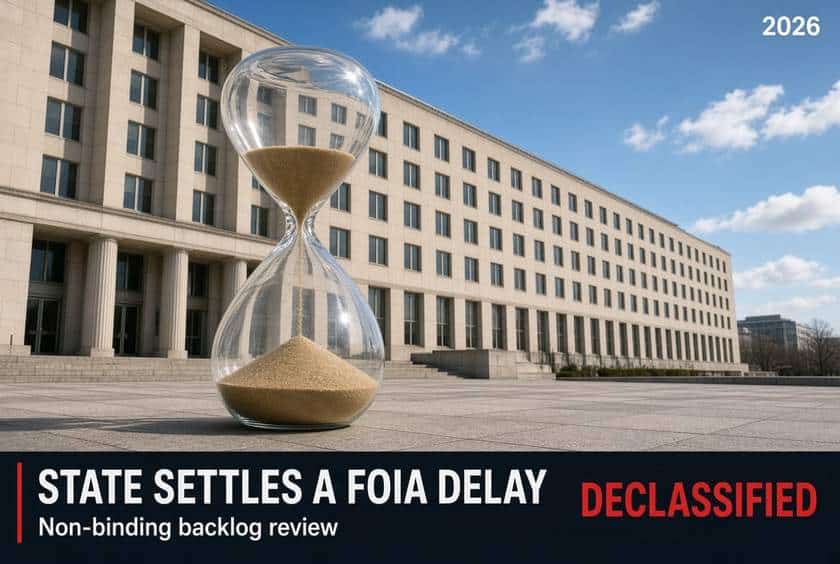
WASHINGTON — The State Department has agreed to ask the National Archives’ FOIA ombudsman to review how it handles public records requests, settling a lawsuit over years of delays brought by Marquette University law professor Ryan Scoville. The settlement agreement, signed in August and announced Sept. 30 by Yale Law School’s Media Freedom and Information Access Clinic, also requires State to pay $150,000 in attorney’s fees and costs.
The clinic called the agreement “the first of its kind.” State held about 8 percent of the federal government’s 339,671 backlogged requests at the end of fiscal 2025, according to the Justice Department’s annual FOIA summary, among the five agencies with the largest backlogs.
The agreement promises a “good faith effort,” not compliance
The clinic’s announcement says State “is required to take all reasonable steps” to address the ombudsman’s recommendations, including by requesting the money to do so. The signed agreement is narrower.
It describes the review by the Office of Government Information Services (OGIS) as “independent, systematic and non-binding.” State commits to “make a good faith effort” to carry out the recommendations. The agreement then adds that State “cannot commit to taking any actions or implementing any recommendations that require resources that are not provided to it.” For budget cycles 2028 through 2030, State’s Bureau of Administration will seek the funding needed, “through available mechanisms.”
OGIS is not a party. The agreement says no court can compel OGIS or the National Archives to do anything under it, and that OGIS has no duty to monitor or verify State’s compliance. OGIS keeps sole discretion over whether to accept or conduct the review at all.
State also reserved the right to negotiate the terms of OGIS access to privileged, non-public or classified material, and gets to review OGIS’s report for errors before it is published.
Reports every year through 2031
Under the agreement, State must ask OGIS for the review within 14 days of the case’s dismissal. The parties expect the review to begin in fiscal 2026 and take four to six months, subject to OGIS’s schedule.
State must then report on each recommendation in its Chief FOIA Officer Reports for 2027 through 2031, including any it could not carry out and why. It must also publish a backlog reduction plan in each of those reports from 2026 on, and link the OGIS report on its FOIA reports page within 15 days of publication. If recommendations remain unaddressed after the 2031 report, State will request one follow-up meeting with OGIS and report on the remaining items in its 2032 report. Its obligations end there.
Two changes reach requesters directly. By the end of fiscal 2026, letters on requests not in litigation will carry the processing analyst’s first name and last initial plus a group inbox for questions. State will also write protocols for interim responses, in line with a 2024 FOIA Advisory Committee recommendation, though the agreement says it “will not provide interim responses for every request.”
The settlement admits no liability.
A 2020 request for arms-transfer reports
Scoville, who studies foreign relations law, asked State on March 4, 2020, for reports it sent Congress from 2001 to 2020 on transfer restrictions, violations and unauthorized transfers involving U.S. defense articles. A year later, State estimated it would finish on March 8, 2023. He sued in the Eastern District of Wisconsin on Jan. 25, 2022, without having received a single responsive page, according to the complaint.
It was his third suit against State over FOIA delays. A 2014 request on ambassadorial nominees took nearly 49 months to fill, the complaint says, and a 2018 request ended with State producing one record. The clinic says the court denied State’s effort to dismiss the broader claim over its pattern of delays, and the case moved into discovery, including depositions of two officials who run State’s FOIA program.
“Transparency that arrives too late is often far less valuable,” Scoville said in the clinic’s announcement.
OGIS, an office inside the National Archives, is the federal FOIA ombudsman and evaluates agency compliance with the law. Its September report found 110 agencies held FOIA records past their disposal dates.
What’s next: State’s request to OGIS is due within 14 days of dismissal. OGIS’s report, when finished, will be posted on its website, and State’s first report on the recommendations is due in its 2027 Chief FOIA Officer Report.
Primary source: Settlement Agreement and Release, Scoville v. U.S. Department of State, No. 2:22-cv-00091 (E.D. Wis.), signed Aug. 12 and 17, 2026 (PDF).
Sources
- Settlement Agreement and Release, Scoville v. U.S. Department of State (Aug. 2026). Used for: all settlement terms, quoted language, the $150,000 payment, the OGIS provisions and the 2031 end date.
- Yale Law School, “MFIA Secures Settlement Committing State Department to Address FOIA Backlog” (Sept. 30, 2026). Used for: the clinic’s description of the terms, the “first of its kind” and Scoville quotes, the motion to dismiss and discovery history.
- Complaint, Scoville v. U.S. Department of State, No. 2:22-cv-91 (E.D. Wis., filed Jan. 25, 2022). Used for: the 2020 request, State’s 2023 estimate and the earlier requests.
- U.S. Department of Justice, Office of Information Policy, “2025 Annual FOIA Report Summary” (July 1, 2026). Used for: the 339,671 government-wide backlog and State’s 8 percent share.
Filed under: U.S. Department of State