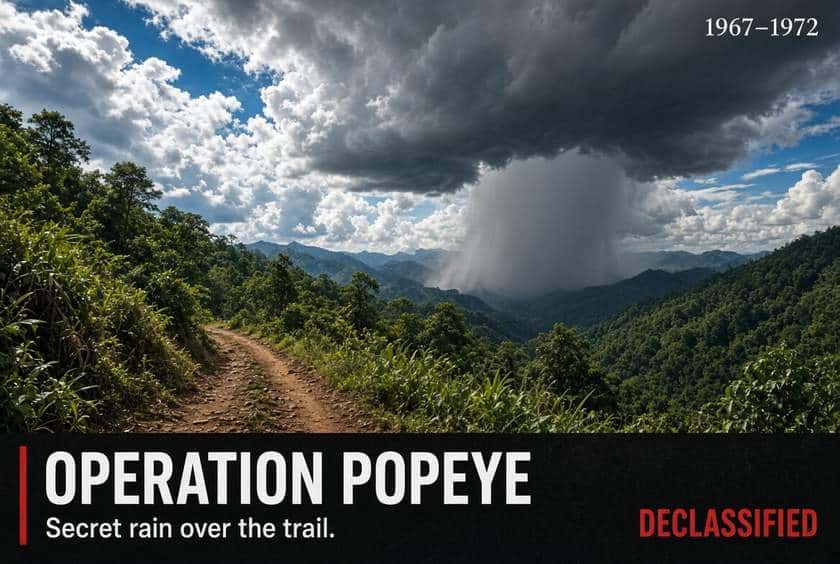
Operation Popeye was a classified U.S. cloud-seeding program that ran over the Laos panhandle, and briefly over North Vietnam, from 1967 to 1972. Air Force aircraft flying from Thailand dropped silver iodide and lead iodide flares into monsoon clouds to add rain over the roads and river crossings of the Ho Chi Minh Trail. The principal released records are State Department memoranda later published in the Foreign Relations of the United States (FRUS) series, and a Pentagon briefing given to a Senate subcommittee in closed session on March 20, 1974, and released on May 19, 1974.
Origins and the October 1966 test
The Pentagon’s Office of Defense Research and Engineering proposed the concept in 1966, according to the 1974 briefing by Lt. Col. Ed Soyster of the Joint Chiefs of Staff (Senate hearing record, p. 92). A test phase was approved by State and Defense and flown in October 1966 over a strip of the Lao panhandle east of the Bolovens Plateau, in the valley of the Se Kong River (FRUS 1964–68, vol. XXVIII, doc. 274). Technical control rested with personnel from the Naval Ordnance Test Station at China Lake, California (hearing record, p. 92).
The two sources give slightly different results for the test. A January 1967 State Department memorandum reports “more than 50” seeding experiments, with 82 percent of seeded clouds producing rain shortly afterward (FRUS doc. 274). Soyster’s 1974 briefing gives 56 seedings and “over 85 percent” of clouds reacting favorably (hearing record, p. 92). The State memo adds an incident absent from the Pentagon’s account. In one case, rain followed a seeded cloud east across the border and put nine inches of rain in four hours on a U.S. Special Forces camp (FRUS doc. 274).
Lao authorities were not consulted about the test.
The State memo records that it proceeded with Ambassador William Sullivan’s “knowledge and concurrence” but without consulting Lao authorities, and that it remained known to “a severely limited number of U.S. officials” (FRUS doc. 274).
The State Department’s January 1967 reservations
On Jan. 13, 1967, Deputy Under Secretary of State Foy Kohler sent Secretary of State Dean Rusk the Defense Department’s request to begin the operational phase (FRUS doc. 274). The memo judged the tests “undeniably successful” and possibly “too successful,” since neither the volume of induced rainfall nor the area affected could be predicted. The only absolute control, it noted, was to stop flying.
The memo set out the costs as State saw them. It warned of out-of-season rain disrupting planting, flooding downstream toward the Mekong, and farmers caught by rising water at fords they normally crossed on foot. It put the outside range of a single seeded cloud’s effect at an area 50 by 100 miles. It predicted that the program would not stay secret, and that Lao and Thai observers might blame the United States for the Mekong flood of September 1966. And it described approval as “a precedent-making decision” that could establish weather alteration as a military tool, with “first use” consequences it compared to those of nuclear weapons.
Kohler’s own handwritten note on the first page read, “I have serious doubts—may I discuss this with you.” Rusk approved the operation “on a strictly experimental basis” in five limited areas, one in North Vietnam and four in Laos, according to a Feb. 7 memorandum cited by the FRUS editors (FRUS doc. 274, note 3). The memo had recommended that the Lao prime minister, Souvanna Phouma, be consulted before operations began. The documents cited here do not show whether he was.
Operations, March 1967 to July 1972
The operational phase began on March 20, 1967, and ran each year through the southwest monsoon, March to November, until the last mission on July 5, 1972 (hearing record, p. 93). The program was authorized three WC-130 weather reconnaissance aircraft and two RF-4C reconnaissance jets. Neither was dedicated solely to seeding. The WC-130s also flew typhoon reconnaissance, and the WC-130 missions were recorded and reported through normal channels as weather flights (pp. 93, 108). Soyster put the annual cost at about $3.6 million (p. 93).
Each seeding unit was a 40 mm photoflash-type cartridge that burned for about 36 seconds while falling some 3,000 feet, dropped into cloud updrafts at roughly half-mile intervals (pp. 92, 96). The stated objective was to soften road surfaces, cause landslides, wash out river crossings and keep soil saturated beyond the normal rainy season (p. 89).
The authorized area expanded on July 11, 1967, and again on Sept. 13, 1967, to include a small area over the A Shau Valley in South Vietnam. An area of North Vietnam was added on Sept. 25, 1968. On Nov. 1, 1968, all seeding inside North Vietnam’s borders ended and was never resumed (pp. 95–98). In 1972 the area was shifted to include parts of northeast Cambodia and South Vietnam (p. 100).
The Pentagon’s summary chart gives the following totals (hearing record, Chart 12, p. 102):
| Year | Sorties | Seeding units |
|---|---|---|
| 1967 | 591 | 6,570 (1,017 over North Vietnam) |
| 1968 | 734 | 7,420 (98 over North Vietnam) |
| 1969 | 528 | 9,457 |
| 1970 | 277 | 8,312 |
| 1971 | 333 | 11,288 |
| 1972 | 139 | 4,362 (Laos, Cambodia, South Vietnam) |
| Total | 2,602 | 47,409 |
On results, the briefing was guarded. The Defense Intelligence Agency estimated that rainfall rose “in limited areas up to 30 percent” above what conditions predicted, but the effect “cannot be precisely quantified” for lack of ground stations (p. 103). Soyster closed by calling the results “certainly limited and unverifiable” (p. 108).
Laird’s 1972 testimony and its correction
On April 18, 1972, Defense Secretary Melvin Laird told the Senate Foreign Relations Committee in public session, “we have never engaged in that type of activity over North Vietnam.” On Jan. 28, 1974, by then counselor to the president, Laird wrote to committee chairman J. William Fulbright that he had “just been informed” such activities were conducted over North Vietnam in 1967 and again in 1968, before his tenure. The Defense Department kept that letter classified Secret when the committee asked to release it (hearing record, pp. 109–111). It was printed in the record when the hearing was made public.
At the March 1974 session, Sen. Claiborne Pell asked why the program had been held at a higher classification than other Vietnam-era combat operations, whose sortie and tonnage figures had already been released. Maj. Gen. Ray Furlong replied that the Lao government had been aware of and acquiesced in U.S. interdiction efforts generally, and that this operation “fell into a similar category.” Deputy Assistant Secretary of Defense Dennis Doolin said that Southeast Asia was in his area of responsibility, yet he had not held the clearance and first learned of the program from a Jack Anderson newspaper column (pp. 108–111). Doolin also confirmed that the code names Popeye, Intermediary and Compatriot referred to the same program, with names changed when they were uncovered (p. 112).
A related experiment: Commando Lava
Popeye was not the only mud-making effort. In a May 29, 1967, telegram, Ambassador Sullivan described Operation Commando Lava, in which common chemicals were air-dropped on two points along Routes 96 and 110 in Laos so that rain would turn the soil into mud unable to support vehicles (FRUS 1964–68, vol. XXVIII, doc. 289). He proposed combining it with Popeye techniques and closed with “Make mud, not war!”
From disclosure to the ENMOD Convention
The 1974 briefing fed directly into arms-control planning. On April 12, 1974, Soviet Foreign Minister Andrei Gromyko pressed Secretary of State Henry Kissinger on a Soviet proposal to restrict environmental modification (FRUS 1969–76, vol. E–14, part 2, doc. 40). On April 26, Kissinger relayed Nixon’s order for a study of international restraints on environmental warfare, which was to draw on “the recent briefing by the Department of Defense on weather modification activity in Southeast Asia” (doc. 44).
The Convention on the Prohibition of Military or Any Other Hostile Use of Environmental Modification Techniques was adopted at the United Nations in New York on Dec. 10, 1976. The United States signed it on May 18, 1977, and ratified it on Jan. 17, 1980. It entered into force on Oct. 5, 1978, the same date Laos deposited its ratification (United Nations Treaty Collection, chapter XXVI-1).
Sources
- FRUS 1964–1968, vol. XXVIII, Laos, doc. 274: Memorandum from Kohler to Rusk, “Weather Modification in North Vietnam and Laos (Project Popeye),” Jan. 13, 1967. Used for: the October 1966 test, the State Department’s assessment, Kohler’s note and Rusk’s limited approval.
- FRUS 1964–1968, vol. XXVIII, Laos, doc. 289: Telegram from the Embassy in Laos, “Operation Commando Lava,” May 29, 1967.
- U.S. Senate, Committee on Foreign Relations, Subcommittee on Oceans and International Environment, “Weather Modification,” hearings of Jan. 25 and March 20, 1974 (GovInfo). Used for: the Pentagon briefing, operational dates, aircraft, costs, Chart 12 totals, the Laird correspondence and the Pell exchange.
- FRUS 1969–1976, vol. E–14, part 2, doc. 40: Memorandum of conversation, Kissinger and Gromyko, April 12, 1974.
- FRUS 1969–1976, vol. E–14, part 2, doc. 44: Kissinger to Rush, “International Restraints on Environmental Warfare,” April 26, 1974.
- United Nations Treaty Collection, chapter XXVI-1: ENMOD Convention, status and participants.