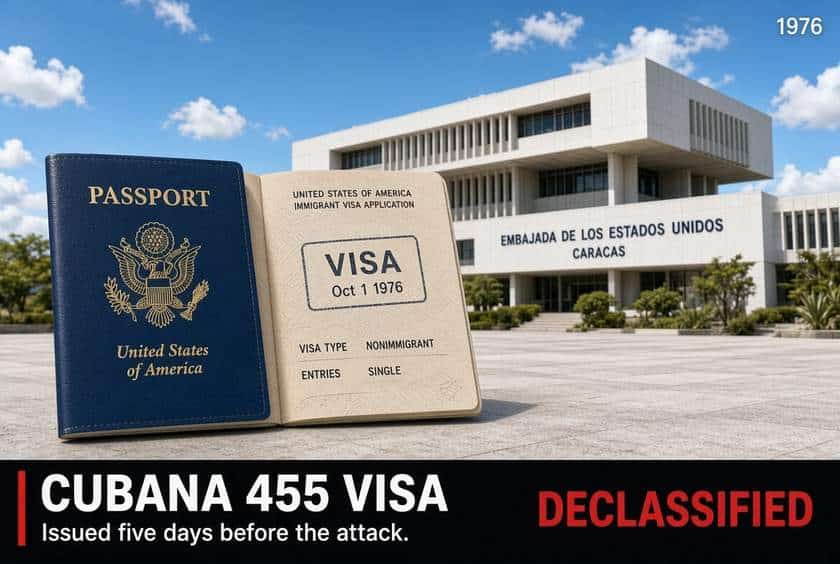
On Sept. 30, 1976, a Venezuelan photographer named Hernán Ricardo Lozano walked into the American Embassy in Caracas without an appointment and asked for help getting a visa. He said he had a photo assignment in Jamaica for a magazine called “Vision” and wanted a two-day stopover in Puerto Rico. The travel agency had told him a visa would take three days. He wanted to leave the next day, so he asked the FBI’s legal attaché to help.
He got the visa on Oct. 1. Five days later, Cubana Airlines Flight 455 blew apart off Barbados, killing all 73 people on board. Ricardo was arrested in Trinidad the next day as one of the two men suspected of carrying the bomb onto the plane.
We know about the visa because FBI Director Clarence Kelley explained it, in two Secret letters, to Secretary of State Henry Kissinger. Both letters are among ten records the National Security Archive posted today for the bombing’s 50th anniversary. Read in order, they answer a question Fidel Castro raised nine days after the attack, though not the way he answered it.
Castro’s charge: “The CIA directly participated”
In an Oct. 15, 1976, speech, Castro said Cuba had first been unsure whether the CIA organized the bombing itself or worked through exile groups. “Now we decidedly believe the first assumption is correct,” he said, according to a State Department intelligence memo prepared for Kissinger three days later. “The CIA directly participated in the destruction of the Cubana aircraft in Barbados.”
The records we read don’t show that. None of them has the CIA planning, ordering or paying for the bombing, and the CIA told the FBI that its files held nothing on Ricardo or the second suspect, Freddy Lugo.
What the records do show is a set of Americans and U.S. agencies standing much closer to the plotters than Washington ever said in public. The visa is the clearest case.
A passport stamp from the morning of another bombing
Kelley’s first letter, dated Oct. 20, 1976, sets out what the legal attaché in Caracas, Special Agent Joseph S. Leo, did with Ricardo’s request. Leo looked at his passport. It showed a trip from Caracas to Port-of-Spain, Trinidad, on Aug. 29, 1976, and a return on Sept. 1.
Leo remembered that the Guyanese consulate in Port-of-Spain had been bombed at about 10:15 a.m. on Sept. 1. An exile umbrella group, the Coordination of United Revolutionary Organizations (CORU), had publicly claimed it.
Leo then told the head of the embassy’s visa section that he wanted “no special consideration” for Ricardo and that the application be “considered on its own merits.” On Oct. 1, a vice consul asked whether Leo thought Ricardo would come back to Venezuela or stay in the U.S. illegally. Leo said he had no reason to think Ricardo would not return to Caracas. The visa was issued that day.
Kelley’s second letter, dated Oct. 29, fills in what Ricardo handed over. On his application he listed himself as a graphic reporter and industrial investigator, employed by Investigaciones Comerciales e Industriales, a private investigative agency.
His letter of employment was signed by its owner, Luis Posada Carriles.
That letter also says Ricardo was not a stranger. He had first come to the legal attaché for visa help in 1975, came back to say thanks, and returned about three more times on visa matters. (Kelley’s first letter puts that first contact in June 1974.) In December 1975 he phoned with a social invitation, which was declined. After the arrests, Leo’s name turned up on a slip apparently torn from a 30-page notebook found with Ricardo. The notebook held more than 170 names.
Nothing in the letters suggests Leo knew of a plot against the airliner. On Oct. 8, a confidential FBI source said the bomb had been meant to go off before the plane left Barbados.
Warnings in June and September
The visa wasn’t the only signal. The State Department memo records that “in late June, a CIA source reported that an exile group headed by Bosch planned to bomb a Cubana flight between Panama and Havana.” Orlando Bosch was CORU’s leader. An FBI source said one attempt was made and the bomb failed to go off, the memo adds, and on July 9 a second bomb exploded in Jamaica before its suitcase could be loaded onto a plane.
In late September, a few days after a fundraising dinner for Bosch in Caracas, Posada was overheard saying, “We are going to hit a Cuban airplane,” and that “Orlando has the details,” according to a CIA cable. At the dinner itself, the cable reports, Bosch said that “now that our organization has come out of the Letelier job looking good, we are going to try something else.” Orlando Letelier, Chile’s former foreign minister, had been killed by a car bomb in Washington on Sept. 21.
That cable was not distributed until Oct. 14, eight days after the plane went down. In follow-up questions dated Oct. 19, the State Department asked the CIA directly whether its source had “deliberately delayed passing on Bosch’s and Posada’s remarks about hitting a Cuban plane until after the incidents.” The CIA’s answer is not in the posting.
Two of the men around the plot had been on U.S. payrolls. A CIA summary prepared decades later for Posada’s immigration-fraud trial in El Paso says he was a paid CIA asset from 1965 to 1967 and again from 1968 to 1974. From 1974 to 1976, it says, he “occasionally provided unsolicited threat reporting, including information regarding a bombing threat against a June 1976 flight from Panama to Havana,” which the CIA “promptly disseminated” to other agencies. The summary and the State Department memo describe the same route and the same month. Neither document says whether they mean the same report.
Kelley’s Oct. 29 letter adds that Ricardo Morales Navarrete, a Venezuelan intelligence official who attended the Bosch dinner, had been a paid informant of the FBI’s Miami office at various times between 1961 and 1975. It was Morales who later told a Dade County organized-crime investigator, in conversations the FBI passed to Kissinger on Nov. 5, that Ricardo had phoned Bosch from Trinidad after the crash: “a bus with 73 dogs went off a cliff and all got killed.”
| Date (1976) | What the record shows | Document |
|---|---|---|
| Late June | CIA source reports a Bosch group plans to bomb a Cubana flight, Panama to Havana | State INR memo, Oct. 18 |
| July 9 | Bomb explodes in Jamaica before its suitcase is put aboard | State INR memo, Oct. 18 |
| Sept. 1 | Guyanese consulate in Port-of-Spain bombed; Ricardo’s passport shows him there | FBI to Kissinger, Oct. 20 |
| Late Sept. | Posada overheard: “We are going to hit a Cuban airplane” | CIA cable, Oct. 14 |
| Sept. 30 | Ricardo asks the FBI legal attaché for help with a U.S. visa | FBI to Kissinger, Oct. 20 |
| Oct. 1 | Visa issued; employment letter signed by Posada | FBI to Kissinger, Oct. 29 |
| Oct. 6 | Flight 455 destroyed off Barbados; no survivors | FBI to Kissinger, Oct. 20 |
| Oct. 14 | CIA distributes the “hit a Cuban airplane” report | CIA cable, Oct. 14 |
The paragraphs still blacked out
The State Department memo gives every suspect a subsection headed “Relationship with US.” For Bosch, Posada, Ricardo, Lugo, Frank Castro and a Venezuelan named Félix Martínez Suárez, the text under that heading opens with a blacked-out block, marked in the margin as withheld “per CIA.” The section on Orlando García, the Venezuelan president’s security adviser, and his deputy Morales is blank in this draft. The Oct. 19 questions ask the CIA for information so it can be completed.
The FBI letters carry their own redactions, several marked “Foreign” in the margin. Kelley also wrote that he had put on hold sending an inspector to Caracas to interview Leo, and would not call Leo to Washington, because of “the existing tension in the Caribbean area.” These copies were released under the JFK Records Act in May 2005.
Bosch and Posada were arrested in Venezuela within days of the bombing. Posada escaped from a Venezuelan prison in 1985, and Bosch was released in 1987, according to the Archive. Both later lived in Florida. Posada was acquitted in El Paso in 2011 on the perjury and immigration-fraud charges and died in 2018. Bosch died in Miami in 2011. Our earlier piece on the FBI’s Letelier-Moffitt investigation covers the Washington car bombing Bosch referred to at the Caracas dinner.
Primary source: FBI Director Clarence M. Kelley to Secretary of State Henry A. Kissinger, Oct. 20, 1976 (PDF). Full context: National Security Archive, “Cubana Flight 455: An Act of Aviation Terrorism 50 Years Later,” Briefing Book #932 (Oct. 8, 2026).
Sources
- FBI, Kelley to Kissinger, Oct. 20, 1976, Secret. Used for: Ricardo’s Sept. 30 and Oct. 1 visa contacts, the passport dates, the Port-of-Spain bombing, Leo’s instructions to the visa section, the Oct. 8 source report and the CIA’s file check.
- FBI, Kelley to Kissinger, Oct. 29, 1976, Secret. Used for: the visa application and Posada’s employment letter, Ricardo’s earlier contacts, the notebook, Morales Navarrete’s informant history and the decision not to send an inspector.
- FBI, Kelley to Kissinger, Nov. 5, 1976, Secret. Used for: the “73 dogs” message and its sourcing.
- State Department, INR, “Castro’s Allegations,” draft memo to the Secretary, Oct. 18, 1976, with questions dated Oct. 19. Used for: Castro’s speech, the June and July attempts, the “Relationship with US” redactions and the question to the CIA.
- CIA, Intelligence Information Cable TDFIR DB-315/10256-76, Oct. 14, 1976, Secret. Used for: the Caracas fundraising dinner, Bosch’s “Letelier job” remark and Posada’s “hit a Cuban airplane” remark.
- CIA, “Unclassified Summary of the CIA’s Relationship With Luis Clemente Posada Carriles,” filed in U.S. v. Posada Carriles (W.D. Tex.). Used for: Posada’s years as a paid asset and the June 1976 threat reporting.
- National Security Archive, Briefing Book #932 (Oct. 8, 2026). Used for: the anniversary posting, the arrests, the 2011 acquittal and the deaths of Bosch and Posada.