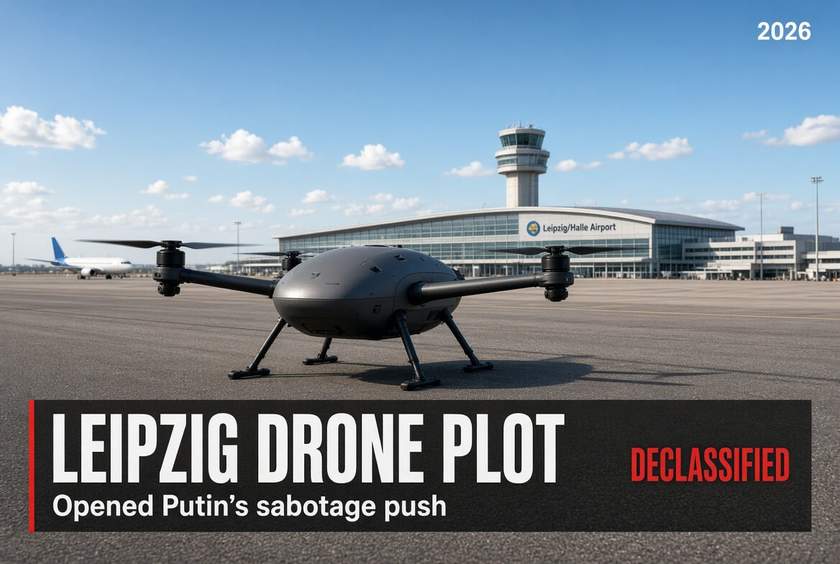
U.S. intelligence agencies have concluded that Vladimir Putin personally ordered a stepped-up campaign of sabotage and covert action against NATO countries, The Wall Street Journal reported Tuesday, citing European officials briefed on the findings. One of the campaign’s opening shots, those officials said, was a failed drone attack on Germany’s Leipzig/Halle Airport in August.
On the night of Aug. 4, one of those drones slammed into a Ukrainian Antonov freighter. It carried military-grade explosives. An airport bus driver later found it on the ground, and a bomb-disposal robot took it away.
It did not go off.
No U.S. agency has confirmed the assessment on the record. The CIA and the White House did not respond to the Journal, and the Kremlin did not answer its request for comment.
The Journal also reported that investigators have found concealed underground caches near airports, arms manufacturers and other possible targets in Europe. That detail has a history. In October 1999, a House Armed Services subcommittee heard testimony about Soviet sabotage caches buried on NATO soil during the Cold War. Both witnesses pointed Congress past the KGB toward the GRU, Russia’s military intelligence service. That is the agency Western officials now say is running the new campaign.
What Germany and U.S. officials had already said about Leipzig
The new reporting moves the order to the top of the Kremlin. That the attack came from Russia was already on the record. On Sept. 1, Germany formally blamed Russia for the drone plot. Interior Minister Alexander Dobrindt raised the national threat level from “general” to “high” and told reporters, “We are not at war, but we are a daily target of hybrid attacks,” CNN reported. Foreign Minister Johann Wadephul ordered the Russian consulate in Bonn and the Russian House cultural center in Berlin closed.
U.S. officials had pointed the same way within weeks of the attack. A U.S. intelligence source told ABC News that the explosives and the build of the device were “typical” of those used by the GRU, an assessment made together with German agencies. A U.S. defense official told CNN the drone was carrying military-grade explosives. U.S. officials told ABC that 18 drone incidents had disrupted air traffic at Leipzig since January.
The airport is a logical target. Leipzig/Halle is one of Europe’s largest air-cargo hubs, the base for Antonov Airlines since Russia destroyed its home airfield at Hostomel in 2022, and a transit point for military aid headed to Ukraine. In July 2024 a parcel bomb caught fire at the DHL logistics center there. Lithuanian prosecutors later said that plot was organized by Russian citizens with links to the GRU, according to the Associated Press.
Accounts of the August attack itself still differ. The Journal says one drone hit the Antonov without exploding, a second collided with another plane, and a third detonated near the airport perimeter. CNN reported that on Aug. 5 a cargo plane struck a flying object near the airport and landed safely in Hannover with minor damage, and that German media later reported a third drone found in a nearby field. Russia has denied involvement throughout. When Berlin made its accusation, Putin asked, “Where is the evidence?” the Journal reported.
Semtex in food cans, routed through Serbia
The Journal’s account of the plot, drawn from investigators and intelligence officials, goes well past what Germany has said publicly. At least three drones packed with Semtex were hidden in bushes and under trees outside the perimeter, the paper reported. They ran on German 5G phone cards so they could be flown over the internet, and German cyber officials traced the traffic to servers the GRU had used before.
The explosives were smuggled in resealed food cans fitted with detonators, according to the Journal, with steel plates added to turn them into fragmentation bombs. The network used Serbia as a logistics hub. German investigators believe a former Russian military officer, recruited by the GRU after a criminal conviction, coordinated the ground work, directing Belarusian operatives who moved the explosives and assembled the drones, the paper reported. Two days before the attack, he and at least one accomplice flew from Germany to Serbia and on to Russia.
One point needs care. The Journal says Serbian authorities later arrested seven suspects in a group that procured and stored explosives and drones for shipment into the EU. In early September, Serbian prosecutors announced four detentions and three more suspects in what looks like the same case, a group moving explosives and drones into the EU. They said then that they had not linked it to Leipzig, Türkiye Today reported. We have not seen a Serbian statement that changes that.
Western officials told the Journal the campaign is run by a GRU branch called the Special Tasks Service, formed in 2023 by merging some of Russia’s most lethal clandestine units, under Col. Gen. Andrey Averyanov. They traced Leipzig to one of his department chiefs, Col. Denis Smolyaninov. Britain put Smolyaninov on its sanctions list on Dec. 4, 2025. The UK notice gives his rank and the reason, “coordination of GRU sabotage operations in Ukraine.” The same day, Britain sanctioned the GRU as a whole.
Britain already has an official finding that Putin gave a GRU order
The claim that Putin personally ordered the campaign rests, for now, on anonymous officials describing classified U.S. assessments. There is one official precedent for that kind of finding. The British government announced those Dec. 4 sanctions alongside the final report of the Dawn Sturgess Inquiry, which found that Putin personally authorized the GRU’s 2018 Novichok attack on Sergei and Yulia Skripal in Salisbury. Sturgess, a British woman, died after exposure to the nerve agent.
The Journal ties the timing of the new campaign to frustration in Moscow over the war. Officials said neither the front line nor talks with Washington were producing the Ukrainian concessions Putin wanted. Aides to Chancellor Friedrich Merz told the paper that if Leipzig had caused mass casualties, Berlin would have considered invoking NATO’s Article 5. The alliance has done that once, after the Sept. 11 attacks.
The CIA was already warning Moscow in late August. CIA Director John Ratcliffe made an unannounced trip to Moscow that month, partly to warn Russia not to attack NATO countries, sources told ABC News. The Kremlin confirmed he met Russian intelligence officials but not Putin, PBS reported, and President Trump called the visit “sort of semi-routine.” Afterward, Ratcliffe personally warned European intelligence counterparts that Moscow was intensifying sabotage against their countries, people who received the warnings told the Journal. The report lands as the administration keeps a diesel arrangement with Moscow. Last week Trump also halted sanctions due under a bipartisan bill, a decision he said was aimed at keeping Russia at the bargaining table and out of the war with Iran.
The caches Congress heard about in 1999
On Oct. 26, 1999, the House Armed Services military research and development subcommittee, chaired by Rep. Curt Weldon, held a hearing titled “Russian Threat Perceptions and Plans for Sabotage Against the United States.” The witnesses were Cambridge historian Christopher Andrew and Oleg Gordievsky, the former KGB station chief in London who had spied for Britain.
Andrew had just published The Sword and the Shield with Vasili Mitrokhin, a KGB archivist who spent years noting and transcribing files before defecting to Britain in 1992. He told the subcommittee that Mitrokhin’s notes showed KGB arms and radio caches being placed in the West from at least 1955 into the late 1970s, some, perhaps many, booby-trapped with a device called Molniya. Austrian authorities searched for one near Salzburg in 1997 and found nothing, because road building had erased the markers. In December 1998 the Swiss dug up another by following Mitrokhin’s transcribed directions, a set number of paces from a forest chapel, then a turn at a marker, then a spot midway between two trees. Its booby trap was unstable and exploded when hit with a water cannon. Andrew read the committee a Swiss federal prosecutor’s statement that anyone who tried to move the container “would have been killed.” The files listed two more Swiss caches and three in Belgium.
Andrew also described KGB target files for the United States, including power pylons below Montana’s Flathead Dam and caches code-named Park and Kemi in the northwest of the state. He said Mitrokhin never saw GRU sabotage files. Gordievsky went further. “Everything which belongs to the area of sabotage, caches, radio communication, weapons, explosives and so on, it is mainly a domain of the GRU,” he testified, adding that over the previous two decades most of the KGB’s sabotage functions had passed to the military service. Andrew put it in one line.
“What we now need to see is a Mitrokhin for the GRU.”
Much of what is public about the GRU’s sabotage work now comes from prosecutors, sanctions notices and officials briefing reporters, which is how the Journal’s account reached print this week. The 1999 transcript, H.A.S.C. No. 106-32, is still the most detailed public record of how Moscow prepared for sabotage on NATO soil. Its witnesses described caches placed in peacetime to be used in a crisis short of war.
We have covered the same Cold War paranoia Gordievsky described to the subcommittee in Able Archer 83 and the 1983 War Scare, and the diesel arrangement in Trump’s Massive Russia Diesel Deal. The full 1999 hearing transcript is on the House committee documents site.
Sources
- The Wall Street Journal (via To Vima syndication), Bojan Pancevski: Airfield Attack Marked Opening Shot in Putin’s Sabotage Campaign Against Europe (Oct. 21, 2026). Used for: the U.S. assessment, the drone sequence, Semtex and 5G details, the Serbian route and seven arrests, the Special Tasks Service, Averyanov and Smolyaninov, Merz aides on Article 5, Ratcliffe’s warnings, Putin’s “Where is the evidence?”, caches near airports.
- House Armed Services Committee: Russian Threat Perceptions and Plans for Sabotage Against the United States, H.A.S.C. No. 106-32 (Oct. 26, 1999). Used for: Andrew and Gordievsky testimony, the Austrian, Swiss and Belgian caches, Molniya booby traps, Montana targets, the GRU quotes.
- CNN: Germany blames Russia for drone attack on Leipzig airport (Sept. 1, 2026). Used for: Germany’s attribution, Dobrindt quote, threat level, closures, the Hannover landing, the third drone, Antonov’s base at Leipzig.
- ABC News: Explosive drone at German airport linked to Russian military intelligence, US intel source says (Aug. 2026). Used for: the GRU “typical” assessment, 18 drone incidents since January.
- Wikipedia: 2026 Leipzig Airport drone incidents. Used for: the bus driver’s discovery and the wing strike, as compiled from German reporting.
- UK HM Treasury financial sanctions notice, Russia (Dec. 4, 2025). Used for: Smolyaninov’s listing, rank and stated reason.
- UK government: UK cracks down on Russian intelligence agency authorised by Putin to target Skripals (Dec. 4, 2025). Used for: sanctions on the whole GRU, the Dawn Sturgess Inquiry finding.
- Türkiye Today: Serbian prosecutors confirm arrests in cross-border explosives case (Sept. 2026). Used for: Serbian prosecutors saying they had not linked their case to Leipzig.
- AP via The Boston Globe: Lithuanian prosecutors allege Russia-linked network planned arson attacks in Europe (Sept. 18, 2025). Used for: the 2024 DHL parcel fire at Leipzig and the GRU link.
- ABC News: CIA director warned Russia not to attack NATO countries during Moscow trip (Aug. 2026). Used for: the purpose of Ratcliffe’s trip.
- PBS NewsHour (AP): The Kremlin says the CIA director held talks in Moscow with his intelligence counterparts (Aug. 2026). Used for: Kremlin confirmation, Trump’s “semi-routine” remark.